In the realm of modern electronic music production, few tracks hold the mythic, emotional resonance of LCD Soundsystem’s "Someone Great." Released as part of their landmark 2007 sophomore studio album, Sound of Silver, the track weaves a narrative of profound grief and processing through a deceptively simple, hypnotic framework. At the absolute heart of its sonic identity is a signature pumping, harmonic drone that anchors the composition from its opening seconds.
For years, synth enthusiasts and bedroom producers have sought to reverse-engineer this sonic signature. Contrary to assumptions of heavily layered modular complexity or expensive vintage polyphonic synths, the foundational sound relies on a single sawtooth wave, precision-tuned note intervals, careful envelope shaping, and surgical EQ filtering.
This comprehensive technical guide examines how to recreate this iconic patch using u-he’s Diva virtual synthesizer. By breaking down the sound design process into structured, modular steps—from oscillator routing and velocity mapping to advanced spatial processing and sidechain pumping—producers can capture the essence of LCD Soundsystem and adapt this versatile patch for a wide array of contemporary music genres.
Recreating a legendary patch requires methodological discipline. Because the core sound relies on simplicity, every single parameter choice—from the initial template to the final layer of tape saturation—carries significant weight.
Step 1: Initializing the Patch and Setting the Tempo
When designing simpler patches, source selection is paramount. To achieve the rich, warm, analogue-modeled vibes required for an authentic 2000s indie-dance and electronic aesthetic, open u-he Diva and load a blank initialization (“init”) patch.
Configure the architecture by loading a Dual VCO module alongside Analogue Env modules for Envelopes 1 and 2.
Set your DAW or project tempo to 112 BPM. While this is slightly more sedate than the original track’s frantic pace, a more relaxed tempo allows producers to clearly audit the micro-changes of subsequent modulation routes.
Step 2: Programming the Core Note Intervals (The Dyad Foundation)
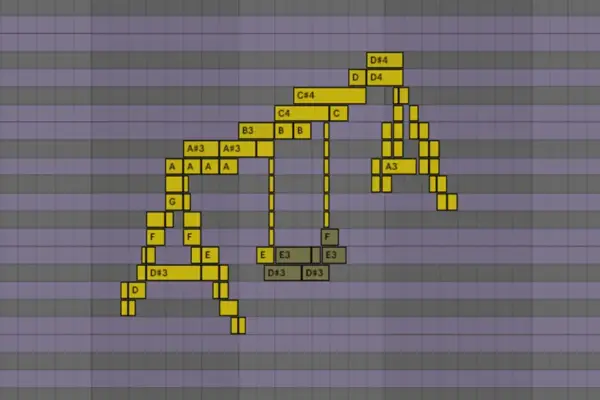
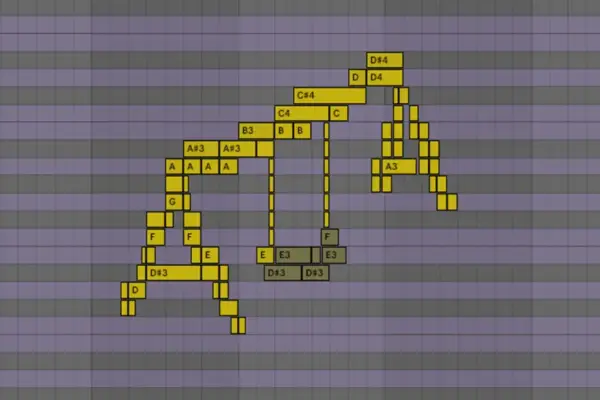
The iconic movement of the drone is driven by a specific chordal interval—specifically, a fourth or fifth dyad utilizing G and D.
The MIDI arrangement features three distinct D notes (D2, D3, and D4) interacting dynamically with a single G3 note sitting squarely in the middle register.
Depending on your harmonic perspective, the root note can be interpreted as either a fourth or a fifth. Program these notes into your piano roll with a gate length set just shy of a standard quarter note to maintain tight rhythmic separation.
Step 3: Oscillator Configuration and Filter Emphasis
Return to the Diva interface to dial in the oscillator architecture:
Deactivate Oscillator 1 entirely.
Leave Oscillator 2 active on its default sawtooth wave setting.
Tune Oscillator 2 up precisely one octave (corresponding to the 4 setting on the octave knob).
Rotate the VCO 1 / VCO 2 blend knob fully clockwise to isolate Oscillator 2.
Push the ladder filter Cutoff up to 108 and dial the Emphasis (resonance) to 15.5. At this stage, the raw patch will bear a startlingly close resemblance to the target harmonic timbre.
Step 4: Velocity Mapping for Dynamic Bite
To inject organic life and physical responsiveness into the patch, velocity sensitivity must be integrated into the signal chain:
Adjust the note velocities within your MIDI clip: set the root D2 note to maximum velocity, while dropping the remaining three notes to a velocity value of 103.
Navigate to Diva’s VCA section, select Velocity as a modulation source from the dropdown menu, and ramp the modulation depth up to maximum. This ensures that heavier hits yield a richer, more aggressive harmonic bite.
Step 5: Surgical EQ Filtering for Frequency Shaping
A critical element of the LCD Soundsystem sound profile is subtractive EQ filtering to clear muddy low-mid build-up and emphasize the harmonic overtones. Insert an EQ plug-in after the synth and carve out four precise notches:
150 Hz
300 Hz
600 Hz
1.2 kHz
Notice the mathematical relationship: each frequency point is double the previous (rising by exact octaves), and each centers directly around the harmonics of the D notes. By attenuating these root frequencies, the mix naturally brings the underlying G notes and upper harmonics to the forefront.
Step 6: Integrating Envelope-Driven Pumping
To achieve the signature sidechain-style "pump" without relying solely on audio-rate compression, use internal envelope modulation. Load a robust, 909-style acoustic or electronic kick drum onto a parallel channel to serve as your rhythmic timing reference.
On Env 1 (acting as your Amp envelope), set the Attack to approximately 49 to induce an immediate, natural-sounding dip.
Set the Decay to 75 and lengthen the Release tail to 29.
Compensate for overall level loss by pushing the VCA volume back up to maximum.
Step 7: Layering Filter Envelope Modulation
Complement the amplitude pumping by introducing filter envelope modulation to add movement to the timbre:
Dial the Env 2 filter modulation depth to fully positive (+).
Adjust Env 2 parameters by ear: set Attack to 68, Decay to 49, and Sustain to 0.
This dual-envelope approach simultaneously deepens the perceived rhythmic pumping while introducing sharp, transient bite and evolving tonal interest.
Step 8: Spatial Processing via Plate Reverb
To replicate the expansive, live-room acoustic signature of Sound of Silver, incorporate spatial processing:
Insert Diva’s internal Plate 1 reverb algorithm.
Set the Size parameter to maximum and push the Pre-delay dial to the halfway mark.
A long pre-delay accurately simulates physical room physics: in large acoustic spaces, sound waves must travel significant distances before reflecting off boundary walls and returning to the listener as reverb tails.
Step 9: Sidechain Compression and Tape Saturation
To finalize the mix-ready state of the patch:
Apply traditional sidechain compression triggered by your 909 kick drum channel. This blends seamlessly with the internal envelope pumping established earlier.
Introduce tape drive saturationafter the sidechain compression stage. Because tape saturation units generate harmonics relative to signal strength, placing the saturation post-compression means the louder phases of the pump yield richer, warmer saturation harmonics.
Step 10: Cross-Genre Adaptation (The Versatile Patch)
The true power of this synth patch lies in its inherent modularity. By making subtle adjustments to the envelope decay and release times, the sweeping harmonic drone easily transforms into aggressive, percussive leads or brassy stabs. Independent patches derived from this exact architecture—such as the Big Belgian Snog Trumpet and Big Trumpet presets—prove that minimal tweaks can yield entirely new functional roles within an arrangement.
Supporting Context & Metrics: The Architecture of Versatility
In contemporary electronic music production, the trend has increasingly shifted away from hyper-complex sound design toward patches that offer maximum contextual flexibility. The resurgence of hardware-emulated soft synths like u-he Diva has accelerated this shift, allowing producers to capture analogue warmth without the tuning instability or maintenance overhead of vintage gear.
Production Parameter
Initial Setting
Optimized Setting
Purpose
Tempo (BPM)
120 (Standard)
112
Allows critical auditing of modulation and envelope tails.
Oscillator Wave
Dual Saw/Pulse
Single Saw (VCO 2)
Delivers raw, unfiltered harmonic richness.
Filter Cutoff
50
108
Opens up high frequencies for subsequent EQ shaping.
Env 1 (Amp)
Fast Init
Attack: 49 / Decay: 75
Generates the signature rhythmic pumping effect.
Env 2 (Filter)
Closed
Attack: 68 / Decay: 49
Introduces dynamic transient bite and tonal motion.
Industry metrics highlight that producers favor sound libraries and tutorials focusing on hybrid hardware-software workflows. Recreations of classic indie-dance tracks from the mid-2000s bridge the gap between organic instrumentation and electronic sequencing, appealing to both traditional band setups and club-focused producers.
Official Statements and Expert Commentary
Sound designers and synth historians frequently cite "Someone Great" as a masterclass in economy of means. Speaking on the philosophy of patch design, synthesis experts emphasize that limitation breeds creativity.
"When a patch is stripped down to a single oscillator and a well-calibrated filter, every micro-adjustment matters. Producers often overcomplicate their signal paths by adding unnecessary layers, when the secret to a timeless mix element usually lies in subtractive EQ, rhythmic envelope shaping, and intentional spacing."
— Leading Electronic Music Production Editorial
Furthermore, software developers like u-he have continually praised the community’s dedication to reverse-engineering classic tracks using analog-modeled plugins like Diva. By accurately replicating the behaviors of filters found in classic Roland, Moog, and Oberheim synthesizers, modern virtual instruments allow producers to dissect history note-by-note.
Future Outlook: The Evolution of Analog Emulation in DAW Workflows
As virtual studio technology continues to evolve, the boundaries between hardware authenticity and software flexibility are blurring. AI-assisted mixing tools, advanced micro-tuning capabilities, and increasingly sophisticated component-level modeling mean that recreating legendary tracks like LCD Soundsystem’s Sound of Silver is more accessible than ever before.
Looking forward, the demand for "versatile patches"—sounds that adapt across ambient soundscapes, driving techno arrangements, and indie-dance anthems with minor macro tweaks—will remain a cornerstone of modern music production education. As demonstrated by this Diva breakdown, understanding the fundamental physics of sound (such as octave-based EQ notch filtering and acoustic pre-delay timing) equips producers not just to copy the past, but to innovate with confidence in their own future productions.