Executive Overview
For anyone who has ever wrestled with the open roads of Denmark, the weather is never a mere backdrop; it is an active participant in the journey. Every cyclist knows the dual forces of medvind (the tailwind that sweeps you effortlessly toward your destination) and modvind (the stubborn headwind that transforms a flat, familiar coastal road into an uphill trudge). It is this elemental duality that anchors the title and thematic core of Medvind Modvind, the sophomore studio album by the acclaimed Danish quartet TINGO.
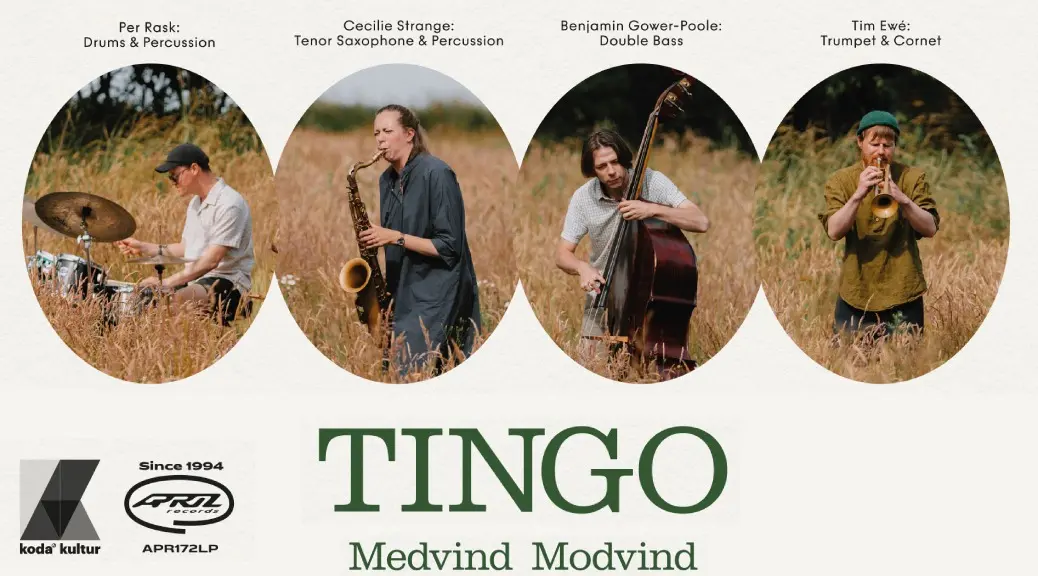
Released via April Records—a label celebrated for housing the evocative releases of saxophonist Cecilie Strange’s own quartet—Medvind Modvind marks a striking evolution for the ensemble. Following their critically lauded 2023 debut, Kvartetten fra verdens ende (released via GO Danish Folk), which earned prestigious new-name nominations at both the Danish Music Awards (DMA) Jazz and DMA Roots, the quartet has doubled down on its unique sonic architecture. Comprising trumpeter/cornettist Tim Ewé, saxophonist Cecilie Strange, bassist Benjamin Gower-Poole, and percussionist Per Rask, TINGO occupies a rare intersection where traditional Nordic folk melodies meet the expansive, spontaneous frameworks of modern acoustic jazz.
What sets Medvind Modvind apart from a crowded landscape of contemporary folk-jazz crossover projects is its deliberate structural minimalism. Eschewing chordal instruments entirely—there is no piano, guitar, or harp to anchor the harmonies—the ensemble leaves a vast, breathing expanse for the twin horns of Ewé and Strange. Supported solely by the rhythmic and harmonic counterpoint of Gower-Poole’s bass and Rask’s multifaceted percussion, the album breathes new life into centuries-old Scandinavian dance tunes and laments. Recorded over three intense, isolated days in the deep forests of Småland, Sweden, Medvind Modvind is a masterclass in acoustic intimacy, collective restraint, and a profound reverence for musical lineage.
Detailed Chronology: From Train Encounters to the Småland Woods
The genesis of TINGO reads like a serendipitous jazz fable. The ensemble’s very moniker is borrowed from Rapa Nui—a linguistic nod to the act of acquiring someone else’s possessions one piece at a time—reflecting their methodology of adopting, repurposing, and revitalizing traditional folk canons.
The story began in 2019, when Tim Ewé and Cecilie Strange crossed paths by pure chance on a train journey between Odense and Copenhagen. Conversations about shared musical curiosities quickly escalated into creative ambition. To realize their vision of bridging ancient Nordic folk idioms with contemporary jazz sensibilities, they recruited Benjamin Gower-Poole and Per Rask. All four musicians share a rigorous pedagogical foundation, having been schooled at the prestigious Danish National Academy of Music in Odense. This shared academic and artistic vocabulary allowed them to bypass the typical teething troubles of a newly formed band, forging an immediate, telepathic musical bond.
[2019: Train Encounter (Odense–Copenhagen)]
       │
       ▼
[Line-up Finalized: Ewé, Strange, Gower-Poole, Rask]
       │
       ▼
[2023: Debut Album - 'Kvartetten fra verdens ende' (GO Danish Folk)]
       │ (Double DMA Nominations: Jazz & Roots)
       ▼
[Late 2025/Early 2026: Recording at Studio Folkhemmet, Unnaryd]
       │
       ▼
[Current Release: 'Medvind Modvind' (April Records)]
The trajectory accelerated with their 2023 debut, Kvartetten fra verdens ende ("The Quartet from the End of the World"). The album caught the attention of critics and cultural gatekeepers alike, securing nominations at the Danish Music Awards in both jazz and roots categories—a rare feat that signaled the band’s cross-genre appeal.
However, for their second outing, the quartet sought a total immersion environment, moving away from urban studios to capture the raw, tactile essence of their repertoire. They decamped to Studio Folkhemmet, situated in Unnaryd within the heavily forested Småland region of Sweden. The studio’s name—translating historically to "the people’s home," which serves as Sweden’s classic ideological byword for the mid-century welfare state—provided a fittingly communal backdrop. Over three intensive days in November, the band married intense recording sessions with bracing excursions into the surrounding wilderness, walking frost-bitten woods and even taking freezing swims in the local lake. This physical immersion in the Nordic landscape directly seeped into the audio grain of Medvind Modvind, lending the recordings a crisp, wintry aura that resonates through every track.
Supporting Context & Metrics: The Acoustic Architecture
To understand the sonic weight of Medvind Modvind, one must examine the deliberate instrumentation choices and historical roots of the material. Traditional Scandinavian folk music—particularly fiddle tunes, hallings, and sønderhonings—relies heavily on implied harmony and rhythmic propulsion. By stripping away chordal accompaniment, TINGO forces the listener’s ear to fill in the vertical spaces, treating the melodies with a transparent reverence.
Instrumentation & Line-up
- Tim Ewé (Trumpet / Cornet): Acts as the primary melodic vector, frequently stepping into the historical shoes of traditional village fiddlers.
- Cecilie Strange (Tenor Saxophone): Provides deep, woody counter-melodies and warm harmonic counterweights, building on her extensive discography with April Records (including her acclaimed solo quartet albums Blue and Beech).
- Benjamin Gower-Poole (Double Bass): Serves as the structural floor, anchoring the modal shifts and occasionally driving the thematic momentum of complex dance meters.
- Per Rask (Percussion): Utilizes an expansive, textural percussion palette that mimics the percussive bow-work of folk dancers rather than standard jazz swing patterns.
Track-by-Track Breakdown
Side A: Into the Woods
- "Gråtlåten" ("The Weeping Tune"): Serving as the opening statement on Side A, this piece acts as a deliberate emotional inversion of "Gladlåten" ("The Happy Tune") from their debut album. Ewé’s trumpet introduces a melancholic motif before the entire quartet unspools the folk pattern in a dense, communicative weave.
- "Halling etter Thorvald Tronsgård": Rooted in the traditional Norwegian halling—historically an athletic solo fiddle dance associated with male bravado—Gower-Poole’s heavy, rhythmic bass establishes a firm percussive floor, allowing Ewé’s trumpet to step dynamically into the fiddler’s shoes.
- "Haresprånget" ("The Hare’s Leap"): Opened by brisk, scurrying percussion from Rask, the band glides across the meter, eventually reining in the tempo as a profound sense of acoustic restraint takes over.
- "Stilhed" ("Silence"): Taking its title from the Danish word for silence, this minimalist track initiates on a muted cornet, treading exceptionally lightly across the stereo field.
Side B: Island Traditions and Family Echoes
- "Stam Villum": Transporting the listener to the windswept Danish island of Fanø, this track tackles a sønderhoning—the intricate couple dance of Sønderho, whose melodies are famously written in duple time while the dancers physically turn in triple time. Strange’s tenor saxophone anchors the piece, evoking a slow, contemplative village procession where invisible flowers are metaphorically handed to children along the road.
- "Svanés Vals": Driven forward by Gower-Poole’s bowed and plucked bass lines, this waltz carries a distinctly mournful, reflective tread.
- "På flugt" ("On the Run"): Strange’s tenor opens with restless urgency before a bright, bell-tone transition opens the door to arguably the album’s most transcendent moment, where the grey skies of the arrangement lift into triumphant sunshine.
- "Medvind Modvind" (Title Track): The emotional anchor of the album. Opening with the innocent, unvarnished vocalizations of Elinor and Alice—two of the band’s nine children—the track skips forward with infectious joy. Captured live before an invited audience of peers and locals on the final day of the Unnaryd sessions, it is dedicated to Per Rask’s late father, Bent. The piece feels structurally akin to a blomsterkæde (a garland of flowers), weaving sorrow and celebration into a singular, radiant sonic monument.
Official Statements and Artistic Vision
Speaking on the conceptual framework driving Medvind Modvind, the members of TINGO emphasize that the album is not merely a preservation exercise, but a living, breathing dialogue between past and present.

"When you remove the piano or the guitar, you expose the skeleton of the music," explains trumpeter Tim Ewé. "You cannot hide behind lush chord progressions. Every note of ornamentation, every microtonal bend in the folk tradition, has to be inhabited fully by the horns and the rhythm section. It forces us to listen to each other with absolute vulnerability."
Saxophonist Cecilie Strange, whose ongoing partnership with April Records has cemented her reputation as one of Scandinavia’s premier contemporary jazz voices, notes how the transition from her piano-centric quartet projects to TINGO represents a vital creative counterweight:
"With my own quartet, the piano builds a warm, harmonic room for us to inhabit. With TINGO, we are out in the open air. The Nordic folk tradition has an inherent starkness to it—it comes from people dancing in barns, playing through long winters and short summers. Capturing that feeling in Studio Folkhemmet in Småland, surrounded by freezing lakes and pine trees, wasn’t just a stylistic choice; it was the only honest way to record this material."
Percussionist Per Rask highlights the community-centric ethos that culminated in the recording of the title track before a live audience:
"Music like this belongs to people, not just to pristine recording booths. Having our families there, hearing the voices of our children on the opening of the title track, and dedicating this journey to my late father, Bent, brought the whole project full circle. It gave the album its medvind—the wind at our backs that carries us home."
Future Outlook
As Medvind Modvind rolls out internationally via April Records, TINGO is poised to cement its status as one of the most innovative and vital ensembles operating within the European acoustic jazz and roots ecosystem. The critical success of their debut established them as promising innovators; this sophomore release proves their staying power, artistic depth, and fearlessness in stripping away conventional harmonic crutches.
Looking ahead, the quartet has announced plans for an extensive live touring circuit spanning Denmark, Sweden, Norway, and select continental European jazz festivals throughout the upcoming season. Given the intimate, acoustic nature of their instrumentation, these live performances are anticipated to lean heavily into the immersive, communal atmosphere that defined their time in the Småland forest.
For an industry frequently oversaturated with polished, hyper-produced crossover projects, TINGO offers a refreshing, bracing alternative. Like the Danish cyclist battling the coastal winds, they remind us that the struggle against the headwind is precisely what makes the eventual tailwind—and the journey home—so deeply rewarding.