Executive Overview
In the shifting landscape of contemporary classical music, the boundaries separating distinct cultural and historical instrumental traditions are increasingly porous. At the vanguard of this cross-cultural evolution is London-based musician Julia Luo. A practitioner of the sheng—one of China’s most ancient free-reed mouth-organs, with historical roots tracing back over three millennia—Luo occupies a fascinating nexus of musical worlds. Her artistic journey is defined by a rare duality: formal conservatory training on the Western euphonium coupled with master-level immersion in traditional Chinese instrumental performance.
This profile explores Luo’s artistic evolution, her recent participation in the fourth London International Chinese Music Festival alongside the UK Chinese Orchestra, and her performance of composer Michael Ellison’s contemporary work Curve. Beyond individual biography, this article investigates a broader paradigm shift within contemporary performance practice. It examines how traditional instruments are being integrated into modern Western scores, the technical and interpretive challenges of cross-cultural notation, and the ways in which a musician’s internal acoustic lexicon can bridge seemingly disparate sonic architectures.
Ultimately, Luo’s work challenges the superficial categorization of "musical fusion." Instead, it highlights an organic, rigorous dialogue between distinct ways of listening, breathing, and making music in the twenty-first century.
Detailed Chronology & Biographical Evolution
From the Brass Bands of Xinghai to the Reed-Pipes of Guangdong
Julia Luo’s musical formation defies conventional compartmentalization. Her journey began at the prestigious Xinghai Conservatory of Music, where she undertook rigorous training as a classical euphonium player. Within the architecture of the Western wind band and brass tradition, the euphonium is prized for its rich, velvety tone, long lyrical lines, and structural stability within an ensemble. It demands a specific somatic discipline: a heavy reliance on diaphragm support, precise air column management, and a standardized relationship between graphic notation and execution.
Yet, Luo’s musical curiosity was not confined to Western brass. Alongside her conservatory studies, she expanded her instrumental vocabulary by learning the sheng, studying under Luo Qixuan, a master tradition-bearer of Guangdong Han music.
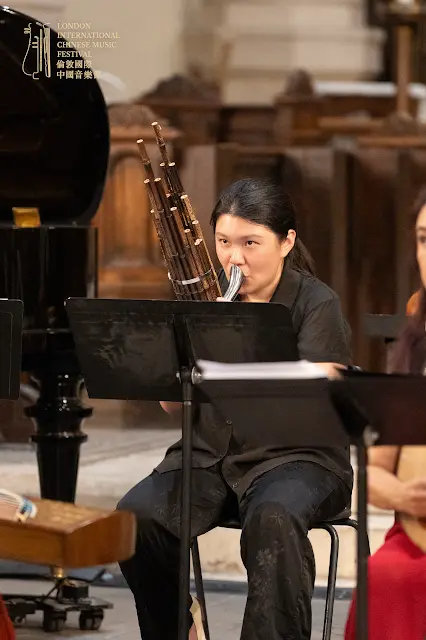
The sheng presents a stark contrast to the euphonium. Held vertically, its bamboo or metal pipes rise from a compact wind chamber. Visually, the player’s hands move with deceptive stillness—lacking the kinetic drama of a violinist’s bow arm or a percussionist’s striking mallets. Yet, acoustically, the sheng is remarkably dynamic. Sound is generated through a dual-action mechanism of both inhalation and exhalation, allowing the instrument to sustain continuous, unbroken streams of sound.
Rather than treating these two instruments as mutually exclusive, Luo began to allow them to inform one another. The structural, architectural listening habits cultivated through years of wind-band and orchestral playing—such as chord balancing, horizontal phrasing, and ensemble cohesion—began to reshape how she approached the sheng. Conversely, the sheng’s nuanced control over micro-tonal bends, timbral shifts, and breath flexibility deepened her sensitivity to the spaces between written notes on the Western page.
Relocation to London and Postgraduate Pedagogy
Seeking to broaden her artistic and academic horizons, Luo relocated to Britain to complete postgraduate studies in music education. London’s vibrant, multicultural contemporary music ecosystem provided an ideal environment for her unique synthesis of disciplines. In this metropolitan hub, non-Western instruments are increasingly integrated into new, experimental scores rather than relegated to historical or ethnographic curiosities.
It was within this dynamic artistic climate that Luo’s integration into the UK’s contemporary music scene accelerated, culminating in high-profile performances that placed her at the forefront of contemporary Chinese-Western musical dialogue.

Supporting Context & Metrics: The Instrument, The Festival, and The Score
The Sheng: History, Mechanics, and Acoustics
To fully appreciate Luo’s work, one must understand the unique mechanical and historical significance of the sheng. Archaeological records and pictorial evidence trace the instrument back to approximately 1100 BCE during the Shang dynasty, making it one of the oldest surviving mouth-blown free-reed instruments in the world. Historically, it served as both a solo instrument and an essential harmonic cornerstone in traditional court and ritual ensembles. Remarkably, the acoustic principles of the sheng—specifically its free-reed design—served as the historical blueprint for the development of Western free-reed instruments such as the accordion and the harmonium when specimens were imported to Europe in the eighteenth century.
Acoustically, the sheng is a marvel of engineering. It consists of multiple vertical bamboo pipes (traditionally 17, though modern concert variants feature up to 37 or more), each fitted with a small metal reed at its base inside a wind chest. When the player blows or draws air through the mouthpiece, air passes over the reeds. Finger holes drilled into the lower sections of the pipes allow the player to sound individual pitches or complex, multi-note cluster chords.
Because the instrument sounds on both inhalation and exhalation, a skilled practitioner can maintain an uninterrupted sonic thread—a technique known as circular breathing applied to a reed instrument. This challenges traditional Western notions of phrasing, which are inherently tied to the physical necessity of stopping to draw breath.
The London International Chinese Music Festival and the UK Chinese Orchestra
In August, Luo’s artistry reached a major milestone when she performed at the fourth annual London International Chinese Music Festival. Operating in partnership with the UK Chinese Orchestra—an ensemble dedicated to championing Chinese orchestral music in Britain—the festival serves as a vital platform for cross-cultural exchange.
The festival’s programming deliberately avoids strict bicultural isolationism. Instead, it juxtaposes centuries-old traditional repertoires with cutting-edge, newly commissioned works. This curatorial philosophy places traditional instruments into dialogue with contemporary Western compositional techniques, microtonality, and extended instrumental practices.
Within this ensemble framework, Luo performed as a member of the sheng section rather than as a featured soloist. This distinction is critical to understanding the depth of her artistic contribution. The most profound cross-cultural interactions often occur not in virtuosic solo showcases, but in the collaborative, microscopic labor of section balancing, timbral blending, and rhythmic synchronization within a diverse orchestral body.
Michael Ellison’s Curve and the Challenges of Notation
A centerpiece of the festival’s contemporary programming was the UK premiere of composer Michael Ellison’s work, Curve. Ellison’s compositions are known for their intricate structural demands, microtonal complexity, and sophisticated textures. Introducing an instrument steeped in oral tradition and idiomatic ornamentation like the sheng into such a tightly structured Western score highlights a fundamental tension in contemporary music: how to translate cultural performance practices onto a standardized Western musical staff.
Western notation relies on discrete visual symbols to denote pitch, rhythm, and duration. However, for instruments like the sheng, a written symbol—such as a grace note or a curved slide—often serves merely as an approximation. The actual execution of the gesture depends entirely on the player’s somatic control of breath pressure, finger-shading over pipe holes, and micro-variations in intonation.
During rehearsals for Curve, Luo and her fellow ensemble members engaged in a collaborative negotiation with the score. They were tasked with determining how traditional sheng gestures—such as weeping glissandi, fluctuating cluster chords, and dynamic swells—could converse with Ellison’s dense harmonic environment without losing their idiomatic integrity.

Official Statements & Artistic Perspectives
Reflecting on the intricate process of bridging her brass training with traditional Chinese reed performance, Luo emphasizes that the two disciplines do not require artificial reconciliation. Rather, they serve as mutual catalysts for heightened auditory awareness.
"The euphonium and the sheng might seem worlds apart when you look at their histories and their physical shapes," Luo notes. "One belongs to the brass band tradition, built for projection and blended ensemble harmony; the other is an ancient voice that breathes in both directions, capable of astonishing timbral shifts with the smallest physical adjustment. But at their core, both instruments begin and end with breath."
Discussing the realities of performing contemporary scores like Michael Ellison’s Curve within the UK Chinese Orchestra, Luo highlights the collaborative nature of modern musical interpretation:
"When a traditional instrument enters a contemporary Western score, reading the notes on the page is only the first step. The notation cannot fully capture the weight, speed, or breath-character of a traditional ornament. Rehearsal becomes a creative dialogue between the composer’s structural intent and the instrument’s physical reality. You are constantly asking: How does this traditional gesture breathe inside this new harmonic landscape?"
Musicologists and festival organizers have likewise underscored the significance of this work. Observers note that London’s vibrant contemporary music scene is uniquely positioned to host these dialogues, where non-Western instruments are increasingly treated as equal partners in the creation of new art music, free from the exoticizing tropes of the past.
Future Outlook: The Next Phase of Cross-Cultural Performance
As the global classical music community continues to reckon with its Eurocentric foundations, the work being done by artists like Julia Luo points toward a more inclusive, porous, and interconnected future.
The trajectory of the sheng in contemporary Western contexts suggests several key developments for the coming decade:
- Expanded Repertoire and Original Commissions: As contemporary composers become more familiar with the acoustic properties, microtonal capabilities, and breath-flexibility of Chinese instruments, we can expect an increase in dedicated solo and chamber repertoire written specifically for the sheng by both Western and Asian composers.
- Pedagogical Integration: Conservatory curricula in Europe and North America are slowly expanding to incorporate non-Western instrumental methodologies. Luo’s dual background as a brass player and a sheng practitioner serves as a compelling model for future music educators who wish to foster cross-cultural literacy from the student level upward.
- Redefining "Fusion": The clumsy, commercialized category of "musical fusion"—which often results in superficial pastiches of musical styles—is being superseded by rigorous, deeply collaborative compositional practices. Musicians are no longer merely combining finished systems; they are learning how foreign instruments "think" from the ground up.
- Institutional Embrace: Ensembles like the UK Chinese Orchestra and festivals such as the London International Chinese Music Festival are proving that non-Western instruments can sustain sophisticated, critically acclaimed contemporary art music seasons that engage diverse metropolitan audiences.
For Julia Luo, this evolution is ongoing. Whether she is shaping a phrase on the euphonium or drawing a continuous, breathing chord from the pipes of the sheng, her work demonstrates that true cross-cultural exchange is not a sudden, dramatic collision of traditions. Rather, it is a patient, meditative process—one rehearsal, one new score, and one breath at a time.