Executive Overview
Ever since he belatedly stepped out of the shadows to launch his solo career in 2013 with The Messenger, Johnny Marr has refused to pause for breath. Operating with the tireless urgency of an artist who simultaneously feels he has worlds left to conquer and nothing left to prove, Marr has constructed a vibrant, multifaceted solo empire. His latest release, The Age Of Everything, arrives as a crowning achievement, dropping directly into a catalog that already boasts four prior solo records (including a sprawling double album), three live albums, a compilation, two published books, a blockbuster Christie’s auction of his historic guitar collection, and a key creative role on an Oscar-nominated James Bond theme.
This relentless whirlwind of activity has firmly cemented Marr front and center in the global spotlight—a striking and welcome turnaround for a musician who spent decades establishing himself as rock’s definitive sideman. From his legendary tenure co-founding The Smiths to high-profile stints with Modest Mouse, The Cribs, Pet Shop Boys, Beth Orton, Kirsty MacColl, Blondie, Bryan Ferry, and Crowded House, Marr was long content letting others take the center stage.
Today, that narrative has completely flipped. Whether this creative explosion stems from an intrinsic realization that it is now or never, or perhaps a calculated drive to ensure he never needs to look backward toward a nostalgic Smiths reunion to stay relevant, the results speak for themselves. The Age Of Everything is an absolute masterclass, synthesizing every defining element that has made Marr’s solo trajectory such a resounding artistic success: towering hooks, instantly hummable melodies, incisive lyricism, and that unmistakably shimmering, jangling guitar architecture.
Detailed Chronology: From Studio Conception to Live-Tested Perfection
The creation of The Age Of Everything is far from a traditional studio record; its unique, road-tested gestation period gives the album a kinetic, living-and-breathing energy.
The US East Coast Trials
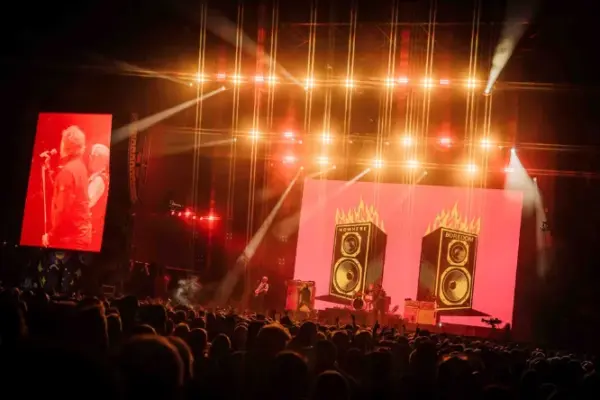
The lifecycle of the album began in earnest during the early summer months. Marr spent weeks meticulously writing the core framework of the tracks before taking a bold conceptual leap: rather than retreating immediately to a sterile recording environment, he took the embryonic material directly out on the road during a US East Coast tour.
By testing the new songs live night after night, Marr and his tightly knit backing band—drummer Jack Mitchell, bassist Iwan Gronow, and multi-instrumentalist/co-writer James Doviak—were able to observe audience reactions in real-time. The crowds acted as a living sounding board. The group could organically shape, mold, and refine the arrangements based on crowd response, adjusting tempos, dynamics, and structural bridges on the fly.
Manchester Realization
Armed with muscle memory and road-tested arrangements, the ensemble returned to the United Kingdom, setting up camp at Marr’s private Manchester studio. Because the structural heavy lifting had already been accomplished on American stages, the tracking process was remarkably swift. The band managed to bottle the volatile, high-voltage electricity of a live concert directly onto tape, bypassing the overthinking that often plagues modern studio productions.
Furthermore, this live-first methodology allowed Marr to carefully curate the album’s pacing and sequencing. The sequence flows seamlessly from frenetic, high-tempo bursts to lush, atmospheric interludes. A prime example is "Beyond The Rain," a mid-tempo atmospheric break that bridges the gap between the frantic opener "Spin" and the propulsive "It’s Time." Featuring a phased, psychedelic middle-eight, the track showcases Marr’s penchant for classic songwriting reference points—such as environmental soundscapes, ending appropriately with the ambient hiss of falling rain, much like the classic Smiths deep cut "Well I Wonder."
Supporting Context & Metrics: Unpacking the Musical DNA
The Age Of Everything functions as an interactive musical museum of Marr’s storied career, drawing sonic blueprints from every era of his multi-decade trajectory.
The Shadow of The Smiths and Marr’s Guitars
The creation of the album was preceded by Marr penning his critically acclaimed book, Marr’s Guitars, an intimate retrospective of his favorite instruments. Delving back into the history of his prized axes appears to have unlocked a wellspring of inspiration, eliciting some of Marr’s most explicitly Smiths-esque guitar riffs in decades.
The gorgeous ballad "How Come" stands as a deeply emotional, quintessentially Smithsian composition. Meanwhile, "It’s Time" features a jagged, interlocking guitar line that, depending on the listener’s perspective, pays homage to classic tracks like "Still Ill," "This Charming Man," and "Some Girls Are Bigger Than Others."
Naturally, this stylistic nod has already set the music press abuzz regarding the lyrical content. When Marr sings lines like "time is now to claim my victory," it is impossible for critics and fans not to search for subtext—wondering if the lyrics are a sly nod to his perpetual, cold-war dynamic with his former, famously truculent collaborator, Morrissey.
Modern Anxiety and Sonic Diversity
More accurately, however, the song mirrors the overarching thematic fabric of the album: an earnest attempt to capture the dizzying, overwhelming confusion of modern life. This existential anxiety is established right out of the gate on the bouncy, relentless opener, "Spin." Here, Marr laments, "there’s too much coming and too much time/Days keep running through my head," while delivering a sharp, angular riff reminiscent of another of Marr’s past collaborators, Franz Ferdinand.
The rhythmic backbone is driven with surgical precision by drummer Jack Mitchell, locked tightly into the rhythm section alongside bassist Iwan Gronow. Meanwhile, vocal textures are enriched by backing contributions from Meredith Sheldon and Marr’s own son, Nile Marr, proving that music remains a multi-generational family affair.
As the record unfolds, Marr’s genre-spanning past surfaces in unexpected ways:
- Electronic Echoes: "Ophelia" features the shimmering synthesizer textures reminiscent of Marr’s 90s dance-pop venture, Electronic, coupled with maritime rain metaphors and a pristine, carefully articulated solo.
- Disco and Dance: This infectious, dance-floor-friendly mood bleeds smoothly into "That Feeling," a track that nods heavily to Marr’s lifelong appreciation for classic disco grooves.
- Melancholic Ballads: "In And Out Of Love" is a sweeping, bustling break-up anthem where Marr’s guitar achieves peak emotional resonance. Lyrically, it trades in nostalgia, with Marr recalling listening to Lou Reed’s Berlin and "Perfect Days" on "the way to no good," before delivering the sobering realization that "melodies and good times/Won’t take away the feeling that lingers."
- Post-Punk Revivalism: "Just Once More" layers dense, swirling tones with a scurrying, urgent beat and a piercing guitar chime that reverberates like a tolling bell, serving as a direct tribute to Marr’s enduring love for Siouxsie And The Banshees.
The journey ultimately culminates before the ominous closer, "All In A Life," with "Fire With Fire"—a soaring, cascading call-to-arms that features Marr at his most defiant. It is the sound of an artist still charging forward into the fray, even after winning every conceivable musical battle and proving his genius a thousand times over.
Official Statements & Creative Philosophy
While Johnny Marr has historically let his guitar speak for itself, the thematic architecture of The Age Of Everything reveals an artist deeply reflective of his current status in the musical landscape.
In recent discussions surrounding the album’s unique rollout and his creative resurgence, Marr has emphasized the importance of momentum over nostalgia:
"You spend a large portion of your early career reacting to expectations, and a middle portion trying to figure out where you fit. But when you reach a stage like this, the only master you have to answer to is the kinetic energy of the room. Taking these songs on the road before they were finished wasn’t just an experiment; it was a necessity. I wanted to see how they breathed in the real world before trapping them in amber in the studio."
Addressing his transition from legendary sideman to undisputed solo bandleader, Marr notes that the sheer volume of his output—spanning books, gallery auctions, film scores, and solo records—is driven by a fundamental refusal to stagnate:
"There’s a common misconception that artists slow down or rest on their laurels once they’ve checked off certain historical boxes. For me, it’s entirely the opposite. Every project informs the next. Writing the book on my guitars made me fall in love with the physical act of playing all over again, and that bled directly into the riffs on this record. I’m hungrier now than I was at twenty."
Future Outlook
With The Age Of Everything, Johnny Marr has officially transcended the legacy artist tag, firmly positioning himself as a vital, forward-thinking contemporary force. By merging the jangly, pioneering DNA of his historic past with the sharp, reflexive urgency of his modern backing band, Marr has crafted a modern classic that satisfies purists and newcomers alike.
As the album hits shelves and streaming platforms, the horizon looks characteristically packed for the Manchester icon. With extensive international touring plans already mapped out to showcase the live-tested vigor of the new material, Marr shows zero signs of slowing down his breathless pace.
For an entire generation of guitarists who learned their craft tracing the contours of his fretboard wizardry, and for contemporary indie fans discovering his kinetic stage presence anew, The Age Of Everything is living proof that Johnny Marr’s golden age isn’t buried in the archives of the 1980s—it is happening right now, live and direct, on his own terms.