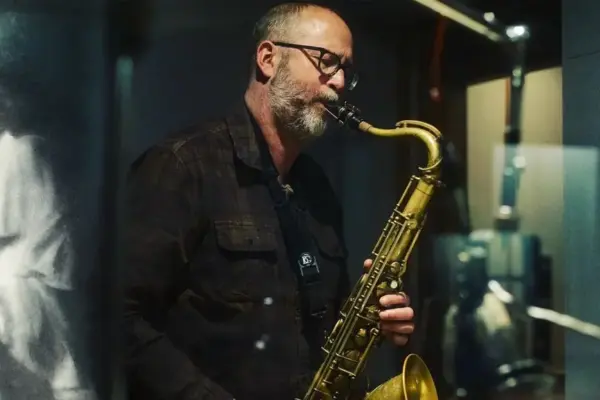
Across a career spanning three decades, Michael Weston King has charted a remarkably idiosyncratic path through modern British music. Emerging from the vibrant post-punk and New Wave crucible of late-1970s Liverpool, King eventually left behind the fading echoes of the Britpop era to champion a distinct brand of American-influenced alt-country and Americana. Over the course of some 20 albums—ranging from early pop ventures and alt-rock outfits to celebrated solo records and his enduring country-duet partnership with his wife, Lou Dalgleish, under the moniker My Darling Clementine—King has remained an unyielding torchbearer for narrative-driven songwriting.
However, the release of his latest solo record, Nothing Can Hurt Me Anymore (Continental Song City), arrives under a shadow of profound personal grief. Following the devastating loss of his granddaughter, Bebe, in the tragic Southport knife attacks, King and Dalgleish found their creative lives utterly upended. Unable to immediately co-write in the manner they had for a decade and a half, the couple temporarily stepped away from collaborative compositions to process their trauma independently. The resulting solo projects—beginning with King’s breathtaking, critically lauded masterwork and followed by Dalgleish’s forthcoming album, The Leaving And The Left Behind—represent a harrowing yet life-affirming confrontation with tragedy. This feature explores King’s evolution from a teenage gig-goer at Eric’s to an architect of transatlantic roots music, chronicling a life shaped by serendipitous encounters, devastating road accidents, and an ultimate, courageous triumph of the human spirit over unimaginable loss.
Detailed Chronology: From Eric’s to the Prairies
The Formative Years: Liverpool and the Pop Awakening
Born in Stockport, King’s musical education began in earnest at the tail end of the 1970s at Eric’s, the legendary Liverpool basement club that served as the epicenter for the region’s burgeoning post-punk movement.
"I was too young, but they weren’t strict on the door," King recalls with a laugh. "I saw Joe Jackson’s first tour, although I missed Elvis Costello. It was two or three years until I put a band together, Fragile Friends, a bit like China Crisis. They were my pop years."
The trajectory of King’s musical consciousness shifted permanently in 1981 with the release of Elvis Costello’s landmark country covers album, Almost Blue. Through Costello, King’s appreciation expanded backward into the rich, melancholic traditions of American roots music.
"My awareness of good country—George Jones, Merle Haggard, Gram Parsons—was raised," he explains, "and a year or two later I became aware of songwriters like Townes Van Zandt and Guy Clark."
Before finding his definitive voice in roots music, King cut his teeth as a guitarist in Gary Hall & The Stormkeepers, a northern outfit navigating a hybrid country-folk landscape. By the early 1990s, he had coalesced his songwriting ambitions into The Good Sons, a gritty country-rock band that signed to German indie stalwart Glitterhouse and shared stages with Americana luminaries like Joe Ely and Steve Earle.
Transatlantic Breakthroughs and Tragedy with The Good Sons
As the driving force behind The Good Sons, King bridged the gap between British melodic sensibility and American alt-country instrumentation. His industrious nature also saw him organizing UK tours for legendary folk acts such as John Renbourn and Bert Jansch. This transatlantic networking bore fruit when King befriended cult singer-songwriter Townes Van Zandt, who contributed vocals to a duet on the band’s debut album, Singing The Glory Down.
"He sang on my ‘Riding The Range’ and a year later cut the song himself," King says proudly. "Not that many people can say they had a song recorded by Townes!"
Van Zandt’s subsequent UK tour further cemented the cross-pollination. Buoyed by the Tindersticks’ recent indie-chart success covering Van Zandt’s "Kathleen," the legendary American songwriter played to nearly 900 people at London’s Union Chapel—a venue far exceeding the 250-capacity crowds he was accustomed to in the States.
The Good Sons subsequently signed with Texan label Watermelon (which had secured a distribution deal with Sire), releasing their third album, Wine, Lines and Valentines. Described by King as a guitar-driven, melodic record akin to Soul Asylum, it marked a high-water mark for the band’s international ambitions.
Yet, momentum came to an abrupt, violent halt in 1998. Watermelon Records collapsed financially, and shortly thereafter, King was involved in a severe road crash in Germany that left him hospitalized and the band’s equipment completely destroyed. Although The Good Sons briefly reunited for a 2001 swan song titled Happiness, the chapter was effectively closed.
The Solo Years and the Birth of My Darling Clementine
Reinventing himself as a solo artist, King released his debut solo effort, God Shaped Hole, in 1999—a record he wryly describes as "a real miserable record, but still my biggest seller in Germany!" He subsequently forged a creative alliance with the late singer-songwriter Jackie Leven, who produced and performed on 2003’s A Decent Man before stepping up to lead King’s touring band, The Decent Men.
During this period, King crossed paths with Lou Dalgleish, a gifted singer-songwriter whose vocal prowess matched his own. Their partnership blossomed both personally and professionally. Albums like Celestial City showcased an elegant, distinctly English-inflected transatlantic sound defined by King’s cool, clear vocal delivery.
However, the relentless grind of solo touring eventually took its toll. "I did lots of solo tours in America and toured myself out," King reflects. "The dream of one man and his guitar driving across the prairie to the next gig wears you down. Then I thought, ‘I’m married to this amazing singer, how can we combine the voices?’ I was listening to a Porter Wagoner-Dolly Parton album and thought, this would be brilliant."
This revelation birthed My Darling Clementine in 2011. Their debut album, How Do You Plead?, married contemporary perspectives with authentic, classic country duets. Bolstered by elite British roots musicians like Geraint Watkins and Martin Belmont, the project struck a chord far deeper than an initial one-off experiment. Dalgleish’s track "The Other Half" functioned as a masterclass in Patsy Cline-esque torch balladry.
Subsequent years saw the duo expand their palette:
- The Reconciliation? (2013): Produced by Colin Elliot (noted for his work with Richard Hawley), leaning further into country-soul.
- The Other Half (2015): An ambitious cross-media collaboration with crime novelist Mark Billingham, transforming Clementine songs into a spoken-word and music stage show featuring Graham Parker and actor David Morrissey.
- Still Testifying (2017): A return to upbeat roots-rock, featuring tracks like "No Matter What Tammy Said (I Won’t Stand By Him)," which used a light-hearted sonic wrapper to address the dark reality of domestic abuse.
- Country Darkness (2020–2021): A four-part EP series reimagining the country-soul catalog of Elvis Costello as duets, arranged alongside Attractions pianist Steve Nieve.
Supporting Context & Metrics
To fully appreciate the scope of Michael Weston King’s career, one must look at the quantitative scale of his output and collaborations:
- Album Output: Over 30 years, King has released approximately 20 studio albums spanning pop, alt-rock, folk, and country genres.
- International Touring: My Darling Clementine completed a rigorous 42-date tour across seven countries between February and June, showcasing their tireless work ethic.
- Critical Acclaim: Landmark releases have spanned indie charts and Americana circles, culminating in high-profile endorsements from peers like Elvis Costello.
- Collaborative Network: Over his career, King has worked alongside towering figures in folk, rock, and country, including Townes Van Zandt, Steve Earle, Graham Parker, Jackie Leven, and Steve Nieve.
Official Statements and Personal Reflections
The trajectory of King and Dalgleish’s creative partnership was irrevocably altered in 2024 when tragedy struck their family. Bebe, King’s granddaughter, was killed in the horrific knife attack in Southport that sent shockwaves across the United Kingdom.
"It changed our lives," King states quietly. "We are still broken-hearted but have to push forward. As songwriters, you put stuff that affects you into songs, and nothing can be more affecting than what happened to us."
The visceral impact of this trauma rendered collaborative writing impossible for the time being. Seeking solace in isolation, the couple retreated to their respective creative spaces to process their grief independently.
For King, this resulted in Nothing Can Hurt Me Anymore. Far from a bleak dirge, the record is a triumph of emotional resilience—quietly positive, dramatically uplifting, and weighed with a profound gravity.
"It’s not a doom and gloom record," King clarifies. "There are dark moments, but we needed hope and optimism. Ironically, I think it’s the best record I’ve ever made."
Elvis Costello, assessing his friend’s latest work via personal correspondence, offered high praise, hailing the album as "a beautiful, complex piece of work."
Lou Dalgleish has mirrored this cathartic process through her own forthcoming solo album, The Leaving And The Left Behind, produced once again by Colin Elliot and slated for release at the end of the year.
Future Outlook: Rebuilding and Moving Forward
Despite the unimaginable weight of their personal loss, Michael Weston King and Lou Dalgleish are steadily navigating their return to the stage.
In July, the duo reunited the original My Darling Clementine lineup—featuring Martin Belmont’s signature rockabilly-country-swing guitar—for an intimate, powerful performance inside a Twickenham church as part of the High Tide festival.
Looking toward the remainder of the year, the duo has announced plans for live dates under the banner My Darling Clementine – Together Apart. This unique live configuration is structured in two distinct halves:
- Act One: A celebration of beloved fan-favorites from their extensive catalogue.
- Act Two: An intimate trading of new material, highlighting the contrasting yet interconnected solo works born out of their shared grief.
With Colin Elliot stepping in to helm a newly assembled backing band for these upcoming performances, My Darling Clementine demonstrates that while tragedy leaves scars that never truly fade, art can provide a vital vessel for survival. Michael Weston King has endured record label collapses, devastating highway accidents, and heartbreaking personal loss; yet, through uncompromising songwriting and an unyielding commitment to his craft, he continues to push forward into the light.