Executive Overview
In a powerful demonstration of mentorship, artistic generosity, and community engagement, world-renowned cellist Sheku Kanneh-Mason recently stepped off the concert stage to collaborate with the next generation of classical talent. Fresh from a critically acclaimed regional tour across Northern England alongside the Royal Northern Sinfonia and conductor Dinis Sousa—where he captivated audiences with sweeping renditions of Saint-Saëns’ Cello Concerto No. 1—Kanneh-Mason traded the formal ambiance of the grand auditorium for the vibrant, open-plan concourse of The Glasshouse International Centre for Music in Gateshead.
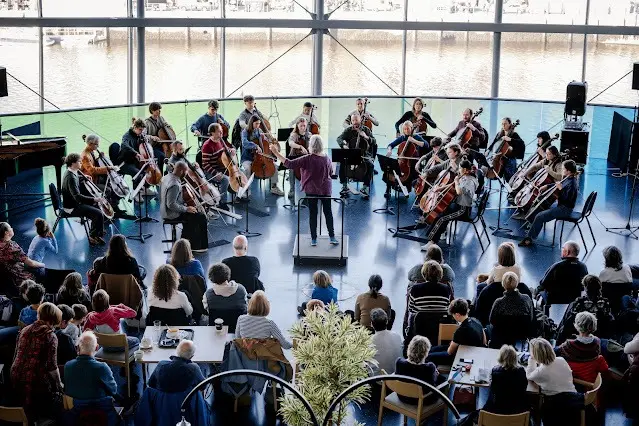
There, he joined forces with a 24-piece massed cello ensemble comprising exceptionally talented young musicians from The Glasshouse’s Young Sinfonia, the Centre for Advanced Training (CAT) programme, dedicated tutors, professional orchestral players, and alumni of the institution’s esteemed education initiatives. The resulting public pop-up performance, held on a bustling Sunday afternoon, served as both a triumphant conclusion to Kanneh-Mason’s regional residency and a high-profile showcase for The Glasshouse’s ongoing commitment to youth music education.
Against the backdrop of the venue’s striking architecture, the assembly of 24 cellos filled the air with rich, resonant harmonies, treating unsuspecting shoppers, families, and dedicated music lovers to an impromptu concert of extraordinary caliber. Performing a carefully curated repertoire that spanned classical masterworks and early jazz-influenced Americana—including a movement from Heitor Villa-Lobos’s Bachianas Brasileiras No. 1, alongside timeless pieces by George Gershwin and Scott Joplin—the collaboration bridged the gap between global classical stardom and grassroots music-making.
This comprehensive report explores the anatomy of this extraordinary collaboration, detailing the tour that preceded it, the structure and philosophy of The Glasshouse’s youth music initiatives, the voices of the artists involved, and the broader cultural significance of nurturing young musical talent in the contemporary arts landscape.
Detailed Chronology: From Orchestral Masterworks to Concourse Collaboration
The events leading up to the massed cello performance unfolded over an intensive week of touring and rehearsal across the North of England, marking a significant artistic milestone for both the Royal Northern Sinfonia and the region’s cultural calendar.
The Regional Tour: Middlesbrough, Kendal, and Gateshead
The journey began with a series of high-profile orchestral concerts that saw Sheku Kanneh-Mason team up with the Royal Northern Sinfonia (RNS), the UK’s only full-time chamber orchestra, under the dynamic baton of conductor Dinis Sousa. The partnership brought sublime classical interpretations to culturally diverse venues, beginning in Middlesbrough and stopping in the picturesque market town of Kendal, before culminating at The Glasshouse in Gateshead.
At the heart of the programme was Camille Saint-Saëns’ Cello Concerto No. 1 in A minor, Op. 33. Written in 1872, the piece is celebrated for its demanding technical requirements, lyrical intensity, and innovative structure, which abandons the traditional three-movement pause in favor of a continuous, flowing dialogue between soloist and orchestra. Kanneh-Mason’s performances throughout the tour were met with rapturous applause, lauded by critics for their emotional depth, technical precision, and captivating stage presence.
For the young string players of the North East, witnessing a musician of Kanneh-Mason’s stature master such a demanding concerto live on stage provided an invaluable masterclass in artistry. However, the collaboration did not end with the final orchestral chord in the main auditorium.
The Rehearsal: Inside the Northern Rock Foundation Hall
On Sunday morning, the focus shifted from professional orchestral performance to grassroots education. In the acoustically pristine environment of The Glasshouse’s Northern Rock Foundation Hall, 24 young cellists gathered with a palpable sense of excitement and nervous anticipation.
The ensemble was a diverse micro-community of string players. It brought together students from The Glasshouse’s prestigious Centre for Advanced Training (CAT) and Young Sinfonia, seasoned tutors who guide their weekly development, professional players from the Royal Northern Sinfonia who had shared the stage with Kanneh-Mason days prior, and alumni of the education programmes who have since transitioned into higher education or professional careers.
Working under the guidance of educators and with Kanneh-Mason himself stepping into the circle, the rehearsal was an exercise in active listening, blending voices, and shared musicality. Unlike standard masterclasses where a single student performs for a master teacher, this session was collaborative. Kanneh-Mason sat among the students, adjusting his intonation, phrasing, and dynamics to match the collective output of the 24-cellist choir.
The Concourse Performance: Bringing Music to the Public
Following the intensive morning rehearsal, the ensemble migrated to the sweeping, light-filled concourse of The Glasshouse for a public lunchtime performance. Part of the venue’s ongoing "Lunchtime Concerts" series—a popular initiative designed to bring live, high-quality music into the public spaces of the building on a regular basis—the event drew a large, enthusiastic audience of weekend visitors, families, and dedicated classical music fans.

The performance transformed the architectural landmark into an intimate chamber hall. Stripped of the physical distance often found between performers and audiences in traditional concert halls, the massed cello ensemble created an immersive acoustic experience. The warm, human resonance of 24 cellos reverberated through the open spaces of the building, providing an arresting counterpoint to the hum of weekend activity.
The programme was designed to showcase both the technical versatility of the cello choir and the eclectic training provided by The Glasshouse’s education wing. Opening with the sweeping, lush textures of a movement from Heitor Villa-Lobos’s Bachianas Brasileiras No. 1—a celebrated work written for an orchestra of violoncellos inspired by Brazilian folk music and the spirit of J.S. Bach—the ensemble demonstrated rich harmonic control and expressive depth. The mood subsequently shifted with vibrant, syncopated arrangements of works by George Gershwin and ragtime pioneer Scott Joplin, proving that these young musicians could effortlessly traverse centuries and genres with infectious energy.
Supporting Context & Metrics: The Ecosystem of The Glasshouse and Youth Music
To fully appreciate the significance of Sheku Kanneh-Mason’s collaboration, it is essential to examine the institutional framework that made it possible: The Glasshouse International Centre for Music (formerly known as Sage Gateshead) and its comprehensive approach to music education.
The Glasshouse: A Beacon for Northern Music
Located on the banks of the River Tyne in Gateshead, The Glasshouse has established itself as a world-class international music centre since its opening in 2004. Designed by renowned architect Norman Foster, the distinctive glass-and-steel structure is more than just a performance venue; it is a creative home for artists of all ages and abilities.
Through its resident orchestra, the Royal Northern Sinfonia, and its extensive learning and participation division, the centre reaches hundreds of thousands of people annually. The institution’s mission is rooted in the belief that music is for everyone, regardless of background, age, or financial status. This philosophy is most vividly embodied in its youth music pathways, which span from early-years exploratory sessions to pre-professional training programmes.
Make Music Young People and the Centre for Advanced Training (CAT)
The weekend’s events were hosted under the banner of The Glasshouse’s Make Music Young People framework, a holistic initiative designed to cultivate musical talent from infancy through early adulthood.
At the apex of this training structure is the Centre for Advanced Training (CAT), a selective yet highly accessible programme funded by the Department for Education’s Music and Dance Scheme. The CAT programme provides rigorous, specialized training for exceptional young musicians aged 11 to 18 who show significant potential and a dedication to pursuing a serious pathway in music. Students receive comprehensive tuition, including principal-study instrumental lessons, chamber music coaching, theory, composition, and performance opportunities alongside world-class artists.
Complementing the CAT programme are The Glasshouse’s broader weekend school offerings. These include non-auditioned, highly inclusive ensembles, bands, and choirs designed to ensure that barriers to entry are minimized. With applications remaining open all year round, these groups cater to young people of all skill levels, ensuring that music-making remains a collaborative, social, and joyful experience rather than an exclusive elite domain.
The Power of Massed Ensembles in Music Pedagogy
The decision to utilize a massed cello ensemble for Kanneh-Mason’s residency is pedagogically significant. String pedagogy has long recognized the psychological and technical benefits of ensemble playing, particularly for developing musicians.
When young players perform alongside peers of varying skill levels—as well as professional mentors like Kanneh-Mason and members of the Royal Northern Sinfonia—several developmental milestones are accelerated:
- Confidence Building: Performing alongside a globally recognized soloist in a public space demystifies the professional world, showing students that world-class artists are approachable human beings who share a fundamental love for the instrument.
- Aural Awareness: Playing in a 24-cello choir requires acute listening skills. Students must learn to balance their tone, match vibrato speeds, and adjust intonation in real-time within a dense acoustic texture dominated by a single instrumental timbre.
- Repertoire Expansion: Engaging with diverse styles—from the Brazilian modernist counterpoint of Villa-Lobos to the swinging syncopation of Gershwin and Joplin—broadens the young musicians’ artistic horizons beyond traditional classical conservatory curricula.
Official Statements and Artistic Perspectives
The convergence of professional mastery and youthful enthusiasm generated profound reflections from the central figures involved in the residency.
Sheku Kanneh-Mason on Mentorship and the Next Generation
Reflecting on the whirlwind week of performances and the Sunday morning collaboration, Sheku Kanneh-Mason emphasized the vital importance of investing time in young musicians.

"After my concerts in Middlesbrough, Kendal, and then here at The Glasshouse this week, it was a really special conclusion to hear the young cellists play in the rehearsal and then to join them out on the Concourse on Sunday morning," Kanneh-Mason shared.
He added, "The next generation of musicians matters so much, and I loved seeing all the enthusiasm and hearing the talent."
Kanneh-Mason’s commitment to education is well-documented. Since rising to international prominence following his historic win at the 2016 BBC Young Musician competition and his unforgettable performance at the royal wedding of Prince Harry and Meghan Markle in 2018, he has consistently used his platform to advocate for classical music education. As an ambassador for various music charities and an active collaborator with youth orchestras worldwide, his presence in Gateshead was not merely a ceremonial appearance, but a genuine exchange of artistic energy.
Institutional Impact: Bridging the Gap
Representatives from The Glasshouse highlighted how visits from artists of Kanneh-Mason’s caliber serve as a catalyst for the institution’s community work. By integrating visiting international soloists into educational programmes, The Glasshouse reinforces its core ethos: that the concert hall and the community space are part of a continuous ecosystem.
The Lunchtime Concerts series, which provided the public platform for Sunday’s performance, is specifically designed to dismantle the formality traditionally associated with classical music recitals. By offering free, drop-in performances in a bustling public concourse, the venue invites accidental audiences—shoppers, casual visitors, and families who might not normally purchase tickets for a classical concert—to experience the transformative power of live music. When those performers are local teenagers sharing the stage with a global superstar, the community impact is magnified exponentially.
Future Outlook: Sustaining the Momentum of Northern Music Education
As the echoes of 24 cellos fade from the concourse of The Glasshouse, the long-term implications of events like Kanneh-Mason’s residency continue to resonate across the North East and the wider British classical music landscape.
Ensuring Equitable Access to Excellence
In an era where arts education funding faces mounting pressures across the United Kingdom, initiatives like The Glasshouse’s Centre for Advanced Training and Make Music Young People programmes stand as crucial bulwarks against cultural elitism. By providing state-funded grants and bursaries through the Music and Dance Scheme, the CAT programme ensures that raw talent—regardless of a family’s socioeconomic background—can be nurtured to professional standards.
The participation of alumni in the massed cello ensemble further illustrates the long-term viability of these pathways. Many young people who begin their musical journeys in inclusive weekend bands at The Glasshouse progress through the CAT programme, eventually finding employment in professional orchestras such as the Royal Northern Sinfonia or carving out careers as independent artists and educators.
The Role of Touring Artists in Community Building
Kanneh-Mason’s residency points toward a progressive model for modern concert touring. Increasingly, top-tier classical artists are expected to do more than simply arrive, perform a concerto in isolation, and depart. Orchestras and concert halls are reimagining touring itineraries to include deep-dive residencies that embed soloists within local communities, schools, and youth ensembles.
This holistic approach benefits all parties involved. For the artist, it grounds high-pressure touring schedules in authentic human connections and community purpose. For the orchestra and venue, it deepens audience engagement and justifies public investment by demonstrating tangible social value. For the student, it provides a life-changing memory and a renewed dedication to their craft.
Conclusion: A Lasting Legacy on the River Tyne
The image of Sheku Kanneh-Mason seated shoulder-to-shoulder with teenage cellists from Gateshead on a Sunday morning captures the very essence of what music can and should be: a shared, living art form that connects generations, breaks down social barriers, and inspires awe.
As these young musicians return to their practice rooms, armed with the inspiration of having shared a physical and musical space with one of the world’s leading cellists, the future of classical music in the North East—and beyond—looks exceptionally bright. Through institutions like The Glasshouse and artists dedicated to mentorship, the bridge between today’s masters and tomorrow’s prodigies remains strong, vibrant, and melodious.