The classical music landscape in Oxford has undergone a dramatic structural evolution over the past decade. With legacy touring powerhouses like Glyndebourne Touring Opera and Welsh National Opera largely absent from the city’s regular calendar, home-grown professional initiatives have emerged to fill the vacuum. Following the 2018 launch of the Oxford Opera Company—which carved out a niche with annual productions focused on emerging young artists—a major new player has officially entered the arena: the Oxford International Opera (OIO).
Launched under the prestigious auspices of the Oxford Philharmonic Orchestra (OPO) and its musical director, Marios Papadopoulos, alongside world-renowned bass-baritone Sir Bryn Terfel serving as artistic director, the OIO arrived with immense industry anticipation. Leveraging Terfel’s formidable international clout, the company assembled an undeniable star-studded cast for its inaugural production of Giacomo Puccini’s timeless, high-stakes melodrama, Tosca.
Staged at the New Theatre Oxford on September 24 and 26, 2026, the debut featured soprano Carmen Giannattasio in the title role, tenor Saimir Pirgu as Mario Cavaradossi, and Bryn Terfel himself stepping into the menacing shoes of Baron Scarpia. Directed by P Burton-Morgan, designed by Anthony Lamble, and conducted by Papadopoulos, the production promised a bold, contemporary reimagining of nineteenth-century Roman politics and passion.
Yet, despite individual vocal brilliance and moments of striking conceptual theatre, the production proved to be a frustratingly fragmented experience. Star casting and strong isolated performances ultimately failed to cohere into a unified, satisfying operatic drama. While the venture establishes an ambitious baseline for Oxford’s burgeoning classical scene, it highlights the intrinsic perils of prioritizing star power over cohesive theatrical direction.
%20(c)%20Chris%20Christodoulou.jpg)
Detailed Chronology: Act-by-Act Breakdown
From the opening curtain to the ambiguous final blackout, P Burton-Morgan’s contemporary staging of Tosca oscillated wildly in tone, shifting aesthetics from act to act and leaving audiences searching for a consistent narrative anchor.
Act One: Brutalist Aesthetics and Lighthearted Dynamics
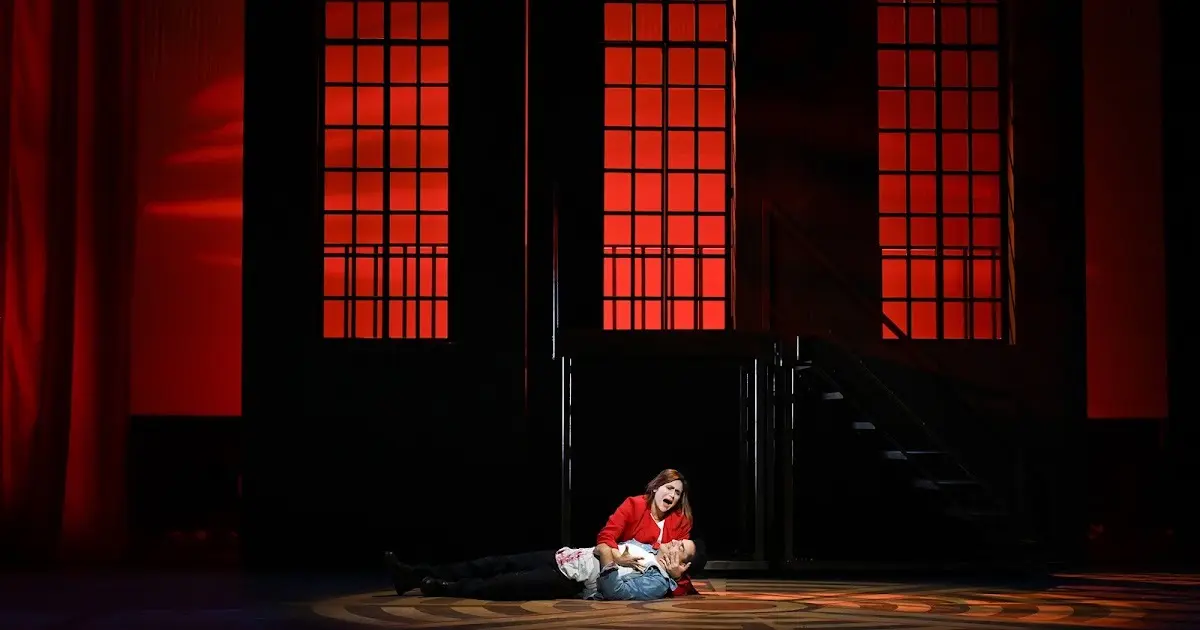
The evening commenced within a striking visual framework designed by Anthony Lamble, drawing explicit inspiration from the brutalist architecture of Italian architect Carlo Scarpa (1906–1978). This heavy, geometric aesthetic persisted as a foundational structure throughout the night, framed by a false proscenium equipped with dynamic lighting that shifted colors during crucial narrative inflection points.
However, the directorial choices within this modernist setting immediately challenged conventional interpretations of Puccini’s score. Rather than playing the interactions between Floria Tosca and Mario Cavaradossi with breathless, high-stakes romantic gravity, the production leaned into an unexpectedly lighthearted dynamic. Giannattasio’s initial histrionic outbursts as a jealous, possessive diva repeatedly provoked open laughter from the audience—an unprecedented audience reaction for this specific repertoire.
Vocally, Bryn Terfel’s entry as Scarpia established a commanding presence, though the spatial limitations of the New Theatre—which lacks a traditional, deep orchestra pit—pushed the Oxford Philharmonic Orchestra’s 40-string section to spill over into the front stalls, creating an acoustically and visually dominant presence right from the opening chords.
%20(c)%20Chris%20Christodoulou.jpg)
Act Two: Hollywood Noir and Over-The-Top Confrontations
By Act Two, the production lurened aggressively into the visual and stylistic territory of Hollywood Noir. Both Giannattasio and Terfel were seemingly encouraged to amplify the histrionic quotient, resulting in a relentless, over-the-top cat-and-mouse game.
Terfel’s Baron Scarpia prowled the stage surrounded by armed heavies, frequently and distractingly fiddling with a mobile phone—a modern touch that added little psychological depth to the villainy. The intense vocal sparring between Scarpia and Tosca reached explosive heights, highlighted by Giannattasio delivering a deeply moving, finely sculpted rendition of "Vissi d’arte." Yet, the overarching theatrical tension suffered from a lack of internal discipline; the staging veered perilously close to comic-book villainy, robbing the psychological torture of its genuine, chilling menace.
Act Three: Abstract Minimalism and Ambiguous Demise
The final act traded the oppressive political realism of the previous scenes for stark abstraction. During Pirgu’s emotionally resonant delivery of "E lucevan le stelle," a solo clarinettist appeared physically on stage, heightening the dreamlike, conceptual nature of the staging.
The tragic pastoral elements were similarly re-conceived: the young shepherd boy sang his aria while carrying a red balloon, which was subsequently released into the air following Tosca’s demise. In a striking directorial departure, the production actively shied away from showing Tosca’s historic leap from the parapet. Instead, audiences watched Giannattasio mount the elevated structure before plunging into an abrupt blackout, accompanied only by a falling flash of red fabric. This abstract finale amplified the fragmented, conceptual identity that characterized the production from its inception.
AlexBrenner__12_3806_dx_s.jpg)
Supporting Context & Metrics: Production and Orchestra Analysis
To understand the artistic successes and friction points of the OIO debut, one must examine the operational and musical mechanics underpinning the production.
- Venue Constraints: The New Theatre Oxford is fundamentally unsuited for heavy operatic staging without compromises. Its shallow pit forced the Oxford Philharmonic Orchestra (OPO) into the stalls, altering the sonic balance and forcing soloists to project over a symphonic body that was visually and acoustically imposing.
- Orchestral Dynamics: Under the baton of Marios Papadopoulos, the OPO displayed immense affection for Puccini’s lush orchestration—arguably to a fault. Papadopoulos exhibited a pronounced tendency to linger lovingly over individual phrases. While this granted soloists ample breathing room, it critically drained the score of forward momentum. Slow tempos stripped the dramatic sequences of their requisite urgency, transforming a taut political thriller into a sequence of isolated concert pieces.
- Vocal and Supporting Roster Metrics:
- Carmen Giannattasio (Tosca): A relatively light-voiced interpreter of the role, Giannattasio compensated with commanding stage presence and vocal intelligence. Her last notable London appearance was at Covent Garden in 2017; her return to the UK stage was a welcome masterclass in vocal discipline, even if pushed toward excessive melodrama in Act Two.
- Saimir Pirgu (Cavaradossi): Brought a lithe, athletic stage presence and a soaring tenor that blossomed effortlessly during the work’s emotional peaks, anchoring the romantic tragedy with genuine musicality.
- Bryn Terfel (Scarpia): Exhibited a commanding, menacing authority during the Te Deum, though his signature vocal vibrato has widened considerably with age. His portrayal, while meticulously detailed, lacked the chilling, understated terror required to elevate the character above a caricatured villain.
- Minor Roles: Peter van Hulle delivered a vividly malevolent Spoletta; Jamie Woollard offered a deeply touching, vocally restrained Angelotti; and Sion Goronwy provided broad, occasionally over-emphasized comic relief as the Sacristan. The Radley College Choristers provided eager, lively choral support, though they frequently lacked the vocal projection required to fill the hall during massive ensemble sequences.
Official Statements and Institutional Vision
The establishment of Oxford International Opera represents a strategic pivot for the city’s classical music infrastructure, bridging the gap between world-class orchestral performance and fully staged lyric theatre.
Speaking on the launch of the company, representatives for the Oxford Philharmonic Orchestra emphasized the imperative of bringing international-caliber operatic productions directly to local audiences. By anchoring the initiative within the institutional stability of the OPO and leveraging the artistic directorship of Sir Bryn Terfel, the OIO was explicitly designed to attract top-tier global talent—such as Giannattasio and Pirgu—who might otherwise bypass regional English stages.
However, critical reception of the debut underscores an acute institutional challenge: translating high-profile branding and star casting into a cohesive, theatrically disciplined production. While the administrative and financial framework of the OIO is robustly supported by its orchestral parent, the artistic leadership faces immediate pressure to refine its directorial vision for future outings.
%20(c)%20Chris%20Christodoulou.jpg)
Future Outlook: Looking Toward Fidelio (2028)
The inaugural production of Tosca will be remembered as a bold, ambitious, yet deeply uneven launching pad for Oxford International Opera. It demonstrated that Oxford possesses the appetite, financial backing, and institutional infrastructure to mount large-scale lyric drama with major international headliners.
Nevertheless, the critical consensus points to a clear lesson for the company’s executive and artistic directors: star wattage and conceptual design cannot substitute for tight, disciplined theatrical direction and rhythmic momentum from the podium.
OIO has already announced its next major venture, scheduling a production of Ludwig van Beethoven’s Fidelio for May 2028. As the company looks toward this monumental operatic milestone, the local and international classical community will be watching closely. The primary hope is that the organization absorbs the growing pains of its debut, applying a firmer directorial hand that prioritizes unified dramatic coherence over superficial star power, ensuring that Oxford International Opera fulfills its immense, latent potential.