Executive Overview
To the modern observer, the European rabbit (Oryctolagus cuniculus) is an ubiquitous fixture of the British countryside, universally recognized as both a pastoral icon and a devastating invasive species capable of inflicting billions of pounds in ecological and agricultural damage. Yet, the current ubiquity of the rabbit masks a fascinating, multi-centennial history that mirrors the profound socioeconomic transformations of medieval England.
Long before they populated every hedgerow and threatened modern crop yields, rabbits were exotic, high-status commodities. Introduced, protected, and prized by monarchs and the Norman aristocracy, these animals began their British existence as rare luxuries. They functioned as living symbols of wealth, consumed at lavish royal banquets and worn as opulent garments by kings.
However, the catastrophic demographic shock of the Black Death (1346–1353)—which eradicated between one-third and two-thirds of the European population—fundamentally upended this rigid social hierarchy. As labor shortages empowered the surviving peasantry and elevated living standards, the consumption of rabbit meat and the wearing of rabbit fur trickled down to aspiring craftsmen and wealthier peasants. Concurrently, the proliferation of rabbits sparked intense agrarian conflicts over crop destruction and triggered paranoid legislation aimed at curbing poaching and armed peasant uprisings.
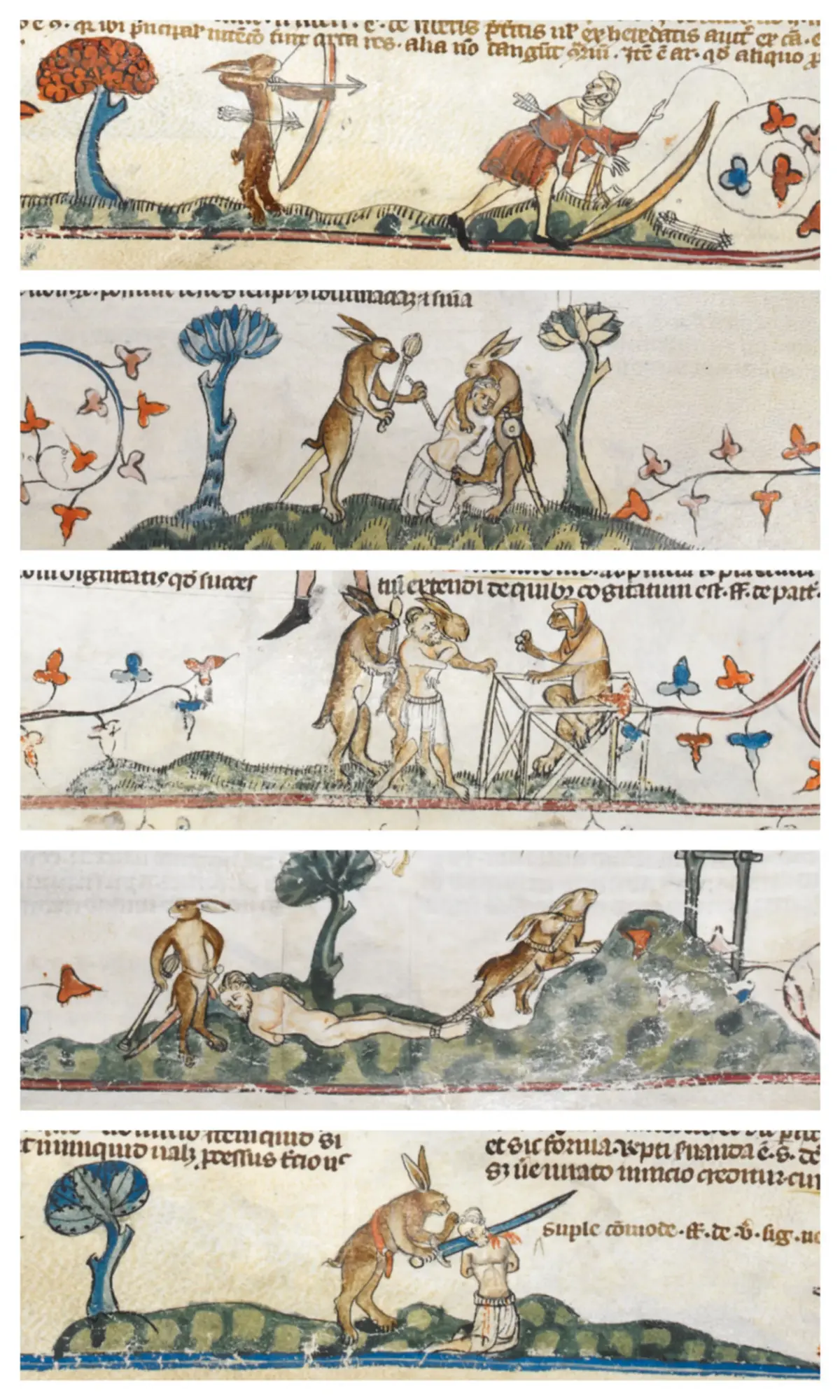
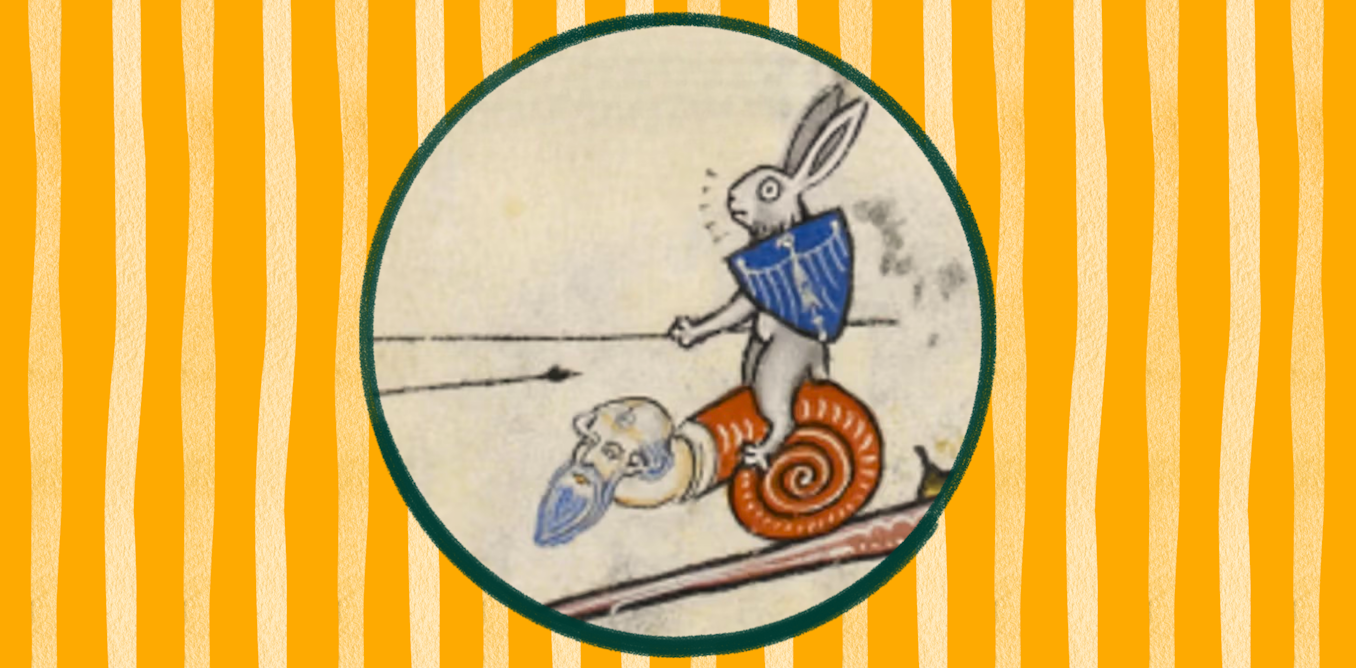
Beyond their economic and ecological impact, medieval rabbits left a rich cultural footprint. Preserved in the margins of illuminated manuscripts, they reveal a sophisticated, subversive medieval humor. Long before Monty Python introduced the world to the "Killer Rabbit of Caerbannog," medieval illustrators were depicting bunnies as victorious executioners, jousting on snails, and turning the feudal world utterly upside down. This article examines the trajectory of the European rabbit in medieval Britain, charting its rise from royal luxury to ubiquitous pest, and exploring how these creatures became vessels for the era’s deepest social anxieties and comedic outlets.
Detailed Chronology: From Roman Curio to Tudor Swarm
1. Antiquity to the Norman Conquest: The Cryptic Arrival
While archaeological excavations have occasionally unearthed isolated rabbit bones from Roman Britain—such as discoveries at Fishbourne Roman Palace—these finds represent rare anomalies rather than established populations. The systematic introduction and widespread ecological establishment of the European rabbit in the British Isles did not occur until the medieval period, catalyzed by the Norman Conquest of 1066. The Normans brought with them sophisticated continental techniques of game management, constructing walled enclosures known as "warrens" or coneygarths to breed and protect these delicate, climate-sensitive animals.
2. The Twelfth and Thirteenth Centuries: Royal Monopolies and Ecclesiastical Confusion
Documentary evidence confirms that by the 12th century, rabbits were established enough to generate legal and religious debate. One of the earliest written references dates to 1176 in the Scilly Isles, where a landowner named Richard de Wyka withheld church tithes on his rabbits, arguing that "tithes were not payable on things of this kind." His confusion underscores the novelty of rabbits at the time, which did not neatly fit into traditional agricultural tithe categories.
By the 13th century, rabbits were valuable enough to command the direct attention of the English crown. In 1235, King Henry III gifted ten live rabbits from his royal park at Guildford to Geoffrey Despenser, the Lord of Martley. Subsequent royal records from the 1240s reveal expeditions dispatched to capture dozens of rabbits from the Guildford warren, strictly conditional upon the colony remaining well-stocked. Henry III’s Christmas feast of 1240 marked a watershed moment, representing the first recorded instance of rabbits being added to the royal requisition list alongside venison, boars, swans, and peacocks.
Because rabbits were highly susceptible to damp British winters and predators, they were housed in specialized manorial warrens protected by watchtowers, stone lodges, and armed guards. They were an elite delicacy, commanding prices four to five times higher than domestic chickens.
3. The Mid-Fourteenth Century: The Black Death and Social Upheaval
The catastrophic arrival of the Black Death between 1346 and 1353 fundamentally destabilized the feudal economic model. With demographic collapse came an abundance of available land and a drastic shortage of labor. Surviving peasants and laborers could command significantly higher wages, enabling them to emulate the lifestyles, fashion choices, and dietary habits of their social superiors.
Rabbits quickly became emblematic of this rising prosperity. During the 14th and 15th centuries, rabbit meat began appearing on the tables of wealthier peasants, while aspiring craftsmen and tradespeople adopted rabbit fur—traditionally reserved for the nobility—for warmth and status.
4. The Late Fourteenth Century: Legislative Backlash and Poaching Panics
The upward social mobility of the lower classes provoked a swift legislative reaction from the ruling elite. In 1363, Parliament introduced strict sumptuary laws designed to regulate dress according to social status, explicitly citing "the excess of dress of people beyond their estate" as a threat to the realm.
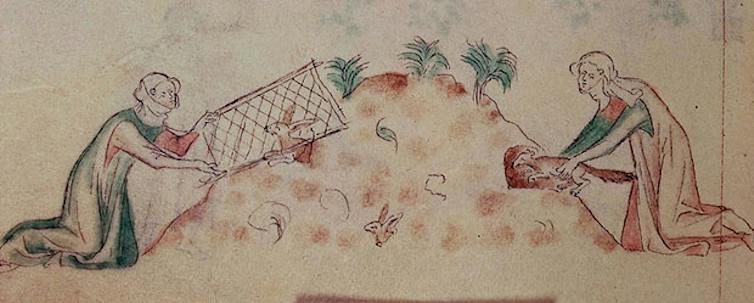
Concurrently, the proliferation of rabbits led to bitter complaints from manorial lords whose crops were continually ravaged by burrowing pests. Yet, hunting these animals became deeply politicized. Following the Peasants’ Revolt of 1381, the Crown grew intensely paranoid that lower-class hunting parties served as a cover for armed sedition. In 1390, Parliament passed sweeping anti-poaching legislation. King Richard II consented to bans prohibiting laborers and artisans from using "hounds and ferrets, hays, nets, hair-pipes, cords and all other devices" to take hares, rabbits, or forest game, fearing that such leisure activities were incubators for political rebellion.
5. The Sixteenth Century: Ecological Saturation
By the mid-16th century, the rabbit had transitioned completely from an artificial, heavily guarded luxury to an ecologically entrenched naturalized species. Writing in 1555, the renowned Swiss naturalist Conrad Gesner observed that while rabbits bred in many countries, "the most plenty of all is in England." The warrens had broken their bounds, paving the way for the rabbit’s modern status as an ecological fixture.
Supporting Context & Metrics: Economics, Ecology, and Culture
| Historical Period / Event | Status of the Rabbit | Primary Economic / Cultural Role |
|---|---|---|
| Roman Britain | Rare / Non-established | Occasional imported curio; no sustained wild populations. |
| 12th – 13th Century | Elite Luxury | Kept in walled warrens; royal gifts; valued at 4–5x the cost of a chicken; protected by watchtowers. |
| Post-Black Death (14th–15th C.) | Rising Commodity | Consumed by wealthy peasants; fur worn by craftsmen; subject to sumptuary laws and poaching bans. |
| 16th Century Onward | Ecological Abundance | Widespread naturalized pest; central to agricultural complaints; noted by naturalists as extraordinarily prolific in England. |
The Mechanics of Medieval Warrening
Maintaining a medieval rabbit warren was an engineering and economic feat. Because continental European rabbits were poorly adapted to the damp, cold British climate, lords constructed artificial earth mounds (pillow mounds) to facilitate burrowing and drainage. These warrens were surrounded by stone walls, earthen banks, and deep ditches to keep out predators such as foxes, wildcats, and raptors, while keeping the valuable livestock secure from poachers.
The Politics of Fur and Feast
In an era where clothing was an explicit legal indicator of rank, fur was heavily regulated. The grey rabbit (coney) provided affordable warmth, but mutations yielding silver-grey or jet-black pelts were highly prized. Royalty maintained a preference for the most exotic grades; records indicate that King Henry VII slept in night attire tailored specifically from black rabbit fur.
However, this democratization of luxury proved deeply unsettling to the medieval Parliament. The sumptuary legislation of 1363 and the anti-poaching statutes of 1390 demonstrate that the ruling class viewed the consumption of game and the wearing of fine pelts not merely as economic infractions, but as direct challenges to the divinely ordained social order.
Official Statements and Historical Perspectives
Historians and medievalists specializing in human-animal relations and material culture have long emphasized the unique symbolic weight carried by the rabbit in pre-modern Europe.
Dr. Richard Almond, an authority on medieval hunting and fauna, notes:
"The rabbit was never ‘just an animal’ in medieval England. It was a carefully engineered economic enterprise, a diplomatic currency exchanged between kings, and a flashpoint for class warfare. When a peasant ate rabbit or wore its fur without legal sanction, they were enacting a micro-revolution within the feudal system."
Furthermore, cultural historians examining manuscript illuminations have highlighted how the juxtaposition of delicate prey animals with violent, militarized human structures exposed underlying societal anxieties.
Dr. Sophie O’Neill, a researcher of medieval marginalia, observes:
"When monks or scribes drew rabbits trying and executing human hunters in the margins of 14th-century psalters, they were engaging in deep socio-political critique. It was safe subversion—a comedic release valve for a populace living under the crushing weight of serfdom and rigid class stratification."
Future Outlook and Ongoing Historical Research
As interdisciplinary research methods continue to evolve, the study of medieval fauna is undergoing a renaissance. Modern zooarchaeologists are increasingly turning to biomolecular analysis—including ancient DNA (aDNA) profiling and stable isotope analysis—to track the exact genetic lineages of medieval rabbit populations. These scientific techniques are helping historians map how Norman lords imported rabbits from specific Mediterranean and continental populations, shedding light on medieval trade routes, selective breeding practices, and veterinary husbandry.
Simultaneously, digital humanities projects are making thousands of digitized manorial court rolls, royal close rolls, and illuminated manuscripts accessible to researchers worldwide. By cross-referencing legal disputes over crop damage with agricultural output data from the post-Black Death era, modern researchers are gaining unprecedented quantitative insights into how invasive species shaped medieval land use and local economies.
Ultimately, the story of the medieval rabbit serves as a compelling reminder that the natural world and human society are inextricably bound. Long before modern ecological crises brought invasive species to the forefront of environmental science, the medieval introduction of the rabbit reshaped landscapes, fueled class conflict, and inspired centuries of artistic satire—proving that even the smallest creature can leave a monumental footprint on history.