Executive Overview
Following a celebrated, Tony Award-winning run on Broadway, the critically acclaimed musical Kimberly Akimbo has crossed the Atlantic to make its highly anticipated UK premiere at London’s Hampstead Theatre. With a unique premise that blends profound melancholy with an unexpected, breezy morbidity, the production immediately challenges theatrical conventions.
At its narrative and emotional core is Kimberly Levaco, a teenager on the precipice of her sixteenth birthday. Yet, unlike her peers consumed by the transient anxieties of youth, Kimberly faces an extraordinary biological countdown. Stricken by a rare, one-in-fifty-million genetic condition functionally akin to progeria, her body ages four to five times faster than the average human rate, placing her life expectancy at a heartbreaking sixteen years.
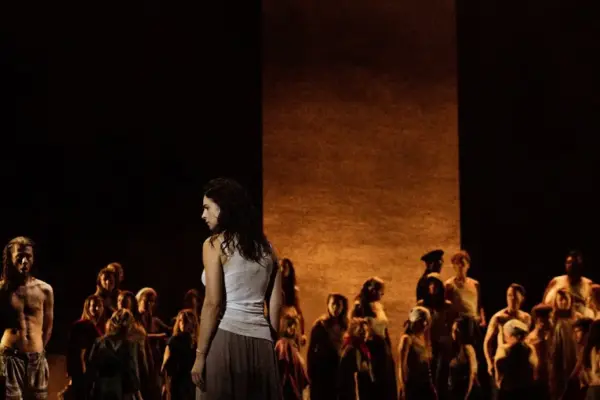
Bringing this complex, multi-layered protagonist to life in the UK production is 66-year-old stage veteran Maria Friedman. Through a masterclass in physical acting and vocal prowess, Friedman bridges the chasm between chronological age and youthful spirit, avoiding the pitfalls of caricature to deliver a deeply human portrait of mortality. Written by David Lindsay-Abaire (book and lyrics) and Jeanine Tesori (music), Kimberly Akimbo treats its heavy subject matter not with oppressive doom, but with a wry, life-affirming humor. As the show settles into its limited run through November 7, it poses a central, universal question: how do we measure the value of a life when time is running out at quadruple speed?
Detailed Chronology: The Journey from New Jersey Rinks to London Stages
The theatrical journey of Kimberly Akimbo is one defined by deliberate pacing, meticulous development, and eventual triumph. Originally conceived as a play by David Lindsay-Abaire before being adapted into a musical partnership with composer Jeanine Tesori, the property spent years evolving through regional workshops and developmental labs before arriving in New York.
[Play Conception & Development]
       │
       ▼
[Off-Broadway & Broadway Run (Tony Wins)]
       │
       ▼
[UK Premiere at Hampstead Theatre] ──► (Running until November 7)
The American Genesis and Broadway Acclaim
When Kimberly Akimbo opened stateside, it quickly became an anomaly in the modern musical landscape—a small-scale musical dealing with terminal illness, dysfunctional family dynamics, and adolescent angst that managed to captivate mainstream audiences. Its Broadway iteration garnered critical raves and major accolades, most notably sweeping the Tony Awards. The challenge for the creative team, however, was whether this uniquely American tragicomedy—steeped in the specific geographic and cultural lore of suburban New Jersey—could successfully translate to international audiences, specifically those packing into North London’s Hampstead Theatre.
The UK Premiere and Initial Reception
As the production raised its curtain for its British debut, those structural fears were swiftly put to rest. The narrative opens with an image that instantly establishes the musical’s melancholic irony: Kimberly Levaco, on the verge of turning sixteen, lacing up her skates at a modest New Jersey ice rink. The juxtaposition of a teenage milestone with an advanced physiological age establishes the dramatic stakes within the first five minutes.
Throughout the first act, the audience is introduced to a revolving door of chaotic influences:
- Buddy (Peter Hannah): Kimberly’s deadbeat, alcohol-reliant father, whose own arrested development mirrors his daughter’s forced acceleration.
- Patty (Niamh Perry): A scatty, mercurial, heavily pregnant mother who behaves with less emotional maturity than the teenager residing in her home.
- Aunt Debra (Alice Fearn): A tornado of criminal chaos who bursts into the narrative with a harebrained, get-rich-quick scheme, injecting high-octane energy into the proceedings.
Despite the bleak ticking clock at the heart of the narrative—the statistical reality that individuals with her specific genetic affliction rarely survive past their sixteenth year—the production maintains an astonishingly buoyant tone. It refuses to wallow in self-pity, choosing instead to find moments of genuine human connection amidst the absurdities of suburban existence.
Supporting Context & Metrics: The Science, Staging, and Score
To fully appreciate the artistic achievement of Kimberly Akimbo, one must examine the intricate mechanics of its production design, its musical architecture, and the rare medical realities that inspired its premise.
The Medical Reality: Progeria and Accelerated Aging
While Kimberly Akimbo is a work of fiction, its emotional anchor is rooted in terrifying biological truths. The character’s condition mirrors real-world genetic disorders such as Hutchinson-Gilford Progeria Syndrome. Progeria is an extremely rare, progressive genetic disorder that causes children to age rapidly, starting in their first two years of life.
| Metric / Feature | Specification |
|---|---|
| Estimated Condition Frequency | ~1 in 50,000,000 births (fictionalized severity) |
| Real-World Progeria Life Expectancy | Typically mid-teens to early twenties (primarily due to heart disease) |
| Playwrights / Creators | David Lindsay-Abaire & Jeanine Tesori |
| UK Venue | Hampstead Theatre |
| Closing Date | November 7 |
| Lead Actor Age | 66 (Portraying a 15-to-16-year-old) |
Patients with progeria typically experience accelerated cardiovascular aging, leading to severe arteriosclerosis, strokes, and heart attacks at a young age. By placing a teenager inside a body that is breaking down on a cellular level, Lindsay-Abaire constructs a visceral metaphor for the universal feeling of time slipping through our fingers long before we are ready to let go.
Architectural Ingenuity: Soutra Gilmour’s Set Design
The physical parameters of Kimberly’s world are brilliantly contained within a single, shapeshifting set designed by Soutra Gilmour. Operating on a 360-degree rotation, the staging effortlessly transforms from:
- A sterile, freezing ice rink.
- A high-school hallway flanked by rows of institutional lockers.
- A quiet, reflective public library.
- The cluttered, three-story Levaco family home.
With the exception of a somewhat superfluous animated backdrop used primarily to mimic a giant ticking clock, Gilmour’s design choices are both economically executed and narratively potent. The scale feels intimately tailored to depict a suffocating New Jersey suburb where every adolescent is desperate to escape.

The Musical Tapestry: Tesori and Lindsay-Abaire’s Score
Musicals of this scale live and die by the strength of their scores, and Jeanine Tesori’s compositions do not disappoint. Eschewing the generic, high-gloss pop sound that dominates many contemporary Broadway imports, Tesori incorporates classical musical-theatre forms that elevate the dramatic tension.
Lyrically, Lindsay-Abaire opts for directness over dense complexity. While occasional internal rhymes peek through, the lyrics remain consistently lively and well-judged. They mirror the emotional cadence of teenagers who are trying to articulate feelings far bigger than their years can comfortably contain.
Official Statements & Critical Perspectives
The arrival of Kimberly Akimbo in London has sparked profound conversations among critics, creatives, and audiences regarding ageism in casting, the universality of theatrical storytelling, and the delicate balance of dark comedy.
The Triumph of Maria Friedman’s Portrayal
At the heart of the production’s critical acclaim is Maria Friedman’s staggering performance. Industry analysts and theater critics have repeatedly highlighted how rare it is for performers over the age of sixty to be entrusted with roles requiring raw physical vulnerability, let alone the embodiment of a teenager.
"Friedman does not merely play a teenager; she captures the precise, awkward physical cadence and the unfiltered emotional transparency of youth, all while maintaining the vocal power and crystalline clarity that have defined her legendary career." — Theatrical Review Excerpt
By avoiding cartoonish physical tropes, Friedman anchors the musical’s flights of fancy in profound emotional truth. Her chemistry with co-star Gilli Jones—who plays Kimberly’s tuba-playing, anagram-obsessed love interest—provides the emotional spine that elevates the show from a quirky dark comedy into a soaring coming-of-age romance.
Cultural Translation: From New Jersey to North London
A primary anxiety surrounding transatlantic theatrical transfers is the potential loss of cultural nuance. Industry insiders frequently question whether localized humor—such as jokes centered on the social ignominy of being a Bruce Springsteen detractor in his home state of New Jersey—will register with audiences in North London.
However, early audience and critical responses suggest that the creative team succeeded precisely because they refused to let the narrative get bogged down by regional specificity. As cultural commentators have noted:
"Ultimately, Kimberly Akimbo is not a musical about New Jersey, nor is it a clinical study of an ultra-rare genetic mutation. It is a universal meditation on the twin mysteries of aging and youth—experiences that unite every human being regardless of geography."
Future Outlook: The Legacy of Kimberly Akimbo
As Kimberly Akimbo continues its strictly limited run at the Hampstead Theatre through November 7, its trajectory offers significant insight into the future of contemporary musical theater.
Expanding Horizons for Aging Performers
The triumphant casting of Maria Friedman in a teenage lead role serves as a vital proof-of-concept for the broader entertainment industry. For decades, the theatrical canon has suffered from a rigid age-stratification system that sidelines veteran actors just as their interpretive powers reach their absolute peak. By demonstrating that an experienced performer can authentically convey the emotional and physical reality of youth—not through artificial youth-chasing, but through brilliant craft—Kimberly Akimbo paves the way for more imaginative, risk-taking casting decisions across global stages.
The Demand for Small-Scale, High-Impact Narrative
In an era dominated by mega-budget spectacles, corporate revivals, and jukebox musicals relying on established pop catalogs, Kimberly Akimbo proves that audiences still yearn for original storytelling driven by complex characters, witty lyrical craftsmanship, and emotional depth.
Whether the production secures a West End transfer following its Hampstead engagement remains to be seen. However, its undeniable resonance with British theatergoers confirms that stories dealing with the delicate friction between mortality and youth possess a truly borderless appeal. As Kimberly counts down her final days on stage, she leaves behind a permanent reminder to audiences everywhere: time may be cruel and relentlessly brief, but the music we make while it passes is entirely our own.