Executive Overview
For sixty years, Star Trek has served as the cultural vanguard of human space exploration, bridging the gap between speculative fiction and hard theoretical physics. From its genesis in the mid-1960s to its modern streaming iterations, the franchise has continually challenged audiences to look past the confines of our solar system and ponder the deep architecture of the universe. Among the most enduring and conceptually captivating tropes of this universe are "wormholes"—hypothetical tunnels through spacetime capable of bridging unfathomable interstellar distances in the blink of an eye.
Yet, translating complex general relativity into compelling television has always required a delicate compromise. While science fiction storytelling frequently favors visual drama and narrative convenience over rigorous mathematical modeling, the underlying physics of wormholes remain one of the most intellectually stimulating subjects in theoretical astrophysics.
Recent advances in computer simulations, general relativity, and quantum mechanics have fundamentally shifted how physicists visualize these cosmic shortcuts. Far from the swirling, dark-matter vortexes commonly projected on television screens, modern calculations suggest that a traversable wormhole would resemble a translucent soap bubble or a crystalline sphere, mirroring and distorting the universe on its opposite side.
This article investigates the fascinating interplay between the science of Star Trek and real-world physics. By examining the franchise’s milestone depictions of wormholes—from Commander Willard Decker’s harrowing encounter in 1979’s Star Trek: The Motion Picture to the technologically mature, traversable conduits of Star Trek: The Next Generation—we explore how science fiction has not only mirrored scientific inquiry but actively inspired generations of physicists to look deeper into the fabric of spacetime.
Detailed Chronology: Wormholes on Screen and in the Laboratory
To understand the evolution of the wormhole concept, one must trace its parallel development across Hollywood script rooms and theoretical physics departments over the past seven decades.
[1957] Wheeler & Misner coin "wormhole"
   │
   ├──> [1973] Ellis & Bronnikov publish traversable solutions
   │      │
   │      └──> [1979] Star Trek: The Motion Picture introduces first on-screen wormhole
   │             │
   │             ├──> [1988] Kip Thorne establishes modern traversable physics
   │             │      │
   │             │      └──> [1987–1994] TNG features commercial/stable wormholes
   │             │             │
   │             │             └──> [Present] Modern simulations reveal "bubble" optics
1957: The Birth of the Term
While science fiction writers had long used alternate dimensions and spatial folding to move plots across the galaxy, the mathematical nomenclature of the wormhole originated in academia. In 1957, theoretical physicists John Wheeler and Charles Misner published a landmark paper titled Classical Physics as Geometry. In it, they attempted to describe fundamental subatomic phenomena, such as electric charges and electrons, as the microscopic, topological ends of tunnels threading through space. Wheeler later coined the term "wormhole" to describe these hypothetical geometric bridges.
1973: Equations of General Relativity
The theoretical framework graduated from microscopic models to macroscopic tunnels capable of supporting matter when physicists H.G. Ellis and K.A. Bronnikov independently published papers describing traversable wormholes that satisfied Albert Einstein’s equations of general relativity. These mathematical configurations demonstrated that spacetime could theoretically be sculpted into a stable cylinder, balancing gravitational curvature with specific distributions of matter.
1979: Star Trek: The Motion Picture
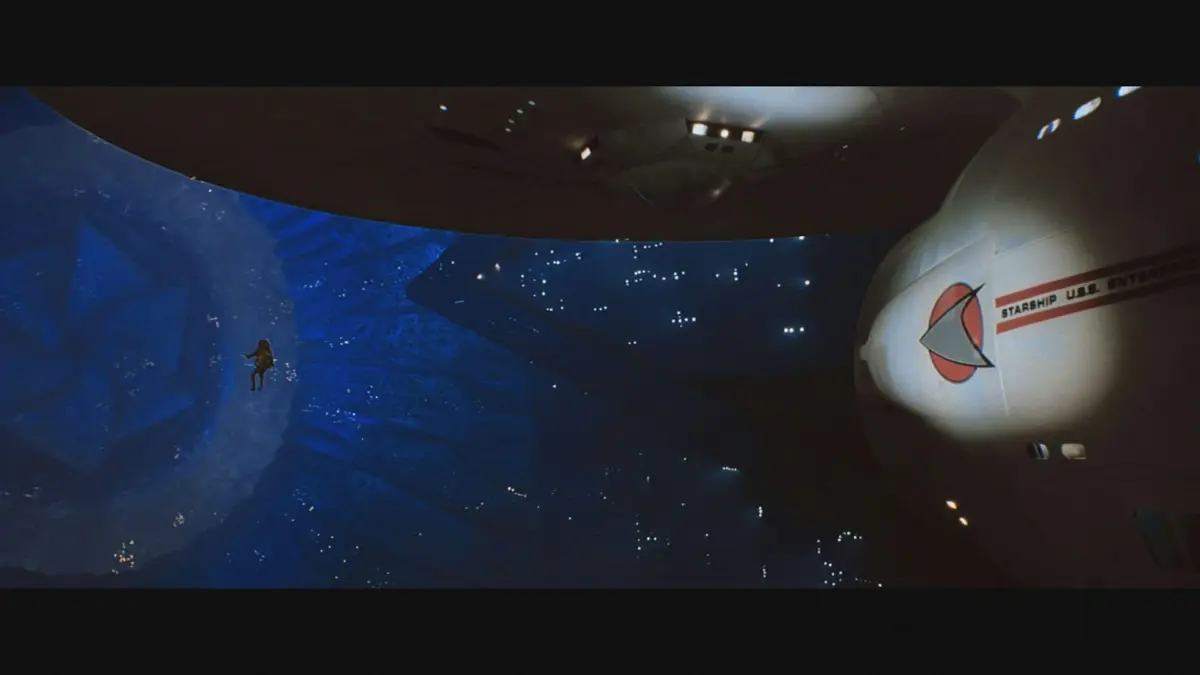
The concept made its cinematic debut in Star Trek: The Motion Picture. When a warp-drive malfunction creates a localized spatial distortion, the USS Enterprise is pulled into a chaotic region of spacetime. Although scientifically inaccurate in several key areas—such as failing to lead to a distinct destination and dissipating once warp drive is disengaged—this scene marked the first time mainstream audiences were exposed to the visual concept of spacetime manipulation on such a scale.
1988: The Kip Thorne Framework
As theoretical physics matured through the 1980s, Nobel laureate Kip Thorne and his colleagues at the California Institute of Technology breathed new life into macroscopic wormhole research. Thorne demonstrated that for a wormhole to remain open long enough for a spacecraft to pass through safely, it would require an exotic form of matter possessing negative energy density. This framework served as the direct scientific blueprint for the sophisticated, stable wormhole plots that populated Star Trek: The Next Generation (1987–1994) and Star Trek: Deep Space Nine (1993–1999).
Supporting Context & Metrics: Optics, Time Dilation, and Stability
When evaluating the physics of Star Trek, researchers frequently encounter friction between cinematic license and physical reality. Three major areas highlight this divergence: optical appearance, temporal distortion, and structural stability.
The Optics of a Spacetime Shortcut
On television, wormholes are typically portrayed as swirling vortexes or dark tunnels, inviting travelers into a murky unknown. However, modern computer simulations—such as those published in journals like Classical and Quantum Gravity—paint an entirely different picture.
Because light rays warp around the intense gravitational fields of a wormhole’s opening, the entrance would not look like a traditional hole in space. Instead, it would appear as a spherical aperture, closely resembling a soap bubble or a crystal ball. Its surface would display magnified, distorted, and multiplied images of the alien landscape lying on the other side. A traveler could approach this spherical opening from any vector and enter cleanly, emerging instantaneously from a corresponding aperture light-years away.
Debunking Cinematic "Slow-Mo"
A classic trope in space-faring cinema is the "temporal distortion" zone, where characters trapped inside a spatial anomaly suddenly move and speak in agonizing slow motion. In The Motion Picture, the Enterprise crew struggles sluggishly to fire photon torpedoes while caught in the wormhole’s grip.
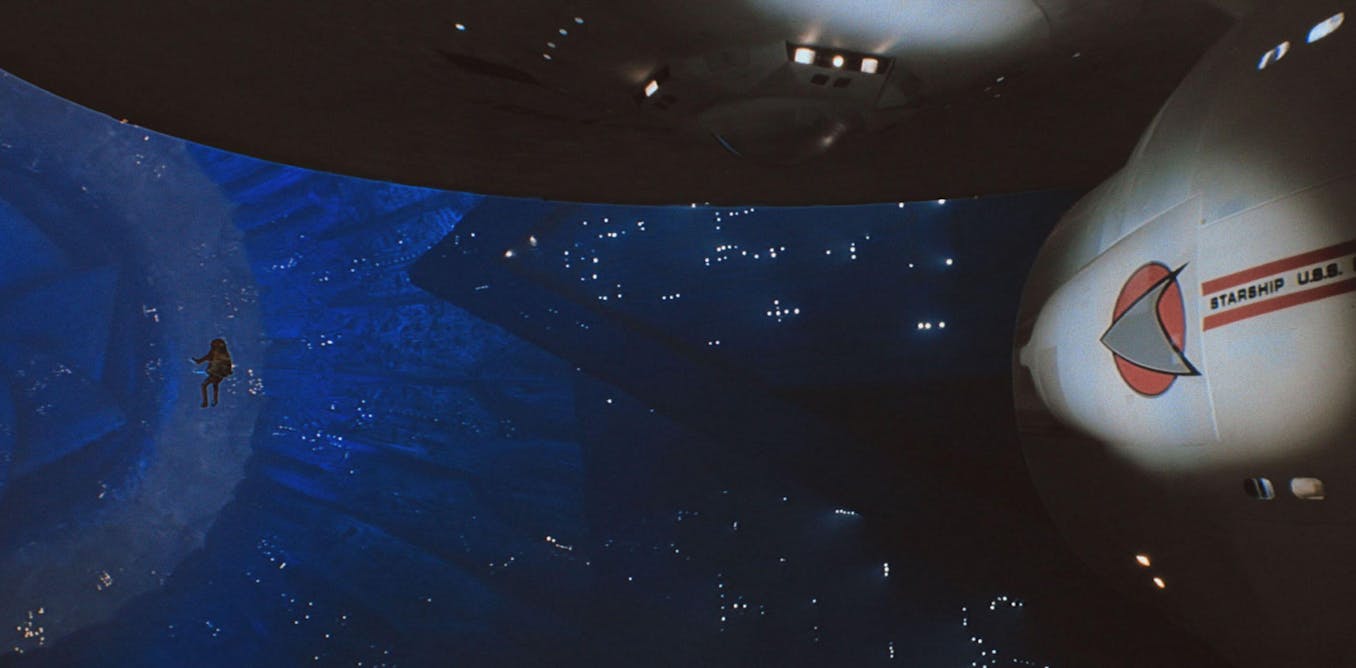
From the perspective of Einstein’s theory of general relativity, gravitational time dilation is a very real phenomenon. Clocks tick more slowly in stronger gravitational fields. However, travelers experiencing this dilation do not feel sluggish.
To an astronaut inside a wormhole or near a massive gravitational source, time proceeds entirely normally: their wristwatch continues to tick at precisely one second per second. Upon emerging, they might discover that decades have passed for friends left behind in normal space, but neither party would experience a subjective slowdown of biological or cognitive functions. This exact relativistic principle is accounted for daily by the atomic clocks aboard Earth-orbiting GPS satellites, which run faster than ground-based clocks due to weaker gravitational fields.
The Physics of Scaffolding and Collapse
The most critical engineering hurdle for any civilization—whether Starfleet or human—is keeping a wormhole open. Unmodified wormholes described by the Ellis-Bronnikov metrics are inherently unstable. Even the slightest perturbation, such as the passage of a single photon or a minor thermal fluctuation, causes the throat of the wormhole to pinch shut at the speed of light, destroying anything inside.
To prevent this catastrophic collapse, physicists calculate that the throat must be lined with "exotic matter"—matter characterized by negative pressure that exerts a repulsive gravitational effect, acting as structural scaffolding to prop the tunnel open. While quantum mechanics allows for temporary, microscopic fluctuations of negative energy (such as the Casimir effect), generating macroscopic quantities sufficient to stabilize a starship-sized portal remains firmly in the realm of speculative physics.
Official Statements and Expert Perspectives
The dialogue between science fiction creators and academic physicists has long been characterized by mutual respect and rigorous debate.
Reflecting on the role of speculative physics in media, theoretical astrophysicists note that the boundary between mathematical viability and physical realization is precisely where scientific breakthroughs are born.
"The space between what is mathematically possible and physically realistic has always been a key part of the magic of Star Trek," notes computational astrophysicist Dr. Elena Vance. "While science fiction allows us to bypass the brutal realities of energy conditions and quantum instabilities for the sake of a narrative, it simultaneously serves as a profound cultural catalyst. It asks generations of students to look at Einstein’s field equations not as dry lines of calculus, but as maps to undiscovered countries."
Similarly, historical accounts from the late Kip Thorne highlight how science fiction writers actively sought out academic validation. During the development of Carl Sagan’s novel Contact—which heavily influenced contemporary portrayals of traversable wormholes—Thorne provided the precise mathematical equations for a stable wormhole, ensuring that the fiction remained anchored to the laws of general relativity as closely as possible.
Future Outlook: From Theory to Empirical Exploration
As humanity enters a new era of multi-messenger astronomy, gravitational wave detection, and quantum computing, the study of spacetime topology is transitioning from pure philosophy to testable astrophysics.
| Research Domain | Current Status | Future Implication |
|---|---|---|
| Gravitational Waves | Active detection via LIGO/Virgo/KAGRA | Potential identification of cosmic string signatures or primordial wormhole remnants. |
| Exotic Matter | Laboratory verification of Casimir effect | Scaling negative energy densities from microscopic to macroscopic applications. |
| Topological Censorship | Mathematical theorem testing | Determining whether macroscopic traversable wormholes are strictly forbidden by quantum gravity. |
While current consensus suggests that macroscopic traversable wormholes likely require physics beyond our current understanding—specifically a unified theory of quantum gravity—the theoretical tools developed to study them continue to yield dividends in cosmology and black hole thermodynamics.
As for the intrepid crews of Star Trek, the allure of the unknown remains undiminished. Whether humanity ever builds a stabilization engine capable of warping spacetime into a crystalline portal or whether wormholes remain forever confined to the realm of television screens, their cultural and scientific legacy is secure. They remind us that the universe is far stranger, more flexible, and more magnificent than our everyday terrestrial experience suggests.
As any cautious physicist will advise, however: when the first operational soap-bubble wormhole flickers into existence in our sector of space, it is probably best to let Starfleet go first.