Executive Overview
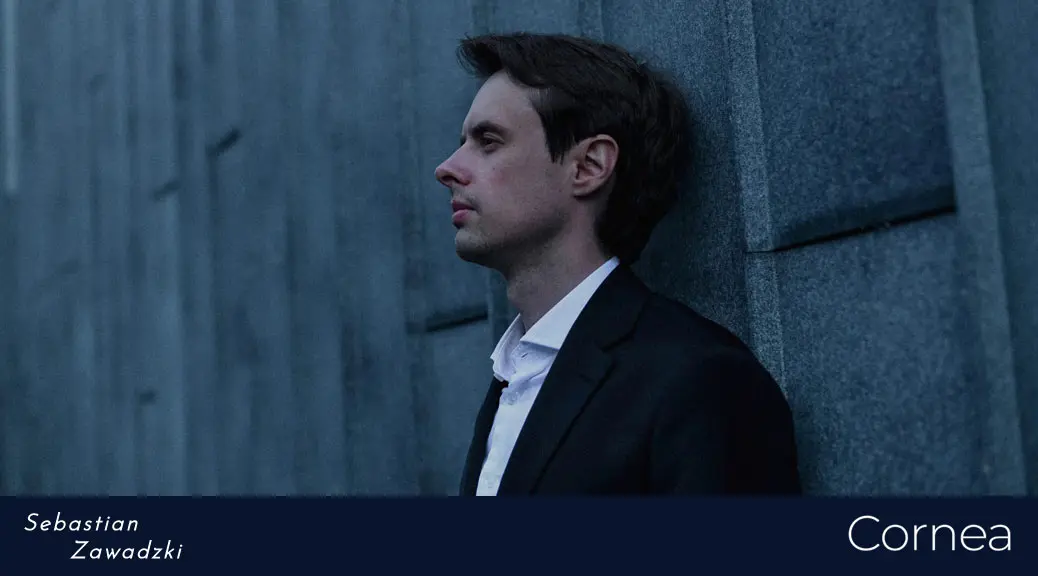
In the contemporary landscape of European improvised music, few artists bridge the gap between rigorous classical orchestration and the expansive, atmospheric freedom of Nordic jazz quite as seamlessly as pianist and composer Sebastian Zawadzki. In his latest release, Cornea, Zawadzki reunites with long-standing collaborators to deliver an album that operates less as a traditional collection of songs and more as a meticulously curated lexicon of membranes, thresholds, and low-light biological phenomena.
Following a trajectory that began a decade ago with foundational releases on the esteemed Polish imprint For Tune—including his striking contributions to the Paweł Wszołek Quintet’s Faith and his own early solo and trio statements Luminescence (2014) and Euphony (2015)—Zawadzki has steadily carved out an uncompromising independent path. Cornea represents a major milestone in this evolution. Featuring bassist Mariusz Praśniewski and drummer Haim Peskoff, the album explores eleven tracks whose titles draw heavily from Latin, Greek, and Polish linguistic roots.
Far from being mere intellectual window dressing, this linguistic framework informs the physical reality of the music. The compositions act as acoustic apertures—windows, air sacs, ivy-covered walls, and peat bogs translated into sound. While currently enjoying a physical release primarily on compact disc—a format that invites debate among vinyl purists—the sheer sonic transparency of the recording underscores Zawadzki’s mastery of the piano trio format. This deep-dive review explores the architecture of Cornea, contextualizing it within Zawadzki’s broader discography, examining the nuanced interplay of its personnel, and assessing its place in the modern jazz ecosystem.
Detailed Chronology: From Warsaw to the Nordic-Polish Synthesis
To fully appreciate the artistic maturity evident on Cornea, one must retrace the trajectory that brought Sebastian Zawadzki to this creative apex. The journey is one of geographic and stylistic migration, characterized by a relentless pursuit of tonal purity and structural sophistication.
The For Tune Era and Early Collaborations (2013–2015)
Zawadzki first began turning heads in European jazz circles through his association with For Tune, a Polish record label known for championing boundary-pushing improvised music. His early footprint was established not only through his own name-led projects but also through vital sideman work, most notably on the Paweł Wszołek Quintet’s critically acclaimed 2013 album Faith. It was here that Zawadzki’s signature touch—a delicate yet commanding blend of European classical harmonic sensibilities and modern jazz cadence—first crystallized.
This momentum led directly to his debut solo and small-ensemble statements on For Tune: Luminescence (2014) and Euphony (2015). These albums captured a young composer experimenting with light, space, and texture. However, seeking absolute creative autonomy, Zawadzki soon transitioned away from traditional label partnerships, founding Sebastian Zawadzki Music as a dedicated vessel exclusively for his own artistic output.
The Deepening Partnership: From Tūge to the Present
A critical anchor in Zawadzki’s ongoing evolution has been his enduring relationship with bassist Mariusz Praśniewski. Their professional partnership dates back to the 2013 album Tūge, a project that laid the groundwork for an almost telepathic musical understanding. Over a decade of shared performance and recording has fostered a rare stylistic economy; neither Zawadzki nor Praśniewski feels compelled to force a phrase or overplay a section, resulting in a mature, patient ensemble dynamic.
The addition of drummer Haim Peskoff further crystallizes the trio’s current iteration. Peskoff’s approach is characterized by refreshing, pointillistic detail, providing a rhythmic framework that supports rather than dictates the harmonic movement. This long-simmering chemistry culminates in Cornea, an album where every musical decision feels earned through years of shared exploration.
Supporting Context & Metrics: The Lexicon of Cornea
One of the most striking narrative elements of Cornea is its nomenclature. Ten of the album’s eleven tracks derive their titles from Latin and Greek root words, creating an overarching thematic unity that transcends standard jazz categorization. The remaining track borrows from Polish, anchoring the abstract concepts in a specific linguistic geography.
Breakdown of the Tracklist Terminology
| Track Title | Etymological Root | Literal Definition / Connotation | Musical Translation on the Album |
|---|---|---|---|
| Cornea | Latin (Corneus) | The transparent front surface of the eye | Clear, unclouded harmonic delivery; pristine piano articulation. |
| Alveola | Latin (Alveolus) | Small hollow or cavity; lung air sac | Breath-like pauses; expansive, resonant chordal breathing. |
| Hedera | Latin | Ivy | A creeping, solo piano miniature (68 seconds) providing botanical calm. |
| Turbarium | Latin | Peat bog or turf-pit | Dense, dark, spongy low-end textures beneath bright treble runs. |
| Luminaria | Latin (Lumen) | Lights, lamps, or illuminations | Radiant modal explorations and shimmering cymbal work. |
| Substrata Umbrae | Latin | The layers beneath the shadow | A brief (sub-minute) abrasive interlude introducing sharp tension. |
| Fractura Somnii | Latin | The breaking of sleep | Fractured, asynchronous time signatures disrupting tranquility. |
| Katalaxia | Greek (Kallallage) | Exchange; admitting a stranger to the community | Democratic interplay; fluid trade-offs between piano and bass. |
| Prześwit | Polish | A clearing, gap, or chink through which light arrives | A moment of structural openness where light pierces the texture. |
| Pastellium | Neologism / Latinate | A pastel-toned expanse | A nearly seven-minute centerpiece showcasing power-trio dynamics. |
| Monochrome III | English / Latinate | A single-color gradation (continuing a 2025 theme) | A reimagined solo miniature expanded into a dynamic trio canvas. |
Thematic Coherence and Critical Reception
When laid out in English, this sequence reads as a veritable lexicon of apertures, membranes, and biological systems designed to capture light, air, and external stimuli in low-light environments. While press materials often lean on vague industry buzzwords like "thresholds" and "perception," the music itself achieves a far deeper, more organic coherence.

The standout track of the collection is indisputably "Pastellium." Spanning close to seven minutes, it represents a complete departure from quiet introspection. Here, the three musicians drop their deferential postures and lean directly into the material. The piano writing opens up dramatically, while Praśniewski’s bass assumes a physical weight that evokes the idiom of a "power trio"—borrowing a term traditionally associated with high-decibel rock or heavy fusion, but applied here with acoustic sophistication.
Conversely, the album strategically employs micro-compositions to disrupt expectations. "Substrata Umbrae" clocks in at barely a minute, injecting a sharp, abrasive edge that shatters the prevailing tranquility right near the tail end of the sequence. Similarly, "Hedera" serves as the album’s sole non-trio track—a 68-second solo piano reflection that stands as its calmest, most solitary moment. Meanwhile, "Monochrome III" directly references Zawadzki’s 2025 solo release Monochrome, showcasing how a sparse solo miniature can be successfully reimagined and expanded for a three-piece ensemble.
Official Statements and Artistic Philosophy
Sebastian Zawadzki’s approach to composition is inextricably linked to his multi-disciplinary background. Having scored works for both traditional orchestras and cinematic projects, his writing exhibits a structural discipline that immediately exposes any compositional weakness when stripped down to the stark, unforgiving confines of a piano trio.
In discussions surrounding his artistic methodology, Zawadzki has consistently emphasized the necessity of spatial awareness in modern music. Speaking on the integration of classical composition techniques with improvised jazz frameworks, the composer notes that the primary challenge lies in preserving the illusion of spontaneity within rigidly defined structural boundaries.
"When writing for a trio, every voice carries immense weight," observations from contemporary European jazz critics note. "Zawadzki does not compose to fill space; he composes to outline the boundaries of the silence, allowing the listener to project their own psychological landscape onto the negative space of the music."
Furthermore, the physical release of Cornea as a compact disc-only product has sparked nuanced conversations among audiophiles and collectors. While the lack of a vinyl pressing has drawn mild critiques from physical-media traditionalists who argue that the album’s pristine acoustic transparency demands the warmth of a grooved wax pressing, the CD format nonetheless preserves the crystalline upper registers and sub-bass frequencies without the compression artifacts common in digital streaming portals. It stands as an uncompromising artifact for listeners willing to engage with the music on its own terms.
Future Outlook: The Horizon of Nordic-Polish Improvised Music
As Sebastian Zawadzki looks toward the future, Cornea establishes a remarkably high watermark for his ongoing explorations. By marrying the introspective frost and structural clarity of the Nordic jazz tradition with the emotional intensity and harmonic adventurousness of the contemporary Polish scene, Zawadzki has positioned himself as a vital voice on the European jazz map.
The success of Cornea points toward several emerging trends in contemporary improvised music:
- Interdisciplinary Nomenclature: A growing movement among younger European composers to ground abstract instrumental works in conceptual, linguistic, or biological frameworks, enhancing listener engagement through programmatic depth.
- The Acoustic Power Trio: A redefinition of the classic piano-bass-drums lineup away from traditional standards-swing and toward cinematic, dynamically fluid soundscapes that rival the scale of larger ensembles.
- Independent Curation: The rising viability of artist-owned labels like Sebastian Zawadzki Music, which allows uncompromising creators to dictate the exact physical presentation, distribution, and artistic trajectory of their work without commercial dilution.
For listeners seeking music that challenges the intellect while soothing the senses, Cornea is an essential addition to the modern jazz canon. Whether experienced through the sprawling, kinetic release of "Pastellium" or the quiet solitude of "Hedera," Sebastian Zawadzki, alongside Mariusz Praśniewski and Haim Peskoff, has opened a window through which entirely new shades of light can enter the contemporary musical landscape.