Executive Overview
The professional studio monitor market has long balanced the tension between traditional analog fidelity and the fast-paced demands of modern, software-driven workflows. Audio engineers, producers, and sound designers constantly seek equipment that provides uncompromising translation across genres while integrating smoothly into complex, multi-channel environments. Enter KRK Systems, a brand globally recognized for its signature yellow-coned monitors. With the introduction of the fifth-generation KRK V Series Five, the company has fundamentally redefined its flagship professional reference speaker range.
Representing what KRK describes as a "significant leap forward in both performance and functionality," the new lineup combines the brand’s historic reputation for acoustic accuracy with forward-thinking innovations. The standout feature of this latest iteration is KRK Mesh, a proprietary wireless control architecture managed via the newly launched KRK Control App. This system allows users to alter parameters, run tests, and manipulate EQ profiles directly from a mobile device or tablet, eliminating the friction of manual rear-panel adjustments.
Beyond software connectivity, the V Series Five incorporates top-tier hardware engineering. Built around custom-designed woven Kevlar woofers, silk-dome tweeters, high-end ESS converters, Analog Devices digital signal processors (DSPs), and Pascal Class D amplification modules, these monitors are tailored for high-stakes professional recording, mixing, mastering, and immersive audio applications like Dolby Atmos. Available in three distinct configurations—the V4, V6, and V8—the fifth-generation V Series aims to bridge the gap between uncompromising physical acoustics and the agile demands of contemporary studio production.
Detailed Chronology and Technical Evolution
To understand the magnitude of the V Series Five release, one must trace the evolution of KRK’s design philosophy. Founded by Keith R. Klawitter in 1986 out of a necessity for more accurate studio monitors in the film industry, KRK carved out a distinct identity. While consumer models often leaned toward hyped low-end responses, the brand’s professional lines were built to reveal the unvarnished truth of a mix. Over the decades, KRK transitioned through various corporate ownerships—ultimately finding its home under Gibson and later Cerwin-Vega/InMusic umbrellas—while steadily refining its component choices.
The evolution leading up to the fifth-generation V Series can be viewed through several distinct milestones:
- The Early Foundation: Early KRK monitors established the iconic yellow Kevlar cone as a symbol of rigid, lightweight transient response. These vintage units prioritized mid-range clarity and transient punch, capturing the golden era of 1990s and 2000s commercial recording studios.
- The Digital Integration Phase: As internal digital signal processing became standard in high-end audio gear, subsequent iterations of KRK reference monitors began incorporating onboard DSP to assist with boundary correction and voicing options, allowing engineers to tailor speaker responses to difficult room geometries.
- The Immersive Audio Pivot: With the exponential rise of spatial audio formats such as Dolby Atmos, Auro-3D, and Sony 360 Reality Audio, studio setups grew from simple stereo pairs to massive arrays featuring upward of nine to twenty-two channels. Managing room calibration and individual speaker profiling manually across such sprawling setups became an operational bottleneck.
- The V Series Five Launch (Present Day): Synthesizing decades of transducer research with modern wireless networking, the fifth-generation V Series introduces a comprehensive ecosystem. By combining high-resolution ESS conversion with the KRK Mesh protocol, the brand has shifted the paradigm of studio hardware management from stationary manipulation to fluid, remote-access control.
Supporting Context, Architecture, and Performance Metrics
The engineering underlying the V Series Five is both rigorous and contemporary. Rather than relying on off-the-shelf components, KRK has custom-engineered nearly every element of the signal chain to ensure maximum headroom, ultra-low distortion, and immaculate phase coherence.
Transducers and Acoustic Design
At the heart of each V Series Five monitor is a custom-designed woven Kevlar woofer housed within a rigid cast-aluminium frame. Kevlar’s exceptional strength-to-weight ratio allows the cone to move pistonically even under extreme excursion loads, minimizing harmonic distortion and maintaining linear low-frequency performance.
For the high frequencies, a one-inch silk-dome tweeter delivers smooth, extended high-end transients without the listening fatigue often associated with harsh metal-dome tweeters. Flanking this tweeter is a custom-engineered integrated waveguide, designed specifically to optimize off-axis frequency dispersion. This ensures a wide, forgiving sweet spot and consistent imaging, making it easier for engineers to maintain spatial accuracy even when moving around large control rooms.

Internal Electronics and Conversion
The digital-to-analog conversion and processing stages are driven by premium ESS converters paired with robust Analog Devices DSPs. This hardware foundation provides pristine signal path integrity, ensuring that internal equalization, crossover points, and alignment delays do not color the raw audio feed.
Powering these drivers are efficient Pascal Class D amplifier modules. Bi-amped configurations allocate dedicated wattage to each frequency band:
- Low-Frequency Driver: Receives a massive 280W of clean, distortion-free power.
- High-Frequency Driver: Backed by 175W of power, ensuring immense dynamic headroom for transient peaks.
The KRK Mesh Ecosystem and Control App
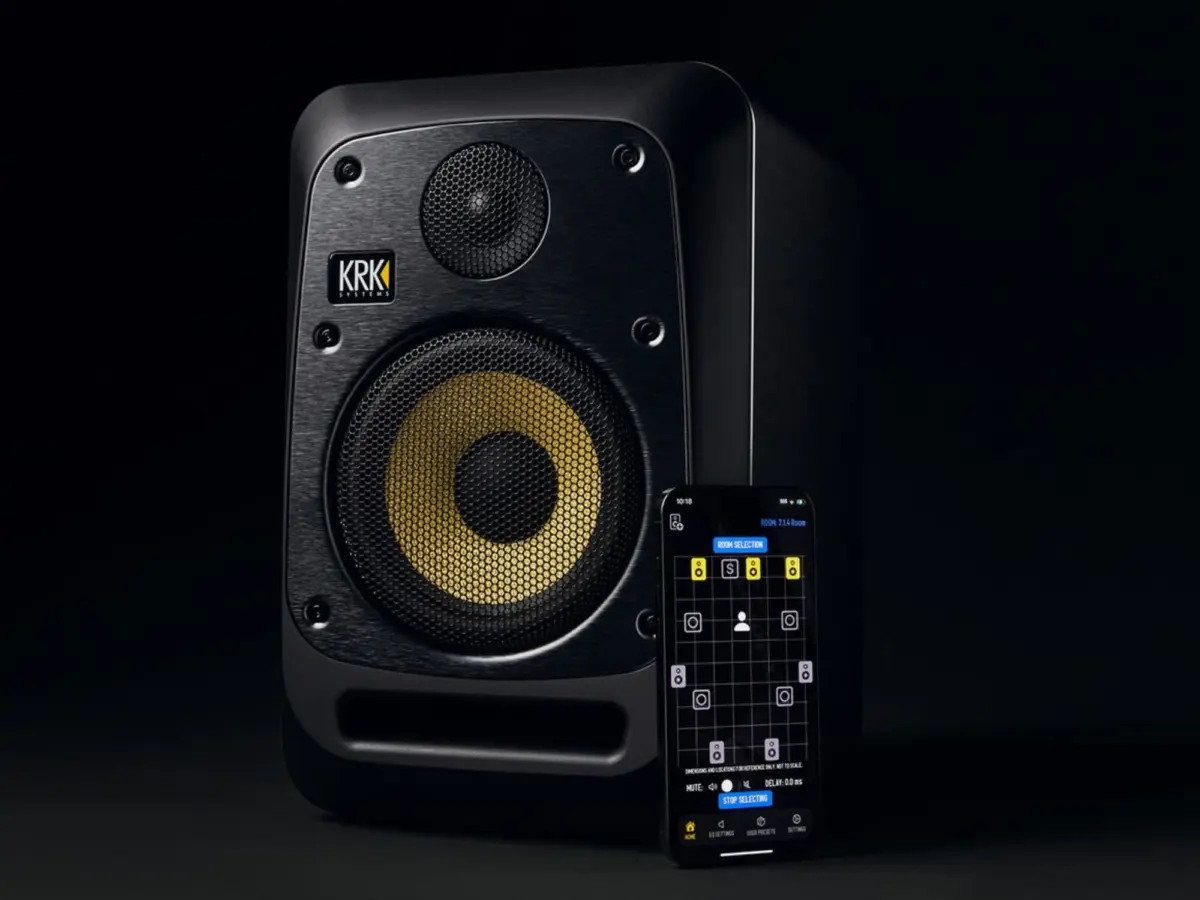
The defining breakthrough of the V Series Five is KRK Mesh. Utilizing wireless connectivity, KRK Mesh allows producers and engineers to interact with their monitoring environment via the KRK Control App on a mobile device or tablet.
In a traditional studio workflow, calibrating or tweaking monitors requires crawling behind speaker stands, squinting at micro-switches, and repeatedly cross-referencing listening positions. KRK Mesh bypasses this friction entirely. Through the app, users can:
- Adjust system volume, individual speaker trim, and calibration settings remotely.
- Compare various EQ profiles on the fly from the optimal mixing position.
- Manage settings individually or group monitors together.
This grouping functionality is invaluable for multi-channel configurations. Whether an engineer is dialing in a conventional stereo pair or configuring a complex, 7.1.4 Dolby Atmos immersive audio space, adjustments can be applied uniformly across the entire array or isolated to problematic zones with a single tap.
Lineup Specifications: The V4, V6, and V8 Models
To accommodate varying control room sizes, budgetary constraints, and low-end extension requirements, the V Series Five is available in three distinct form factors:
-
KRK V4 (Compact Format):
- Woofer Size: 4-inch woven Kevlar woofer.
- Frequency Response: 48Hz to 40kHz.
- Maximum SPL: 113dB.
- Best Suited For: Mobile tracking rigs, smaller project studios, editing suites, or height channels in immersive setups where space is at a premium.
-
KRK V6 (Mid-Size Standard):

- Woofer Size: 6.5-inch woven Kevlar woofer.
- Frequency Response: 40Hz to 40kHz.
- Maximum SPL: 118dB.
- Best Suited For: Standard-sized control rooms, project studios, and versatile production environments requiring a balanced footprint with deeper low-end reach.
-
KRK V8 (Flagship Powerhouse):
- Woofer Size: 8-inch woven Kevlar woofer.
- Frequency Response: 32Hz to 40kHz.
- Maximum SPL: 121dB.
- Best Suited For: High-end commercial recording studios, heavy electronic music production, film scoring stages, and professional mastering rooms demanding high output and deep sub-bass extension.
All three models feature rugged front-ported bass-reflex enclosures—minimizing boundary coupling issues when placed near studio walls—alongside versatile Neutrik combo XLR/TRS connectivity supporting both standard analog inputs and professional AES3 digital inputs. Furthermore, every unit ships with a removable protective grille and integrated mounting points, catering seamlessly to both desktop and permanent architectural installations.
Official Statements and Industry Perspective
KRK’s development team has emphasized that the V Series Five was born from direct dialogue with working professionals across multiple genres.
"The modern producer and mixing engineer moves faster, works in more diverse spatial formats, and demands greater precision than ever before," noted a representative during the global launch. "With the V Series Five, we didn’t just want to build another accurate speaker. We wanted to eliminate the physical barriers between the engineer and their acoustic environment. By integrating KRK Mesh and advanced DSP tools with our legendary transducer designs, we are giving creators a monitoring system that adapts natively to how they work today—and how they will work tomorrow."
Industry analysts point out that the introduction of wireless control architectures into studio monitors signifies a broader trend toward software-defined hardware. As digital audio workstations (DAWs) and spatial mixing platforms absorb more operational focus, hardware manufacturers are under pressure to make physical studio integration as seamless as software plugins. By addressing the tediousness of hardware calibration, KRK has positioned the V Series Five as an efficiency-multiplier for professional engineers working under tight deadlines.
Future Outlook
The launch of the KRK V Series Five arrives at a critical juncture in the audio production landscape. As immersive audio formats like Dolby Atmos transition from high-end luxury studios to project-level facilities, the complexity of studio architecture is skyrocketing. The days of simply plugging in a pair of left and right monitors and calling it a day are giving way to sophisticated, multi-channel ecosystems that demand dynamic calibration and rigorous phase alignment.
By anchoring its flagship range in time-tested physical engineering—such as custom Kevlar cones, silk domes, and heavy-duty Pascal amplification—while simultaneously embracing wireless mesh networking and advanced DSP, KRK has future-proofed its reference monitor line.
For producers, film scorers, and mixing engineers navigating the increasingly demanding requirements of modern spatial and stereo production, the V Series Five offers a compelling proposition: uncompromising acoustic translation combined with the operational agility required to stay ahead in a fast-moving industry. As these monitors hit the market, they are poised to become a familiar sight—and sound—in control rooms worldwide, bridging the timeless pursuit of sonic truth with the effortless control of the digital age.