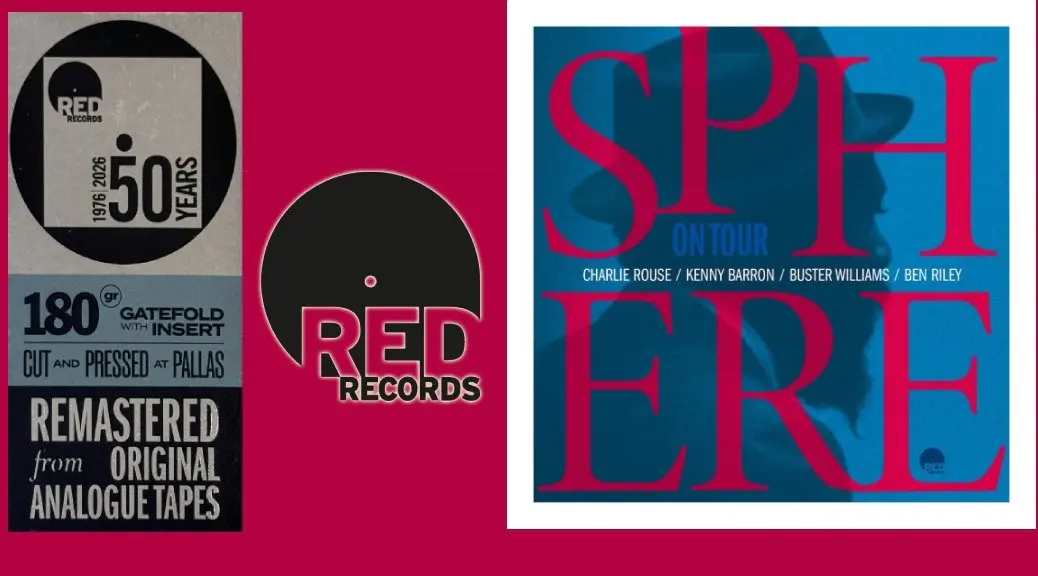
Forty years after its initial pressing by Italy’s esteemed Red Records, the historic live recording On Tour by the legendary jazz supergroup Sphere has returned to the physical marketplace. Remastered directly from the original analogue tapes, cut and pressed on 180-gram audiophile vinyl at Germany’s Pallas plant, and packaged in a deluxe gatefold sleeve limited to 3,000 individually numbered copies, this release serves as both a historical preservation and a vital reminder of an elite ensemble. Coinciding with Red Records’ golden jubilee, this archival reissue illuminates a pivotal, yet historically under-discussed, chapter in modern jazz history.
Formed in the early months of 1982, Sphere brought together four heavyweight modernists: pianist Kenny Barron, bassist Buster Williams, drummer Ben Riley, and tenor saxophonist Charlie Rouse. Far from being a casual pick-up band or a fleeting repertory exercise, Sphere was structured as a fiercely independent business cooperative. Having spent decades navigating the precarious economic and artistic conditions of the mid-century jazz industry, the founding quartet insisted on absolute artistic control, complete with their own publishing and recording entities.
What began as a shared vision to honor the architectural genius of Thelonious Monk rapidly metastasized into a singular, forward-looking contemporary jazz unit. Although the group’s recorded output—spanning two studio albums for Elektra Musician, a pair for Verve, and foundational dates for Red Records—remains frustratingly lean relative to their immense caliber, their legacy stands untouched. As living founding members Kenny Barron and Buster Williams continue to perform into their eighties, On Tour captures Sphere at a critical juncture: transitioning from a reverent repertory tribute into a fearless, self-sustaining laboratory for contemporary acoustic jazz composition and improvisation.
Detailed Chronology
Genesis and the Shadow of Monk (1981–1982)
The conceptual architecture of Sphere was erected through months of deliberate conversation throughout 1981. Barron, Williams, Riley, and Rouse frequently convened to discuss not merely setlists and voicings, but the business realities of the music industry. Each member brought decades of road-tested wisdom harvested from sideman duties with jazz royalty; they understood acutely why artistic and financial autonomy were non-negotiable for creative survival.
It was Kenny Barron who supplied the ensemble’s evocative moniker. "Sphere" was drawn from the middle name of Thelonious Monk, which in turn had been inherited from Monk’s maternal grandfather, Sphere Batts. In an ultimate gesture of reverence, the newly incorporated cooperative decided that their debut album would be dedicated exclusively to Monk’s idiosyncratic compositions.
That project, titled Four in One, was booked into Rudy Van Gelder’s legendary Englewood Cliffs studio in New Jersey for a ten o’clock session on a crisp February morning in 1982. Tragically, unknown to the musicians, Thelonious Monk had passed away at his home just two hours earlier, at 8:00 AM.
Driving home that afternoon after dropping Buster Williams off in New York City, Kenny Barron heard the news broadcast on a local jazz station. A session originally intended as a living tribute to a reigning master instantly transformed into the world’s first posthumous memorial record on wax. Williams later noted the poignant irony of the date: they had approached the studio with the singular ambition to record music that Monk himself would hear, evaluate, and digest.
The Anatomy of a Rhythm Section
The foundation of Sphere rested upon a pre-existing rhythmic telepathy. Barron, Williams, and Riley had spent the mid-1970s anchoring the celebrated quartet of bassist Ron Carter. It was within Carter’s boundary-pushing band—where Carter famously experimented with the piccolo bass, leaving Williams to shoulder the foundational low-end frequencies—that their synergy was forged and subsequently captured live at New York’s Sweet Basil on the album Piccolo.
Outside of their work with Carter, the trio operated as a tight-knit unit, maintaining several Monk compositions in their active repertoire. However, navigating three fiercely busy professional schedules left virtually no room to rehearse and lock in a fourth, frontline voice. Seeking a saxophone partner who shared their historical fluency and harmonic audacity, Ben Riley recalled reaching out to Charlie Rouse. They booked a tentative weekend residency at a Manhattan club on 72nd Street. By the final set of that weekend, the psychic architecture of Sphere was fully cemented.
Pedigrees and Lineages
The four members of Sphere brought divergent yet deeply complementary lineages to the bandstand. Half the group traced its DNA directly through the engine room of Thelonious Monk’s legendary working bands, while the other half brought external, modern perspectives.
- Charlie Rouse (Tenor Saxophone): Born in Washington, D.C., in 1924, Rouse possessed a jazz pedigree matched by few of his contemporaries. His early career read like a historical index of American orchestral jazz, featuring major stints in Billy Eckstine’s bebop incubator, Dizzy Gillespie’s foundational big band, and Duke Ellington’s sophisticated orchestra, alongside co-leading The Jazz Modes with French horn innovator Julius Watkins. However, it was his historic, unbroken eleven-year tenure alongside Thelonious Monk—joining in 1959 and remaining until 1970—that defined his legacy. No horn player spent as many consecutive years at Monk’s side, absorbing the master’s angular phrasing and spatial economy.
- Ben Riley (Drums): Born in Savannah and raised in New York, Riley served as an Army paratrooper before establishing himself as an elite timekeeper. His curriculum vitae included high-profile associations with the Eddie "Lockjaw" Davis–Johnny Griffin quintet, Sonny Rollins, Stan Getz, and Alice Coltrane. Yet, it was his three-year run within Monk’s 1964 quartet alongside Rouse that permanently etched his name into the jazz pantheon.
- Kenny Barron (Piano): Hailing from Philadelphia and carrying the torch as the younger brother of tenor saxophonist Bill Barron, Kenny emerged as one of the most sophisticated pianists of his generation. After cutting his teeth in Dizzy Gillespie’s early-1960s quintet, Barron passed through the bands of Yusef Lateef, Freddie Hubbard, and Ron Carter, later cementing a celebrated, career-defining partnership with Stan Getz through the 1980s. Crucially, Barron had never played in Monk’s band—a distinction that injected a fresh, harmonically expansive voice into Sphere’s collective dialogue.
- Buster Williams (Bass): A native of Camden, New Jersey, Williams was thrust onto the professional touring circuit immediately out of school, backing organ-trio titans Gene Ammons and Sonny Stitt. Vocal royalty followed, with Betty Carter, Sarah Vaughan, and Nancy Wilson all retaining his services. From 1969 to 1973, Williams provided the oceanic bottom end for Herbie Hancock’s pioneering, electric-acoustic Mwandishi sextet. Like Barron, Williams’s lack of a direct Monk pedigree allowed him to reinterpret the group’s harmonic foundations through a lens shaped by post-bop modalism and avant-garde jazz-funk.
International Touring and the Red Records Era
As documented on their historic concert recording in Bologna, Italy—produced by Sergio Veschi and Alberto Alberti’s Milan-based Red Records (founded in 1976)—Sphere had rapidly evolved far beyond a traditional tribute band.
Their structural blueprint, initially established on sophomore Elektra Musician release Flight Path and detailed explicitly in Rouse’s liner notes, relied on an exquisite compositional balance: four original pieces authored from within the cooperative, one jazz standard, and a solitary nod to Thelonious Monk.
On Tour adhered to this rigid formula with a fascinating internal twist. Every single original composition performed on the date was contributed by either Barron or Williams—the two members who had never played in Monk’s ensemble. In a masterclass of structural pacing, Monk’s compositions were deliberately withheld until the very final moments of the performance.
Following their Italian dates, Red Records welcomed the ensemble back to Europe the subsequent summer for a celebrated performance at the Umbria Jazz Festival in Perugia—a concert later issued in its complete, unedited form. These European live documents, framed by their studio dates for Elektra and their concluding Verve recordings of the late 1980s, constitute a fiercely concentrated, high-water mark discography.
Supporting Context & Metrics
To understand the cultural weight of Sphere’s 1980s output, one must analyze the commercial and artistic ecosystem of acoustic jazz during the Reagan era. While the mainstream commercial market was heavily incentivized toward smooth jazz, fusion, and commercial crossover projects, acoustic hard bop and modal modernism were largely relegated to independent European labels or boutique domestic imprints.

| Album / Release | Year | Primary Label | Key Composers / Repertoire Focus |
|---|---|---|---|
| Four in One | 1982 | Elektra Musician | 100% Thelonious Monk compositions |
| Flight Path | 1983 | Elektra Musician | 4 Originals, 1 Standard, 1 Monk tune |
| On Tour (Live in Bologna) | 1985 | Red Records | Barron/Williams originals, Standards, Monk finale |
| Sphere Live at Umbria Jazz | 1986 | Red Records | Extended live repertoire, original compositions |
| Four in One (Verve Era) | Late 80s | Verve Records | Final studio statements of the Rouse-era lineup |
Musical Analysis of On Tour
Side one of the remastered vinyl reissue opens with Buster Williams’s composition "Dual Force," an uncluttered, muscular theme whose opening melodic phrase offers a subtle, knowing nod to the standard "Invitation." Barron delivers a blistering, high-speed solo marked by unyielding precision and impeccable time, leading into a tightly wound coda that resolves with breathless efficiency.
This is followed by "Beautiful Friendship," a staple of the band’s early club repertoire that swings with brilliant, uninhibited joy. Barron takes the initial lead, while Rouse digs in with ferocious intensity over the interlocking rhythmic grid laid down by Williams and Riley, puncturing his lines with the clipped, staccato articulations forged during his decade with Monk. Side one concludes with Barron’s "Scratch," easily the record’s most structurally adventurous excursion. The theme is jagged and asymmetrical. During Rouse’s searing solo, Barron lays out entirely, dropping his piano keys to grant Williams the harmonic freedom to walk and drift away from the root changes, leaving Rouse to improvise directly off the skeletal contours of the melody itself.
Side two initiates with Buster Williams’s "Tayamisha," utilizing an unfamiliar thematic head laid across a traditional twelve-bar blues structure. Rouse approaches the changes with remarkable patience, gradually expanding his phrasing into free-flowing, exploratory territory, while Williams contributes an improvised solo defined by intellectual wit and structural clarity.
Barron’s "Spiral" unfolds with the architectural scale of a modern chamber suite. It begins as a lush, rhapsodic ballad before abruptly shifting gears into a brisk, driving Latin vamp, inspiring Rouse to deliver some of the most commanding, forceful tenor work of his career.
The album reaches its conceptual climax with its sole Monk selection: "Well, You Needn’t." Rather than playing the classic arrangement straight, Sphere retains the foundational melody and chord progression of Monk’s original tune but superimposes an entirely new, angular counter-riff across the opening choruses. Brief, incisive solos quickly give way to a telepathic three-way conversation between piano, bass, and drums. As a closing artistic statement defining what Sphere had ultimately become—an autonomous unit paying homage to their spiritual godfather while boldly charting their own geographic coordinates—it could hardly have been articulated more clearly.
Official Statements & Archival Perspectives
Reflecting on the formation of the group, bassist Buster Williams underscored the cooperative ethos that kept the band anchored through shifting industry tides:
"We had all spent enough years paying dues on other people’s bandstands to understand that artistic vision without business infrastructure is simply a recipe for exploitation. When we formed Sphere, we weren’t just putting together a quartet to blow over changes; we were establishing a corporation where artistic and administrative control belonged entirely to the creators."
Drummer Ben Riley, recalling the logistical hurdles of finding a matching frontline voice to complement the pre-existing rhythm section, noted:
"Kenny, Buster, and I had a specific musical language already dialed in from our years with Ron [Carter]. We needed a horn player who didn’t just read charts, but who lived inside the modern jazz tradition. Bringing Charlie [Rouse] into a club on 72nd Street for a weekend trial run changed everything. By the second night, there were no questions left to ask."
In the original liner notes for the band’s studio recordings, Charlie Rouse contextualized their delicate balancing act between historical preservation and contemporary creation:
"Playing Monk’s music is an education in space and economy, but a working band cannot survive as a museum piece. Our mandate was to take the lessons we learned from the masters, apply our own contemporary compositional voices through Kenny and Buster, and forge a new vocabulary that honors the past while aggressively looking toward the future."
Future Outlook
The release of On Tour on 180-gram audiophile vinyl via Pallas, paired with comprehensive English and Italian liner notes by Giuseppe Piacentino, closes an important circle for contemporary jazz preservation. Yet, it also prompts a broader evaluation of how modern jazz heritage is curated, protected, and transmitted to younger generations of listeners.
The human landscape of Sphere has inevitably shifted over the decades. Charlie Rouse passed away in Seattle in November 1988, just months after completing his final recordings with the ensemble. When Sphere briefly regrouped in 1997 to honor their legacy, the remaining founders selected visionary alto saxophonist Gary Bartz to fill the frontline vacancy. Ben Riley departed this life in 2017 at the age of 84, leaving behind a masterclass in dynamic, interactive timekeeping.
Today, Kenny Barron and Buster Williams stand as two of the last active titans of the acoustic post-bop era. Both well into their eighties, they continue to perform, teach, and mentor rising generations of instrumentalists.
The reappearance of On Tour arrives at a moment of renewed cultural hunger for analogue-sourced, uncompromising acoustic jazz. As younger listeners and dedicated collectors scour the physical marketplace for authentic documentation of late-twentieth-century masterworks, the compositions penned by Barron and Williams for Sphere have lost none of their harmonic bite, rhythmic complexity, or emotional urgency. Forty years after four veterans gathered to secure their artistic destiny, Sphere proves that true musical innovation is built to outlast both trends and time.