Executive Overview
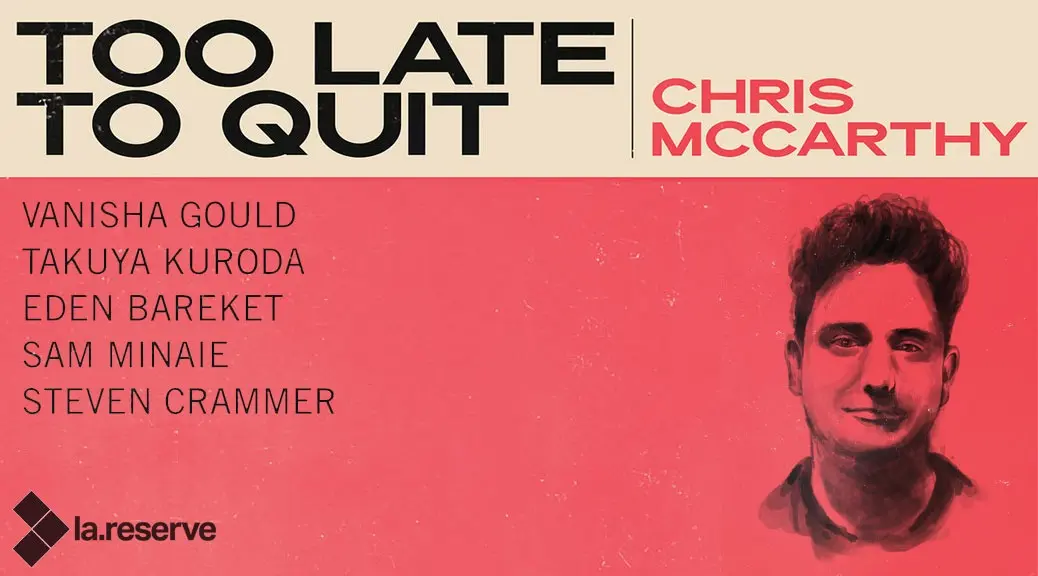
Pianist and composer Chris McCarthy has never shied away from self-examination, often titling his records like a man locked in an ongoing dialogue with his own artistic ambitions. When he released Still Time To Quit in 2020, it served as a sonic snapshot of an artist a decade into navigating the hyper-competitive, endlessly malleable jazz ecosystem of New York City. Now, with the release of his latest project, Too Late To Quit, that internal argument finally appears to be settled.
Initially toying with the concept of recording a traditional Great American Songbook album, McCarthy pivoted toward a more ambitious personal challenge: he wrote eight brand-new jazz standards of his own. Rather than interpreting historical material, he forged a contemporary repertoire and handed five of these compositions over to acclaimed vocalist Vanisha Gould. Distributed cleanly across a vinyl format—four tracks per side—the album’s tracklist structural split tells a compelling story of tension between the genre’s hallowed past and its adventurous, forward-thinking future.
The album features a powerhouse ensemble comprising Takuya Kuroda on trumpet and flugelhorn, Eden Bareket on baritone saxophone, Sam Minaie on bass, and McCarthy himself steering the keys and Wurlitzer. Throughout its runtime, Too Late To Quit explores the boundaries of modern vocal jazz, cinematic soundscapes, and angular post-bop. Yet, beneath the record’s technical brilliance lies a fascinating critical debate: a stylistic tug-of-war between the pull of nostalgic vocal jazz traditions and the unchained instrumental innovation that pulses beneath the surface. This review delves deep into the anatomy of Too Late To Quit, analyzing its track-by-track architecture, contextualizing McCarthy’s artistic trajectory, evaluating the broader implications of his collaboration with Gould, and forecasting what this pivotal release means for the future of contemporary jazz.
Detailed Chronology: A Track-by-Track Exploration of Too Late To Quit
To truly understand the narrative arc of Too Late To Quit, one must journey through its meticulously sequenced sides. The vinyl layout acts as a diptych, dividing the album’s eight original compositions into two distinct aesthetic experiences.
Side A: Atmospheric Introductions and Modern Angularity
Side A wastes no time establishing depth, opening with "Curtain Call," the longest and most immersive piece on the record. Trumpeter Takuya Kuroda draws the listener in with a smoky, deliberate introduction, while Eden Bareket envelopes the arrangement on baritone saxophone, casting a warm, enveloping shadow over the rhythm section. Vanisha Gould enters with heartfelt, sophisticated vocals rooted firmly in the classic jazz-singing mold. Her phrasing exhibits a clear reverence for masters of the past—evoking shades of vocal iconoclast Mark Murphy in her attention to lyrical cadence and emotional weight.
The mood shifts smoothly into "As If," a laid-back, blues-inflected meditation. The track begins with an intimate dialogue between piano and baritone saxophone before the full ensemble and voice drift in behind them. It is a piece content to exist as a standard-shaped vehicle for mood, unhurried and gracefully executed.
However, the album abruptly changes gear with "Overnight Excess." This is where Too Late To Quit truly hits a contemporary stride. The track is angular, sharp, and relentlessly modern. McCarthy’s piano work shines with a percussive brilliance, while Kuroda takes a blistering finale that pushes the entire band to lock into a palpable, crackling energy. It is a high-water mark for the album, showcasing a band entirely in sync with the sharper edges of 21st-century jazz.
Side A concludes with "Insomnia Waltz," which welcomes Gould back to the microphone for a contemporary vocal delivery. Intriguingly, McCarthy originally wrote this piece for ballet barre classes at the Mark Morris Dance Group. This origin accounts for the piece’s rigid, captivating rhythmic count, though it scarcely hints at the immense physical and creative effort Kuroda, Sam Minaie, and McCarthy pour into the instrumental undercurrent beneath Gould’s vocal line.
Side B: Wurlitzer Grooves, Urban Soundscapes, and Sonic Circularity
Flipping the record over to Side B reveals an immediate stylistic pivot. "Tuck and Draw" features McCarthy on the Wurlitzer electric piano, offering a refreshing, earthy break from the acoustic precision of Side A. The track captures a band visibly and audibly having fun, injecting a sense of playful propulsion into the sequence.
Things take a dramatically urban turn with "MTA (Much Too Angry)." Here, the hectic, claustrophobic sensory overload of the New York City subway system is rendered entirely in brass and rhythm. Kuroda screeches and bellows through his horn, the piano takes on jagged, industrial shapes, and Gould—for once stepping back from the lyrical frontline—supplies wordless vocal colors that weave through the metallic chaos.
By the time the needle reaches "After All"—the shortest track on the album—Gould is firmly back center stage. The style sits squarely with the traditional vocalists of yesteryear. While the performance is superbly executed, it introduces a subtle structural friction: the rigid traditionalism of the vocal vehicle inherently restricts the band, preventing them from stretching out. The untamed, exploratory playing heard earlier on tracks like "Overnight Excess" and "Tuck and Draw" feels like an entirely different beast compared to the polite constraints of this vocal standard.
The album closes with "Sonder," a mysterious, deeply atmospheric piece centered on Bareket’s rich baritone saxophone. The band gradually lifts the composition toward a cinematic grandeur. Notably, "Sonder" borrows its name from McCarthy’s 2007 debut album and cleverly revisits that record’s opening theme. A melody that a vocalist once carried wordlessly on his earlier work now belongs entirely to the baritone saxophone, making for a poignant, circular, and fitting end to the album.

Supporting Context & Metrics: The Evolution of Chris McCarthy
To contextualize Too Late To Quit, one must look at the mathematical and artistic arithmetic underpinning Chris McCarthy’s career. Over the past decade, McCarthy has established himself as a vital fixture of the New York jazz underground, collaborating with a diverse array of instrumentalists and vocalists. However, Too Late To Quit represents a crucial tipping point in his discography.
Numerically speaking, the album’s track distribution fuels a compelling critical debate. Across its eight songs, Gould takes the limelight on five tracks. While her performances are unfalteringly pristine and superbly sung, her dominance tilts the stylistic pendulum backward every time she steps up to the mic. Conversely, the three purely instrumental tracks point toward a wider, more contemporary audience—one eager to hear McCarthy and his ensemble stretch the boundaries of modern post-bop harmony.
This tension raises questions about identity and authorship. For an album bearing Chris McCarthy’s name on the spine, the heavy presence of vocal-led standards occasionally feels like a detour from his formidable instrumental capabilities. Yet, this push-and-pull is precisely what makes the record fascinating. It captures an artist wrestling with accessibility versus abstraction, tradition versus innovation.
Furthermore, this release arrives on the heels of an intensely collaborative period. With Gould releasing her own collaborative project with McCarthy shortly after this record, the pianist finds himself at a crucial crossroads. Whether this ongoing pairing will ground McCarthy in a more traditional, vocal-centric stylistic corner or launch him into uncharted instrumental territory remains one of the most compelling storylines in contemporary jazz.
Official Statements and Critical Reception
In interviews and liner notes surrounding the rollout of Too Late To Quit, McCarthy has reflected on the decade-long journey that led him from the exploratory optimism of Still Time To Quit (2020) to the decisive closure of this new release. The title itself—Too Late To Quit—functions as an artistic declaration. It acknowledges the exhaustion, perseverance, and ultimate surrender required to commit fully to a life in creative music within one of the world’s most demanding cultural hubs.
Jazz critics and industry insiders have been quick to praise the album’s technical mastery. Reviewers have lauded the exceptional interplay between Kuroda and Bareket, noting how the combination of trumpet and baritone saxophone creates a unique sonic signature that immediately sets McCarthy’s arrangements apart from standard piano-trio configurations.
However, critical discourse has also zeroed in on the stylistic dichotomy highlighted earlier. Jazz purists have celebrated the record’s seamless integration of classic vocal phrasing with modern harmonic voicings, praising Gould’s ability to navigate McCarthy’s intricate original compositions with apparent ease. On the other hand, progressive jazz critics have echoed the sentiment that when the rhythm section is unleashed on instrumentals like "Overnight Excess" and "Tuck and Draw," the music achieves a level of visceral excitement that occasionally outshines the more restrained vocal numbers. This duality has sparked lively debates across jazz publications regarding whether McCarthy’s future lies in vocal accompaniment or uncompromising instrumental exploration.
Future Outlook: What Lies Ahead for Chris McCarthy and Modern Vocal Jazz
As Too Late To Quit makes its way onto turntables and streaming platforms worldwide, it opens up several fascinating avenues for the future of Chris McCarthy’s career.
First, the commercial and critical reception of this album will likely dictate the balance of his upcoming projects. With his creative partnership with Vanisha Gould continuing to bear fruit—manifesting in her upcoming companion release—audiences can expect this collaborative synergy to deepen. Whether this partnership cements a permanent shift toward vocal-forward jazz composition or simply serves as a fertile chapter in a continuously evolving career is a question time will answer.
Second, the instrumental brilliance displayed on tracks like "Overnight Excess," "MTA (Much Too Angry)," and the self-referential "Sonder" proves that McCarthy possesses a potent compositional voice that requires no lyrical translation to connect with listeners. The sophisticated manner in which he recontextualizes themes from his 2017 debut demonstrates an artistic maturity and self-awareness rare among artists of his generation.
Ultimately, Too Late To Quit is not merely a collection of songs; it is a masterclass in artistic tension. It captures a brilliant bandleader negotiating the space between yesterday’s jazz standards and tomorrow’s harmonic horizons. Whether McCarthy ultimately leans into the instrumental avant-garde or continues to refine the vocal-jazz paradigm he explores here, one thing is certain: the internal argument is settled, but the music has never been more alive.