Executive Overview
For the first time in British exhibition history, the complete Thirty-six Views of Mount Fuji—masterpieces created by the legendary Japanese ukiyo-e artist Katsushika Hokusai between 1830 and 1833—are being displayed together under one roof. Housed at the prestigious Dulwich Picture Gallery in London, this landmark exhibition draws from the esteemed Iuchi Collection, bringing to the UK a rare assemblage of all 46 prints (comprising the original 36 views alongside ten supplementary designs added after the series achieved runaway commercial success).
Created when Hokusai was already in his seventies, these woodblock prints were originally mass-produced as inexpensive commodities for ordinary citizens in Edo (modern-day Tokyo). Today, they are revered as pinnacles of graphic art and world culture. Yet, beyond their undeniable technical brilliance—characterized by the striking use of Prussian blue and organic pigments—the collection offers a profound psychological journey.
This review-driven journalistic analysis explores the exhibition not merely as an art-historical milestone, but as a lens through which human perception, mentalizing, and the psychology of awe are examined. By bringing Under the Wave off Kanagawa (universally known as The Great Wave) out of isolation and placing it into direct dialogue with lesser-known prints of laborers, pilgrims, and sweeping landscapes, the Dulwich Picture Gallery challenges viewers to dismantle static interpretations of art—and of one another.
Detailed Chronology: The Genesis and Evolution of Hokusai’s Masterpiece
To understand the magnitude of the Dulwich Picture Gallery exhibition, one must trace the historical and creative timeline of Hokusai’s late-life masterwork.
1. The Early 1830s: A Septuagenarian’s Vision
By 1830, Katsushika Hokusai had already lived a long and tumultuous life as an artist, perpetually restless and constantly reinventing his style. Entering his seventh decade—an advanced age in 19th-century Japan—Hokusai embarked on what would become his most defining project. Commissioned during a period of rising domestic tourism and a booming interest in climbing Mount Fuji as a spiritual pilgrimage, the series captured the cultural zeitgeist of Edo-period Japan.
2. The Mechanics of Mass Production
Contrary to the elite, one-of-a-kind status fine art often commands today, Hokusai’s Thirty-six Views were designed for the masses. Executed through the collaborative ukiyo-e publishing system—which required the synchronized efforts of a publisher, designer, woodblock carver, and printer—these prints were affordable enough for common townspeople. The introduction of synthetic Prussian blue imported from Europe infused the prints with vibrant, light-resistant pigments that revolutionized Japanese landscape art, giving skies and waters an unprecedented psychological depth.
3. Expansion: From 36 to 46 Views
The series resonated so deeply with the public that the initial run of 36 prints was expanded by an additional ten designs. These later additions further explored the mountain from unexpected angles, weather conditions, and seasonal shifts. It is this complete roster of 46 prints from the Iuchi Collection that now lines the walls of the Dulwich Picture Gallery, remaining on view until January 17, 2027.
Supporting Context & Metrics: The Art, The Psychology, and The Exhibition Space
The Visual Anatomy of the Series
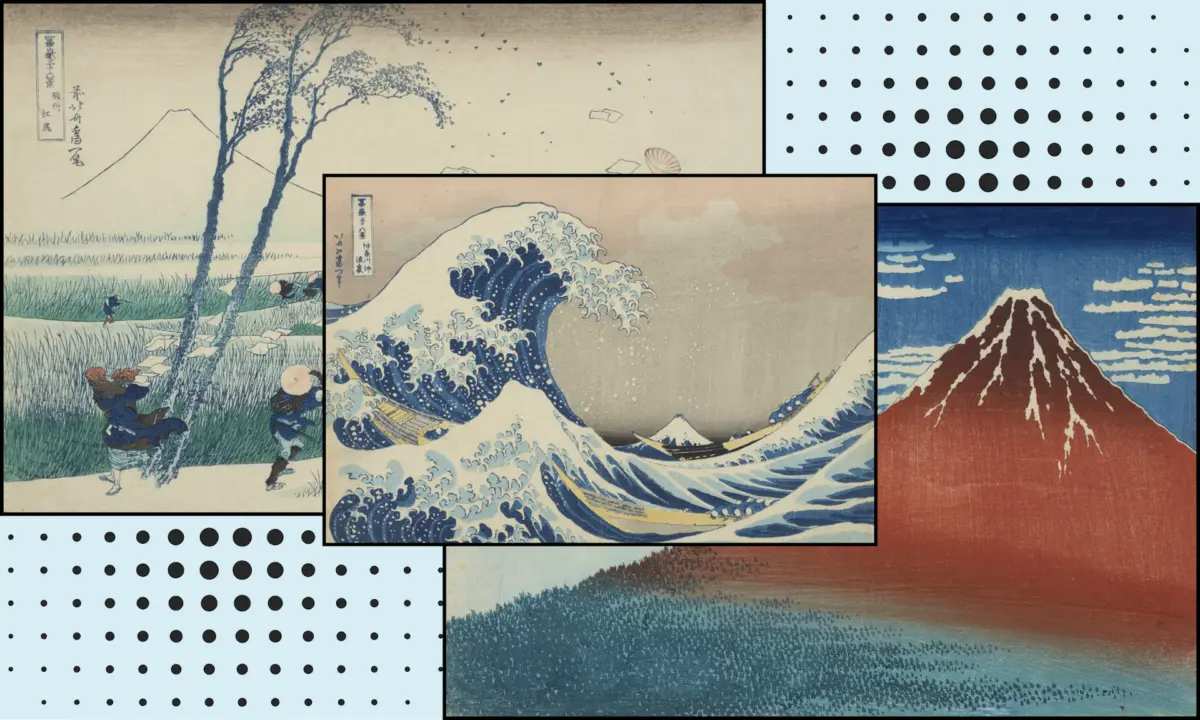
Walking through the exhibition’s first room, visitors are immediately met with three distinct interpretations of Mount Fuji hanging in close proximity:
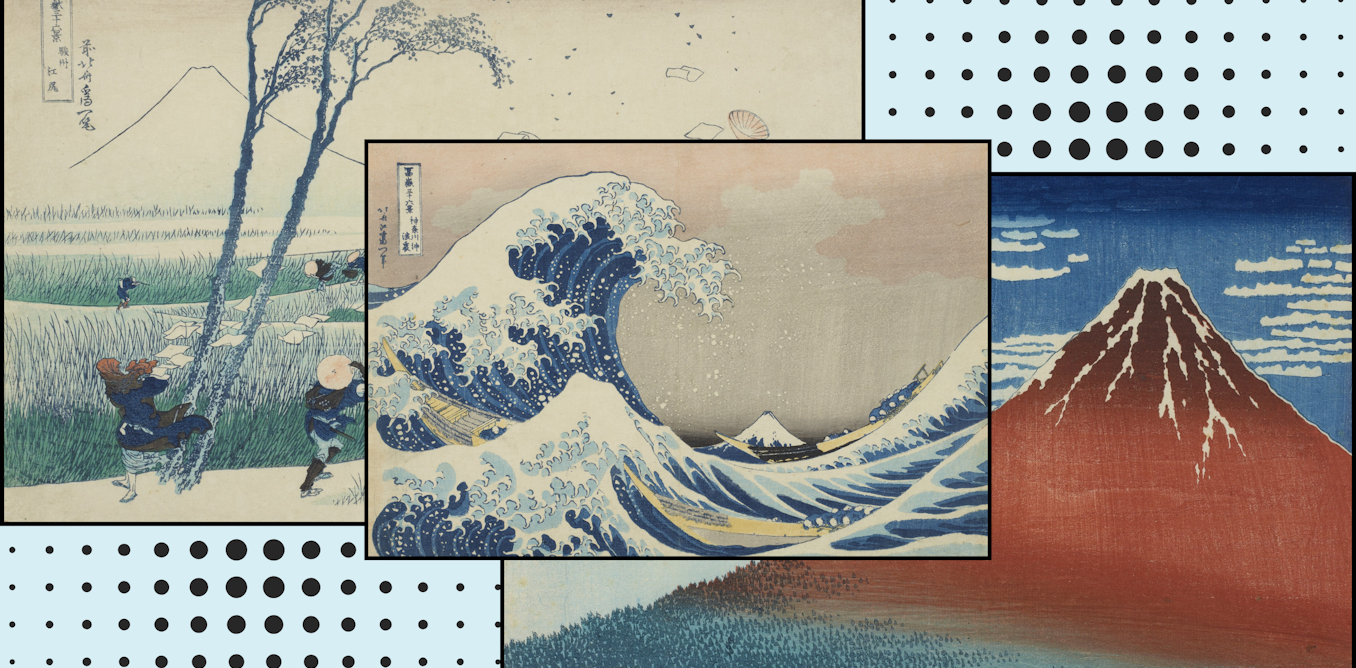
- Clear Day with a Southern Breeze (Red Fuji): Characterized by a lustrous, warm red resonating against a receding blue sky, this print reduces the mountain to almost pure, monumental form, softened only by gentle cloud formations and a meticulous cluster of tiny trees at its base.
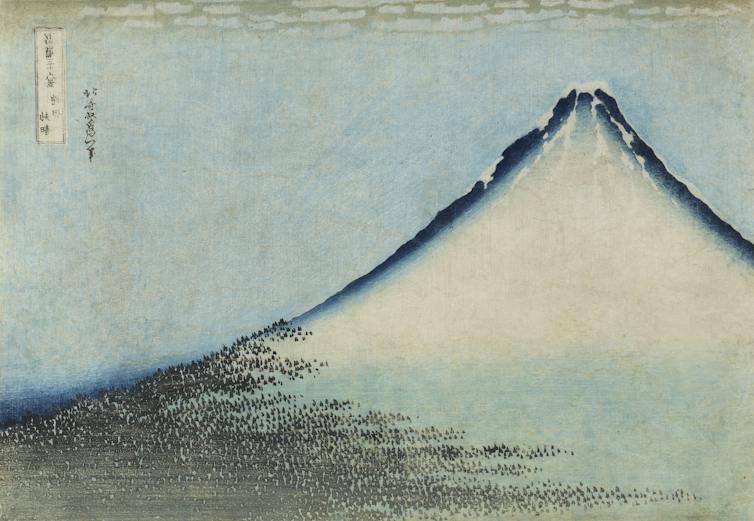
- The Blue Fuji Variant: Featuring a light-blue body edged in heavy indigo, this version opens a cooler, more cavernous visual pathway into the mountain.
- The Storm-Ravaged Fuji: A third iteration shows the mountain marred by lightning-like cracks resembling a shattered ceramic pot, casting a dark, unsettled mood over the landscape.
Across the room hangs The Great Wave off Kanagawa. In isolation, The Great Wave is a ubiquitous global icon. However, viewed within the context of the complete series, it shifts from an isolated masterpiece into a single narrative thread. The wave’s foaming crests reach out like grasping, knuckled fingers while flecks of spray scatter like stars. Yet, beneath the chaotic motion, the composition maintains a striking stillness, framing a tiny, triangular Mount Fuji in the distance—the very same mountain seen in the expansive Red Fuji, now entirely reframed by the tumultuous sea.
The Psychology of Perspective and Mentalizing
As the exhibition progresses, Hokusai transports the viewer across bridges, agricultural fields, and mountain passes. Figures hurry along roads or gaze out from temple halls. In one arresting print, Mishima Pass in Kai Province, travelers link arms around an enormous tree. At first glance, an observer might interpret the gesture as an affectionate, emotional embrace—only to realize they are likely measuring the tree’s massive girth.
This perceptual shift touches on a core psychological concept known as mentalizing—the innate human capacity to imagine what others are thinking and feeling based on our own internal states. As art psychotherapists note, the danger in mentalizing lies in rushing to assumptions rather than lingering in curiosity. Just as the viewer readily projects emotional warmth onto strangers from 1830s Japan, modern society constantly misinterprets the complex inner lives of contemporaries.
Furthermore, Hokusai’s towering trees and sweeping vistas tie directly into empirical research on the emotion of awe. Psychological studies show that individuals who gaze up at towering natural structures—such as giant eucalyptus trees—for even a brief period exhibit heightened prosocial behavior, demonstrating that encounters with vast, sublime landscapes temporarily reduce self-absorption and increase connection to the wider world.
Official Statements and Curatorial Insights
While the exhibition’s art historical importance is undisputed, critics and curators have offered nuanced perspectives on the staging of the works.
The Dulwich Picture Gallery’s curation utilizes dusky blue walls designed to mirror Hokusai’s signature Prussian palettes. The soft lighting creates a hushed, contemplative atmosphere, allowing visitors to commune quietly with the prints. However, some aesthetic commentators have noted that the physical arrangement occasionally risks isolating individual pieces too strictly:
"The curation is less subtle than the prints. Its dusky blue walls echo Hokusai’s colours, but I was left cold. I felt fixed as a viewer, each picture held apart when I wanted to see how they connect — although the soft lighting creates an atmosphere, a quietness that simply lets you be with them."
As visitors move toward the final gallery space, the narrative reaches its physical and spiritual climax. Pilgrims are depicted climbing directly into the rugged terrain of Mount Fuji, eventually crowding together into a rocky shelter near the summit. Here, the curatorial intent becomes clear: the viewer is no longer merely observing a distant geographical landmark from afar. Instead, they are drawn inward, merging with a collective community of travelers making an arduous, shared ascent.
Future Outlook
The exhibition Hokusai: Thirty-six Views of Mount Fuji from the Iuchi Collection stands as a watershed moment for UK cultural institutions, offering rare access to a delicate and irreplaceable body of work. Running at the Dulwich Picture Gallery until January 17, 2027, the event provides art enthusiasts, historians, and psychologists alike with a profound lesson in perspective.
In an era dominated by polarized viewpoints and rapid, superficial judgments, Hokusai’s multi-faceted monument serves as a timeless reminder. Whether looking at a mountain, a raging ocean, or a fellow human being, settling on a single, rigid view is a fundamental misunderstanding of reality. True appreciation—much like Hokusai’s complete vision—requires patience, curiosity, and the willingness to observe the subject through every shifting season, weather condition, and human experience.