Executive Overview
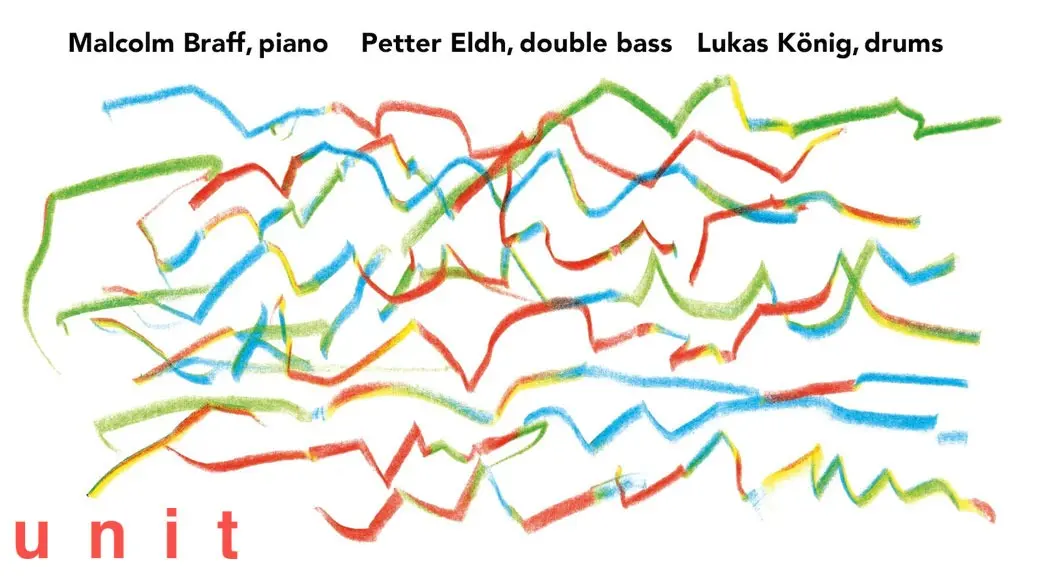
In the contemporary landscape of improvised music, few artists approach the piano with the philosophical rigor and somatic detachment of Malcolm Braff. Known for viewing his instrument not as a personal extension of identity, but merely as a familiar conduit for physical action, Braff has spent decades peering past the traditional guardrails of jazz. His latest release, the concise yet deeply immersive record Outside, stands as a masterclass in this philosophy. Featuring Swedish bassist Petter Eldh and Austrian drummer Lukas König, the album is less a collection of songs than a laboratory for exploring the elasticity of time.
Braff’s approach is rooted in more than twenty years of rigorous academic and practical research into the "mechanics of swing"—work that has culminated in his ambitious, witty "Generalized Theory of Swing" at Jazzcampus Basel. By treating time not as a linear metronome, but as undulations and waves, Braff—alongside Eldh’s relentless curiosity and König’s whiplash percussion—manages to dismantle musical conventions without alienating the listener. The resulting record is an intellectual puzzle wrapped in an intensely visceral, emotionally resonant experience. This review-driven profile examines the philosophy, global heritage, and avant-garde mechanics behind one of the most intellectually stimulating trios working in European jazz today.
Detailed Chronology & Musical Evolution
Formative Years and Global Roots
While Braff’s academic base is firmly planted in Switzerland, his artistic DNA is fiercely cosmopolitan. Born in Rio de Janeiro, Brazil, to a missionary father, Braff experienced a childhood defined by cultural displacement and geographical fluidity. Growing up across Cape Verde and Senegal before ultimately settling in the Swiss confederation, Braff absorbed a rich tapestry of rhythmic frameworks that would quietly subterranean his later European conservatory training.
Despite this global journey, Braff resists the romanticized label of the "citizen of the world," preferring to see himself simply as an artist shaped by immediate environments and deep-seated human connections. Among these, none proved more profoundly formative than his decade-long collaboration with Burkinabe percussionist Yaya Ouattara. Working side-by-side with Ouattara, whom Braff regards "more than a brother," fundamentally altered the pianist’s rhythmic vocabulary. Ouattara’s djembe effectively took the place of a traditional drum kit in Braff’s early configurations—a dynamic immortalized on the critically acclaimed 2006 live album Yele, released via Unit Records. This foundational embrace of West African polyrhythms laid the groundwork for Braff’s lifelong obsession with groove, pulse, and temporal distortion.
The Evolution of the Trio: Enter Eldh and König
As Braff’s artistic vision matured, he sought collaborators who could match his analytical yet deeply instinctual approach to improvisation. He found his ideal foil in Swedish bassist Petter Eldh—an artist renowned for his relentless curiosity and forward-thinking harmonic palette—and Austrian drummer Lukas König, whose playing is characterized by a "whiplash styling" that keeps listeners perpetually on the edge of their seats.
This current iteration of the trio finds its ultimate expression on Outside. Though the release sits closer to an EP than a full-length LP in terms of duration, it defies conventional metrics of scale. As the old adage goes, time is relative; within the dense, microtonal, and rhythmically skewed universes of tracks like "3TOES" and the arrestingly titled opener "Viennese Gröt à la Berlinaise," the constraints of clock-time dissolve entirely.
Supporting Context & Metrics: The "Generalized Theory of Swing"
To truly understand the sonic architecture of Outside, one must look toward Braff’s pedagogical and theoretical work at Jazzcampus Basel. For over two decades, Braff has dedicated himself to parsing the hidden anatomy of groove. The result of this exhaustive research is his "Generalized Theory of Swing"—a conceptual framework that investigates the "distortion of time as perceived by the listener."
The Mathematics and Somatic Reality of Time
In classical and traditional jazz pedagogy, swing is often taught as a static ratio of eighth notes (such as triplet-based swinging). Braff, however, views swing as a dynamic, psychological phenomenon. By manipulating micro-intervals, anticipations, and retardations, a musician can warp the listener’s internal clock.
- Linear vs. Wave Time: Braff rejects the notion of time as a straight line moving from past to future. Instead, he conceptualizes time as a series of waves—ebbing, flowing, accelerating, and compressing.
- The Somatic Instrument: Braff’s technique involves what he calls "getting out of the way." Rather than focusing on self-aggrandizement or cultivating a signature "personal voice," Braff believes that the act of physical playing is sufficient unto itself. By viewing the trio as a single unified instrument rather than three isolated players (piano, bass, drums), Braff relinquishes ego in favor of collective somatic action.
This theoretical underpinning explains why Outside is simultaneously disorientating and deeply accessible. While the music’s intellectual scaffolding is complex enough to satisfy the most stringent conservatory academic, its emotional delivery bypasses the analytical mind entirely, striking the listener at a visceral, gut level first.

Official Statements & Artistic Perspectives
In reflective moments regarding his craft, Braff has consistently downplayed the mythology of the virtuoso soloist, choosing instead to focus on interpersonal musical dynamics and immediate physical sensations.
"What power am I having on the music?"
— Malcolm Braff, reflecting on his internal dialogue during performance. Rather than listening to his own output in real-time, Braff gauges his success by the tangible, vibrational impact his playing exerts upon his fellow ensemble members.
Further elucidating his relationship with the piano, Braff notes:
"This is not what I am, just something I enjoy doing."
By detaching his identity from the physical apparatus of the piano, Braff is able to approach improvisation with an extraordinary level of fearlessness. This philosophy of radical self-effacement directly influences his rhythm section. Bassist Petter Eldh and drummer Lukas König operate not as accompanists fulfilling a standard rhythm-section duty, but as co-conspirators in an ongoing sonic deconstruction.
As observed in critiques of the trio’s interplay, the traditional hierarchy of the jazz piano trio is completely flattened. On Outside, every voice carries equal weight. König’s frenetic rim clicks and Eldh’s thrumming, subterranean vibrations are granted vast expanses of space, carving out sharp, geometric dialogues through the gaps left by Braff’s exuberant, shape-shifting swing.
Future Outlook: The Ongoing Exploration of Improvised Music
As Outside continues to circulate among critics and dedicated aficionados of avant-garde jazz, it signals a vital signpost for the future of improvised music in Europe and beyond. The intersection of Braff’s academic rigor at Jazzcampus Basel, Eldh’s boundary-pushing contributions to the modern underground jazz scene, and König’s kinetic, genre-agnostic drumming creates a potent formula that resists stagnation.
The implications of Braff’s "Generalized Theory of Swing" extend far beyond a single release. As jazz education increasingly seeks to reconcile traditional swing vernacular with contemporary, globally diverse rhythmic sensibilities (incorporating elements ranging from West African djembe traditions to modern European free improvisation), Braff’s work offers a blueprint for future generations.
Listeners and scholars alike can anticipate that Braff, Eldh, and König will continue to challenge orthodoxies, bending time and expectation in equal measure. Outside is not merely a snapshot of a trio at work; it is an invitation to unlearn our preconceived notions of rhythm, duration, and musical interaction. For those willing to surrender to its waves, the journey is as disorientating as it is exhilarating.