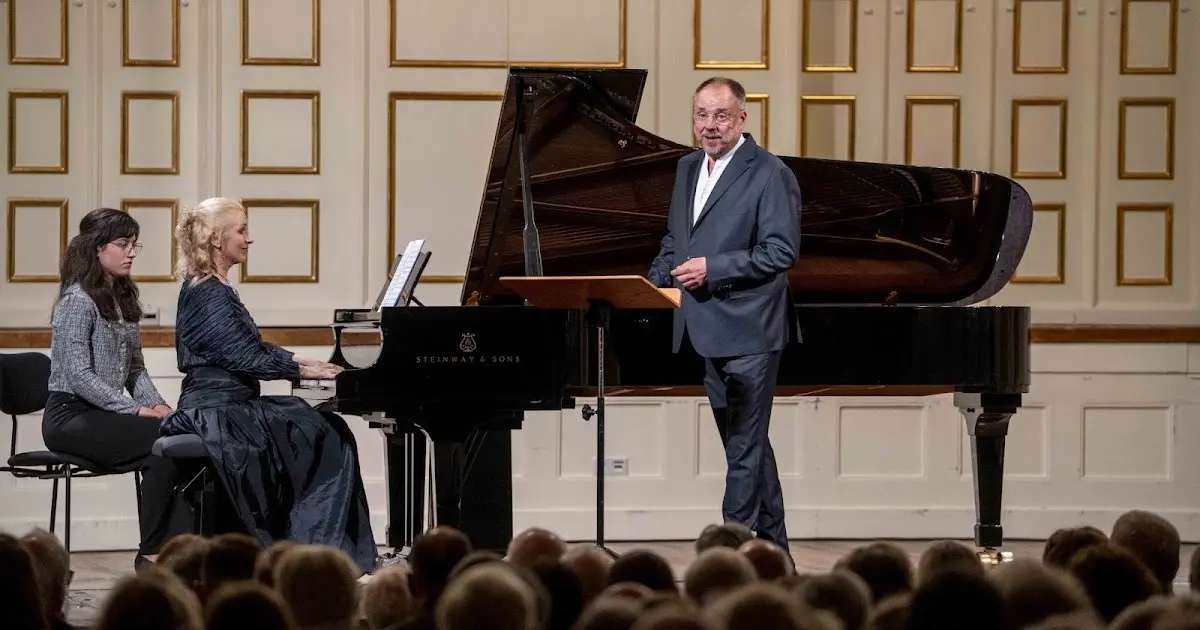
On Saturday, October 10, 2026, a capacity audience gathered at the Olivier Hall within St Edward’s School for a landmark event of the opening weekend of the Oxford International Song Festival: a deeply visceral, masterclass performance of Franz Schubert’s 1827 monumental song cycle, Winterreise (D. 911). The recital marked the festival debut of legendary German baritone Matthias Goerne—a staggering milestone for an artist of his international caliber—alongside visionary pianist Tamara Stefanovich.
Coming nearly thirty years after Goerne’s historic 1997 debut at the Salzburg Festival as Papageno in Mozart’s Die Zauberflöte, and nearly a quarter-century after his harrowing, glass-tank-bound portrayal of the title role in Berg’s Wozzeck at Covent Garden in 2002, this Winterreise felt less like a standard concert and more like the culmination of a storied, decades-long artistic life.
Goerne performed the 24-song cycle entirely from memory. Rather than presenting a polite, traditional traversal of Wilhelm Müller’s poetry set to Schubert’s harrowing music, Goerne and Stefanovich offered a profoundly psychological, physically intense exploration of a mind unraveling. Utilizing expressive bodily language, a fragile yet searing vocal palette, and an uncompromising structural approach, Goerne transformed Winterreise into a raw piece of lived experience. The performance challenged standard conventions—not least through the festival’s innovative use of projected subtitles—and solidified Goerne’s place as one of the preeminent interpreters of German art song (Lieder) in living memory.
Detailed Chronology & Musical Analysis
The Descent Begins: From "Gute Nacht" to "Erstarrung"
From the very first notes played by Tamara Stefanovich, it was clear that this journey would offer no easy comforts. Goerne eschewed conventional vocal pristine-ness; his expressive legato was at times deliberately reined in, replaced by a delicate, trembling vibrato that lent his voice a haunting fragility. Combined with his restless, highly charged physical language, Goerne established the psychological architecture of the wanderer immediately.
Opening with "Gute Nacht," Goerne maintained a measured, thoughtful pace, imbuing the introductory song with acute anxiety and profound melancholy rather than simple nostalgic sadness. The momentum shifted violently with "Die Wetterfahne." Stefanovich’s uncompromising, incisive piano attack fused seamlessly with Goerne’s dark, commanding tone to project a flash of bitter, vivid anger.
As the cycle pressed forward, the boundary between objective reality and internal delusion began to blur. In "Erstarrung," Goerne’s voice scaled terrifying heights of high tension. The poet no longer felt like a man merely lamenting a lost love; he appeared entirely beside himself, teetering precariously on the razor’s edge of sanity.
The Path of Delusion: "Der Lindenbaum" to "Frühlingstraum"
One of the most striking interpretive choices of the evening occurred in "Der Lindenbaum." While Stefanovich provided a transparent, crystalline piano texture, the song was deliberately stripped of its traditional function as a comforting, nostalgic way-point. Instead, it emerged as a chilling highlight of the protagonist’s accelerating psychosis. Goerne’s distant, internalized gaze suggested he was physically present in the Olivier Hall, but mentally residing somewhere entirely unreachable.
This detachment bled directly into "Auf dem Flusse," which felt less like an art song and more like a fragmented, haunting popular tune muttered under the protagonist’s breath. Goerne’s conscious choice to consistently avoid looking directly at the audience heightened the unsettling atmosphere, forcing listeners to eavesdrop on a deeply disturbed psyche.
As the first half wound through "Irrlicht" and "Rast," the musical landscape plunged into abyssal depths of darkness. By the time the duo reached "Frühlingstraum," any lingering ambiguity vanished: the idyllic dream sequence was firmly planted within the hallucinatory architecture of a shattered mind.
The Disturbed Destination: The Second Half
If the first half of Winterreise represents a physical and emotional journey away from society, the second half feels less like traveling and more like exploring a permanent, inescapable destination of profound psychological distress.
Moments of external storytelling, such as the ominous flapping and cawing depicted in "Die Krähe," punctuated the grim proceedings, but the overarching tone was one of total psychological entrapment. In "Im Dorfe," Goerne delivered a remarkable physical enactment of the text, his bodily movements physically manifesting the isolation of the deserted village.

By the time the performance reached "Der Wegweiser," the phrase “travel a road from which no man returned” resonated with terrifying weight, mirroring the poet’s irrevocable descent. This was contrasted with the agonizingly slow, hushed stillness of "Das Wirtshaus" (The Inn). The deliberate reduction of speed and volume yielded a surprisingly magical, spectral quality, which stood in stark, ironic contrast to the jarring, martial vigor of "Mut."
The Final Stretch: "Die Nebensonnen" to "Der Leiermann"
As the cycle neared its conclusion, "Die Nebensonnen" (The Mock Suns) revealed a protagonist utterly at the end of his tether. Goerne elongated the phrases, stretching the temporal space to breaking point.
Throughout the second half, both Goerne and Stefanovich utilized rubato not merely as a decorative expressive device, but as an architectural tool. While individual tempos were not excessively slow on paper, the duo’s generous manipulation of time created vast spatial dimensions. This resulted in a remarkably expansive, heavy Winterreise. The theatrical truth of the performance proved that the further along the journey one travels, the harder the going becomes.
When the final notes of the harrowing masterpiece, "Der Leiermann" (The Hurdy-Gurdy Man), faded into absolute silence, the audience experienced a collective exhale. Never had an audience felt quite so relieved to reach the end of a musical destination—except that, in Goerne’s bleakly brilliant conception, this was no true end at all. Through a lingering, desolate vocal posture, Goerne suggested that his wanderer was fundamentally doomed to wander the infinite corridors of his own delusion for eternity.
Supporting Context & Metrics
The Festival and Venue Context
- The Festival: The Oxford International Song Festival (formerly the Oxford Lieder Festival) is globally recognized as a premier institution for the celebration and performance of art song. Its inclusion of Goerne marked a monumental coup for the festival’s opening weekend.
- The Venue: Olivier Hall at St Edward’s School provided an intimate yet acoustically pristine environment capable of supporting the delicate dynamic range required by Schubert’s score, bridging the gap between chamber intimacy and theatrical scale.
- The Subtitle Innovation: The 2026 festival introduced projected English subtitles for Lieder recitals—a relatively novel and debated innovation in the historically purist world of song recitals. While critics note that subtitles prevent audiences from burying their heads in physical lyric booklets, purists argue that the organic, flexible phrasing of live Schubert can sometimes fall slightly out of alignment with static textual translations. Nevertheless, for a complex narrative like Winterreise, it offered immediate audience accessibility.
Artistic Lineage and Career Metrics
- Matthias Goerne: Born in Weimar, Germany, Goerne has spent over three decades defining the baritone repertoire. A protégé of legendary baritone Dietrich Fischer-Dieskau and soprano Elisabeth Schwarzkopf, Goerne has recorded Winterreise multiple times with various pianists (including Alfred Brendel, Markus Hinterhäuser, and Christoph Eschenbach), yet his 2026 Oxford interpretation proved that his relationship with the cycle remains endlessly evolving.
- Tamara Stefanovich: A critically acclaimed contemporary and classical pianist renowned for her intellectual rigor and crystalline touch, Stefanovich provided an essential counterweight to Goerne’s dark, operatic vocalism, treating Schubert’s piano writing with razor-sharp clarity and modernist structural awareness.
Official Statements & Critical Reception
While formal press releases from the festival administration emphasized the historic nature of Goerne’s long-overdue festival debut, critical and audience responses focused heavily on the physical and psychological totality of the performance.
Festival organizers noted prior to the opening weekend:
"Bringing artists of the absolute highest tier, such as Matthias Goerne and Tamara Stefanovich, to the Olivier Hall underscores our commitment to pairing timeless masterworks with definitive contemporary interpreters. This opening weekend sets a monumental standard for the festival season ahead."
Music critics in attendance universally praised the synergy between Goerne’s vocal fragility and Stefanovich’s uncompromising keyboard architecture. Observers noted that Goerne’s refusal to rely on traditional, beautiful bel canto phrasing demonstrated a fearless commitment to dramatic truth. By trading vocal smoothness for psychological jaggedness, Goerne elevated the performance from a standard song recital into an immersive masterclass in theatrical realism.
Future Outlook
The triumphant Oxford International Song Festival debut of Matthias Goerne and Tamara Stefanovich signals a vibrant, uncompromising trajectory for the performance of classical Lieder in the mid-2020s. As audiences increasingly crave authentic, emotionally resonant live experiences over polished, sanitized studio perfection, interpretations like this Winterreise point the way forward.
Looking ahead, Goerne’s ongoing exploration of Schubert, Brahms, and Mahler continues to influence a younger generation of vocal artists who look to him as a benchmark for dramatic commitment. For the Oxford International Song Festival, successfully anchoring its opening weekend with a landmark performance of this magnitude cements its reputation as an essential crucible for world-class vocal art. As concertgoers filed out of Olivier Hall into the crisp Oxford evening, the lingering resonance of Der Leiermann served as a stark reminder: true masterworks, interpreted by artists at the absolute zenith of their powers, refuse to stay safely confined within the history books—they live, breathe, and break our hearts anew.