Executive Overview
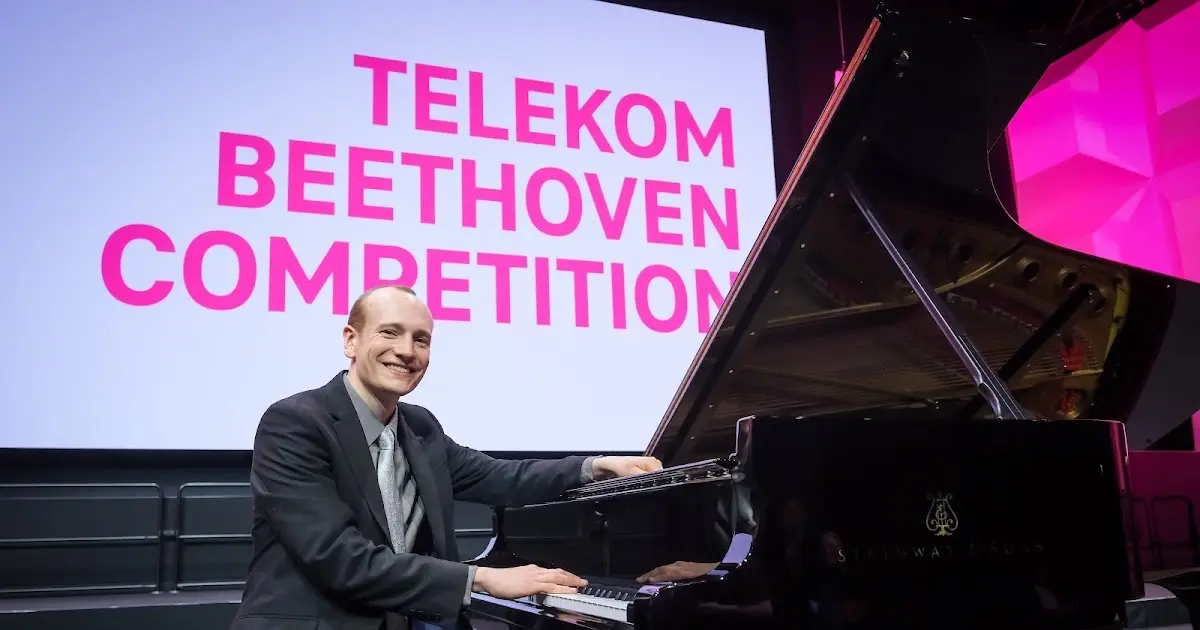
On October 9, 2026, the historic Marble Hall of Hatfield House played host to one of the most intellectually stimulating and technically demanding piano recitals of the season. Featuring American-born, London-based virtuoso Seth Schultheis—the reigning First Prize and Chamber Music Special Prize winner of the 2025 Telekom Beethoven Competition in Bonn—the morning concert offered an audacious, brilliantly curated programme. Rather than relying on monumental multi-movement sonatas, Schultheis constructed a recital out of thirty-four concise, character-driven movements by three distinct composers: Ludwig van Beethoven, contemporary American composer Elizabeth Ogonek, and Robert Schumann.
Schultheis, currently an Aud Jebson Fellow at the Royal Academy of Music, navigated this miniature landscape with a rare combination of structural poise, intellectual rigor, and emotional sensitivity. His performance was not merely a display of finger agility; it was a masterclass in psychological portraiture through music, exploring how composers across centuries have used short-form canvases to express profound emotional complexities, structural freedom, and unbridled imagination.
Detailed Chronology and Musical Analysis
Opening with Beethoven: The 11 Bagatelles, Op. 119
The recital commenced with Beethoven’s 11 Bagatelles, Op. 119, a set of short, characteristic pieces that offer a fascinating glimpse into the composer’s late-period mindset. Beethoven famously referred to such works dismissively as "cobbler’s patches," yet these miniatures reveal a master relatively unfettered by the crushing formal constraints of the symphonic sonata or large-scale variation set.
Schultheis launched the sequence with classical elegance in the opening minuet and trio, anchoring the listener in a familiar 18th-century aesthetic before seamlessly steering the music into quirkier, more idiosyncratic territory. As the set progressed, Schultheis balanced moments of robust, rustic dance vigor with intricate, fleeting rhythms. A particularly striking classical movement featured harmonic interrogations that dissolved into a showy dance bearing subtle echoes of Weber, ultimately precipitating a helter-skelter dash to a touching, understated conclusion.
Rather than treating the bagatelles as spontaneous, free-form improvisations—a trap into which many pianists fall—Schultheis framed them as the highly considered, distilled products of Beethoven’s formidable imagination. His acute sensitivity to the music’s quicksilver mood swings and sly, abrupt endings established an immediate rapport with the Hatfield audience.
Modern Textures: Elizabeth Ogonek’s Preludes (2024)
Transitioning smoothly from the dawn of romanticism to the cutting edge of contemporary American composition, Schultheis presented five preludes by Elizabeth Ogonek. A product of Indiana University, the USC Thornton School of Music, and London’s Guildhall School (where she studied under Julian Anderson as a Marshall Scholar), Ogonek has established herself as a major voice in contemporary classical music.
Composed in 2024, the five preludes performed in the Marble Hall were notable for their highly wrought, intricate textures and complex harmonic architecture:
- Prelude 1: Exhibited a fluid, rolling surface that nevertheless concealed an underlying, persistent restlessness.
- Prelude 2: Picked up this nervous energy, utilizing mobile, shifting harmonies that hinted at shadowy, ambiguous corners.
- Prelude 3: Presented a slow, uncompromising rhythmic profile, cleverly mitigated by delicate, filigree elaborations that softened its austere edges.
- Prelude 4: Unfolded as an gossamer-thin, delicate web of pure sound, showcasing Schultheis’s exquisite control over pianissimo dynamics.
- Prelude 5: Concluded the set with an exotic, quasi-Oriental character, blending transparent musical elaborations with a distinctly hypnotic spatial awareness.
Romantic Duality: Schumann’s Davidsbündlertänze, Op. 6
The recital culminated in Robert Schumann’s monumental yet structurally fragmented Davidsbündlertänze, Op. 6, written in 1837—just three years before Schumann and his lifelong muse, Clara Wieck, finally achieved wedded bliss. Comprising eighteen short movements, the work embodies Schumann’s conceptual league of artists (the Davidsbündler or "League of David") fighting against the "Philistines" of conventional, uninspired art.
Schultheis initiated the suite with a subtle nod to Clara, opening with a brisk burst of a mazurka before plunging into writing that constantly oscillated between aristocratic style, robust character, and profound, tender yearning. The performance brilliantly captured the volatile, frequently polarized nature of Schumann’s psyche, personified by his alter egos: the fiery, impetuous Florestan and the dreamy, contemplative Eusebius.

Schultheis proved remarkably attuned to these rapid emotional mutations. His playing moved effortlessly from vigorous outbursts to delicate introspection, supported by an ironclad yet supple finger technique. Passages of deceptive simplicity gave way to sudden surges of urgency, while skittish impetuosity was consistently balanced by a deep, underlying rhythmic anchor. Towards the close of the cycle, a tender, flowing movement with quirky harmonic detours transitioned into a muscular dance, before winding down to a quiet, profoundly simple dance that faded gracefully into silence.
Supporting Context & Metrics
| Performance Detail | Description |
|---|---|
| Date & Venue | October 9, 2026; Marble Hall, Hatfield House Music Festival |
| Featured Artist | Seth Schultheis (American pianist, London-based) |
| Key Accolades | First Prize & Chamber Music Special Prize, 2025 Telekom Beethoven Competition (Bonn) |
| Residency / Fellowship | Aud Jebson Fellow, Royal Academy of Music |
| Programme Scope | 34 short movements across ~65 minutes of continuous music |
| Repertoire | Beethoven (11 Bagatelles, Op. 119), Elizabeth Ogonek (5 Preludes, 2024), Schumann (Davidsbündlertänze, Op. 6) |
The structural audacity of Schultheis’s programme cannot be overstated. Compressing roughly thirty-four distinct musical miniatures into an hour-long recital demands absolute concentration from both performer and audience. In traditional piano recitals, performers often rely on massive architectural pillars—such as late Beethoven sonatas or Chopin ballades—to anchor the listener’s attention. By contrast, Schultheis’s curation required the audience to constantly reset their cognitive frameworks, shifting rapidly from Viennese classical wit to 21st-century American textural modernism, and finally into High Romantic psychological turbulence.
Official Statements and Critical Reception
While formal press releases from the Hatfield House Music Festival emphasized the historical significance of hosting the reigning Telekom Beethoven Competition champion, music critics in attendance were quick to praise Schultheis’s unassuming stage presence and formidable intellectual depth.
Festival organizers noted in pre-concert documentation:
"The inclusion of Seth Schultheis in this year’s festival highlights our ongoing commitment to platforming the most exceptional prize-winners of international competitions. Schultheis represents a new generation of thinking musicians who refuse to separate technical mastery from rigorous musicological curiosity."
Reviewers highlighted the pianist’s physical economy of motion on stage contrasted with the immense sonic and emotional palette he unlocked at the keyboard. Despite possessing the virtuosic firepower required for international competitions, Schultheis avoided empty grandstanding. His approach to the instrument was consistently service-oriented—subordinating his ego to the microscopic shifts in character demanded by Beethoven, Ogonek, and Schumann alike.
Future Outlook
Seth Schultheis’s appearance at the Hatfield House Music Festival cements his status as one of the most compelling young artists on the international classical music circuit. Following his triumphant sweep at the 2025 Telekom Beethoven Competition in Bonn and his prestigious tenure as an Aud Jebson Fellow at the Royal Academy of Music, Schultheis is rapidly carving out a niche as a thoughtful programmer and a master of nuanced, texturally demanding repertoire.
As he continues his London residency and looks toward upcoming international engagements throughout Europe and the United States, audiences can anticipate further explorations into the intersections of classical masterworks and contemporary composition. If his performance of the Bagatelles, Preludes, and Davidsbündlertänze is any indication, Schultheis’s career will be defined not by predictable crowd-pleasing, but by intellectual bravery, technical brilliance, and an unwavering commitment to the expressive power of miniature forms.