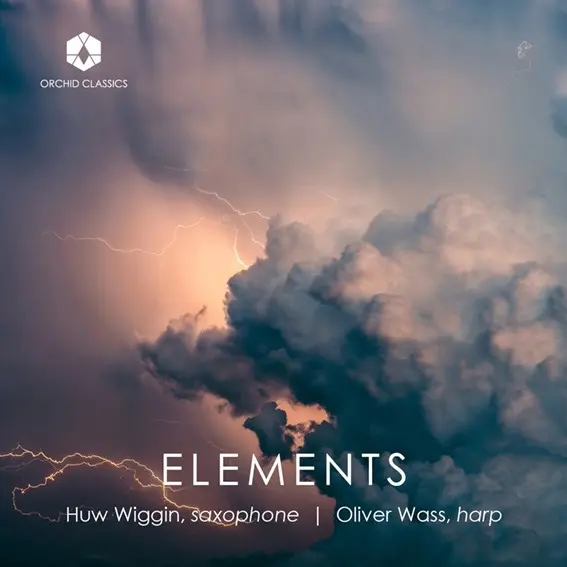
In the contemporary landscape of classical and crossover music, few instrumental pairings challenge and reward the listener quite like the saxophone and the harp. While historically disparate—one anchored in the brass and woodwind family with a metallic, vocal timbre, and the other an ancient plucked string instrument resonant with ethereal harmonies—these two sonic worlds find a miraculous synthesis on Elements, a critically acclaimed album released by Orchid Classics (ORCD100457). Spearheaded by saxophonist Huw Wiggin and harpist Oliver Wass, the recording acts as a conceptual exploration of the ancient philosophical building blocks of the material universe: Earth, Air, Fire, and Water.
Reviewed on September 4, 2026, and recorded at All Saints Church in Dunsden Green, Oxfordshire, between July 7 and 9, 2025, Elements bridges centuries of musical tradition. It juxtaposes carefully curated Baroque masterpieces by the likes of Johann Sebastian Bach, François Couperin, Henry Purcell, Antonio Vivaldi, and Arcangelo Corelli with striking, newly commissioned works by prominent contemporary British composers including Charlotte Harding, Yshani Perinpanayagam, David Wallace, Simon Rowland-Jones, Laura Bowler, and Andy Scott. Frequently joined by cellist Leander Kippenberg, the duo expands the sonic palette of chamber music, offering an album that is at once intellectually rigorous, deeply emotive, and sensorially vivid.
Detailed Chronology of the Program and Musical Analysis
The structural narrative of Elements unfolds through a carefully calibrated sequence of tracks that alternate between historical transcriptions and avant-garde contemporary compositions. Rather than rigidly segregating the old from the new, the album interweaves eras to allow the thematic threads of Earth, Air, Fire, and Water to emerge organically.
Opening Horizons: From Couperin to the Euphotic Zone
The album opens with a delicate transcription of François Couperin’s Le Rossignol en Amour. Wiggin and Wass establish an immediately seductive and spare soundworld. Wass provides a restrained, crystalline harp accompaniment that ensures the saxophone maintains a vocal, unobstructed clarity.
This leads directly into Charlotte Harding’s Euphotic. Drawing its inspiration from the upper layer of a body of water where sunlight enables photosynthesis, Harding constructs a fluidly engaging saxophone line that glitters against the running, cascading arpeggios of the harp. The piece marries a thoroughly modern rhythmic impetus with a haunting, aquatic atmosphere.
Baroque Reflections and Ecological Fables
The journey briefly returns to the Baroque period with an elegant transcription by Wass of the aria from J.S. Bach’s Goldberg Variations. Here, the sparse harp foundation allows Wiggin’s saxophone to soar with pristine vocal lyricism. This vocal quality carries over into a deeply moving adaptation of Henry Purcell’s Dido’s Lament ("When I am laid in Earth") from Dido and Aeneas. For this track, the duo is joined by cellist Leander Kippenberg, who assumes the iconic, sighing ground bass line. Wiggin’s saxophone clings closely to the implied vocal line, resulting in a starkly sorrowful chamber arrangement.
Transitioning back to contemporary idioms, Yshani Perinpanayagam’s The Weary Soil and the Greedy Shoot introduces a sobering narrative based on an imaginary fable concerning the exploitation of natural resources. Beginning from near-silence, the piece is concentrated and thoughtful. The two instruments trade contrasting materials and timbres, steadily tightening the harmonic tension without ever descending into bombast or melodrama.

Winds, Gales, and Meditative Airs
The elemental theme of air and wind dominates the central portion of the album. Following a thoughtful, introspective reading of the Largo from Vivaldi’s Spring (transcribed by Bernard Dewagtere), David Wallace contributes blowing a gale. Beginning disguised as an energetic Irish jig in triple time, the piece quickly evolves into a bravura depiction of tempestuous wind. Despite its dense counterpoint and rhythmic hyperactivity, it retains an unmistakable Celtic folk DNA.
The program then pivots to serenity with Iain Farrington’s stylish and quietly meditative arrangement of the Air from J.S. Bach’s Orchestral Suite No. 3. This is complemented by Simon Rowland-Jones’s Silent Air, a work that weaponizes silence, building its architecture out of short, fragmented motifs that feel quite literally plucked from the surrounding atmosphere. The dialogue between saxophone and harp is punctuated by pregnant pauses, emphasizing space as an active musical participant.
Solo Interludes and Pyrotechnics
Wass takes the spotlight in a solo harp transcription of the Sarabande from J.S. Bach’s French Suite No. 3 in B Minor, capturing the gravity of the Baroque dance through the shimmering, resonant color palette of the modern pedal harp.
The full ensemble reconvenes with Leander Kippenberg for a fiery, virtuosic reading of Arcangelo Corelli’s La Folia (Op. 5, No. 12). Moving effortlessly from structural elegance to dazzling pyrotechnics, Wiggin’s rapid-fire passages are mirrored by Kippenberg’s cello in an engaging tour de force.
Fire, Dance, and Farewell
Laura Bowler’s Caesium directly engages with the element of fire. Inspired by the highly reactive, silvery-gold metal that explodes upon contact with water and combusts spontaneously in air, the work opens with a razor-sharp, swirling vortex of sound. It gradually decelerates, stretching time itself, before erupting into a final, volatile blaze.
After a palate-cleansing interlude of J.S. Bach’s Two-Part Invention No. 8 in F major, Andy Scott injects Latin American warmth into the program with Sussurros Brasileiros. Scott merges the infectious grooves and rhythms of Brazil with the sophisticated vocabulary of contemporary classical chamber music, creating a snap-punctuated, joyous soundscape.
The album concludes on a deeply personal note. Following an Allegro from Corelli’s Sonata Op. 5 No. 4, the recording closes with Laura Bowler’s With You. Originally written for Wiggin to perform at the funeral of the composer’s mother, it is a spare, haunting piece for solo saxophone that leaves the listener suspended in a state of touching, profound vulnerability.

Supporting Context & Metrics
| Recording Parameter / Detail | Specification |
|---|---|
| Album Title | Elements |
| Artists | Huw Wiggin (Saxophone), Oliver Wass (Harp), Leander Kippenberg (Cello) |
| Record Label | Orchid Classics |
| Catalog Number | ORCD100457 |
| Recording Venue | All Saints Church, Dunsden Green, Oxfordshire |
| Recording Dates | July 7–9, 2025 |
| Review Date | September 4, 2026 |
| Core Repertoire Range | Baroque (Corelli, Purcell, Bach, Couperin, Vivaldi) to Contemporary British (21st Century) |
The Instrumentation Challenge
Pairing a saxophone—an instrument invented in the 1840s by Adolphe Sax and traditionally associated with military bands, jazz clubs, and late-Romantic orchestral color—with the harp presents acute acoustic hurdles. The harp is fundamentally a percussive-plucked instrument with a rapid decay, whereas the saxophone is capable of sustaining continuous, dynamic pneumatic tones with vibrato control.
Through meticulous arrangement and acoustic restraint (exemplified by Oliver Wass’s deliberate avoidance of over-accompaniment), Elements proves that these two instruments do not merely coexist; they enhance one another’s expressive ranges. The saxophone adopts the crystalline transparency of plucked strings, while the harp absorbs the breath and vocal inflection of the reed.
Official Statements and Artistic Intentions
The conceptual cohesion of Elements relies heavily on the stated intentions of its contributing composers, who approached the project not merely as an assemblage of standalone tracks, but as an elemental meditation:
- Laura Bowler on Caesium: Describing her fascination with the volatile alkaline metal, Bowler noted that she was "drawn to caesium as a highly reactive soft silvery-gold metal that reacts explosively with water and catches fire spontaneously in air," an ethos directly translated into the work’s jagged, volatile sonic trajectory.
- Andy Scott on Sussurros Brasileiros: Scott outlined his compositional premise as an attempt to "combine grooves and musical rhythms that I love from Brazil with the many sound worlds that are available to the saxophone and harp via contemporary classical music."
- Yshani Perinpanayagam on Resource Consumption: The composer structured The Weary Soil and the Greedy Shoot around an intentional fable examining environmental exhaustion, opting for an evolving, intimate dialogue that refuses simple auditory gratification in favor of intellectual gravity.
Future Outlook
The release and critical reception of Elements via Orchid Classics signal a broader, highly encouraging trend within modern classical music: the championing of non-traditional chamber ensembles. For decades, classical programming was rigidly bound to standard configurations (string quartets, piano trios, woodwind quintets). Projects like those forged by Huw Wiggin and Oliver Wass break down these institutional silos, proving to concert promoters, academic institutions, and recording executives alike that audiences are eager for fresh timbre combinations.
Looking forward, the success of this album sets a high benchmark for contemporary commissioning projects. By tethering avant-garde compositions to universally recognized Baroque pillars, the artists have successfully bridged the often-impenetrable gap between contemporary classical music and the general listening public. As chamber musicians continue to seek out novel acoustic spaces, the blueprint established on Elements—respecting historical lineage while aggressively pushing instrumental boundaries—will undoubtedly inspire a new generation of performers to explore the vast, uncharted waters of unconventional musical duos.