Executive Overview
In an era where the arts are frequently siloed by ability, background, and geography, a pioneering four-year partnership is quietly redefining what inclusive music-making looks like in the United Kingdom. This unique collaboration brings together two distinct musical powerhouses: the National Children’s Choir of Great Britain (NCCGB), an elite, auditioned ensemble for exceptional young vocalists aged 9 to 19, and Soundabout, a trailblazing national charity dedicated to unlocking the musical potential of learning-disabled individuals of all ages, particularly those with profound and complex support needs.
Every year during their intensive Easter residential courses, the secondary-school-aged members of the NCCGB’s Blue Choir take part in a transformative, interactive workshop alongside Soundabout participants. For many of the young choristers, this represents their very first encounter with learning-disabled peers who have complex support needs. Far from being a superficial exercise in corporate social responsibility, the initiative has evolved into an educational cornerstone of the NCCGB curriculum.
At its core, the collaboration rests on a shared philosophical conviction: that true artistic excellence cannot exist in isolation, and that creating equitable, shared musical spaces is essential for nurturing the next generation of empathetic artists. By integrating Soundabout’s person-centered methodology—which utilizes sensory tools, vocal improvisation, structured greetings, and tactile percussion—into a mainstream choral environment, the partnership bridges communities that rarely intersect. As the collaboration looks ahead to its continued programming in 2027 and seeks external funding to scale its impact, it serves as a powerful blueprint for how the classical and youth music sectors can champion accessibility, belonging, and shared humanity through song.
Detailed Chronology: The Evolution of a Groundbreaking Partnership
The Genesis of an Unlikely Alliance
The roots of the collaboration stretch back to the early planning phases that culminated in its launch four years ago. Leadership from both the NCCGB and Soundabout recognized a critical gap in mainstream musical education. While elite youth choirs excel at cultivating technical vocal mastery, pitch accuracy, and ensemble discipline, they occasionally risk operating within a cultural bubble, disconnected from the broader, neurodiverse reality of British society.
Soundabout, on the other hand, had spent decades championing the belief that everyone—regardless of cognitive or physical ability—has a musical voice. The charity’s methodology was built around the principle of removing barriers through total immersion, sensory engagement, and unconditional positive regard. When the two organizations first converged, leadership discovered a profound philosophical alignment: both entities believed that equity is not an afterthought, but the very foundation upon which meaningful music-making must be built.
Embedding the Workshop into the Easter Residential
The collaboration quickly found a permanent home within the NCCGB’s annual calendar. Each spring, during the choir’s rigorous week-long residential training camps, the Blue Choir sets aside its traditional repertoire to welcome Soundabout practitioners and participants.
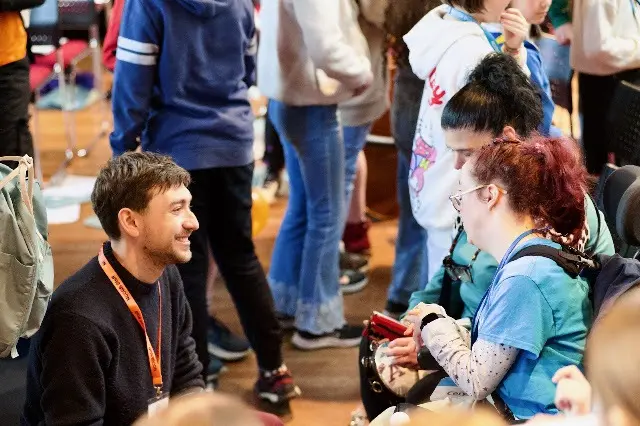
Unlike a standard audience-performer dynamic, these sessions are explicitly collaborative. The workshop follows a carefully crafted arc designed to reduce anxiety, foster psychological safety, and maximize engagement. It opens with Soundabout’s signature Hello song—a predictable, welcoming ritual that establishes a secure framework for participants who rely on routine.
As the session unfolds, the boundaries between "choir member" and "workshop participant" dissolve. The room fills with the sounds of shared favorite songs, interactive singing games, hand-held percussion instruments, and specialized sensory toys. Music practitioners guide both groups through call-and-response exercises, rhythmic games, and vocal explorations that prioritize expression over perfection. The session invariably concludes with Soundabout’s signature Goodbye song, reinforcing the structure, followed by an extended, informal social period where choristers and Soundabout participants mingle, chat, and form personal connections.
Overcoming Initial Apprehension
For many 11- to 18-year-olds in the Blue Choir, stepping into this shared space can initially provoke anxiety. Raised in communities where disability is often hidden or segregated, many choristers arrive at their first Soundabout workshop unsure of how to interact, communicate, or engage with peers who have complex support needs.
However, the chronological arc of each workshop consistently mirrors a transformation from tentative curiosity to unbridled joy. Within minutes, the universal language of music bypasses verbal and cognitive barriers. Rhythms are mirrored, smiles are exchanged, and shared laughter fills the rehearsal hall. By the time the final notes of the Goodbye song fade, the initial nervousness has invariably been replaced by a profound sense of camaraderie.
Supporting Context & Metrics: The Philosophy and Impact of Inclusive Music
Understanding Soundabout’s Person-Centred Approach
To fully appreciate the significance of this collaboration, one must examine the pedagogical framework that underpins Soundabout’s work. Traditional music education often relies on standardized notation, verbal instruction, and rigid physical positioning—methods that can inadvertently exclude neurodivergent individuals or those with severe learning disabilities.
Soundabout upends this paradigm through a strictly person-centered philosophy. Every intervention is tailored to the individual’s unique profile of communication, sensory processing, and emotional expression. Practitioners look for micro-expressions, shifts in breathing, bodily movements, and vocalizations, treating every single reaction as a valid musical contribution.

When translated into a mainstream setting like the NCCGB’s Blue Choir, this approach offers profound pedagogical benefits. High-level classical choristers are trained to listen meticulously, blend their voices, and respond dynamically to their environment. The Soundabout workshops challenge these young singers to expand their definition of "listening," teaching them to tune into non-verbal cues, sensory feedback, and alternative modes of communication. This deepens their overall musicianship in ways that standard choral training alone cannot achieve.
Demographics and Reach
The partnership bridges two distinct demographic populations within the UK cultural landscape:
- The National Children’s Choir of Great Britain (NCCGB): Comprising approximately 300 to 400 talented young singers aged 9 to 19 selected via rigorous national auditions. The choristers represent a diverse cross-section of geographic regions across England, Scotland, Wales, and Northern Ireland, united by exceptional vocal aptitude and a dedication to choral excellence.
- Soundabout Participants: Individuals of all ages living with learning disabilities, autism, and complex support needs—including those with profound and multiple learning disabilities (PMLD) who are frequently marginalized in cultural spaces.
- The Intersection (The Blue Choir): Specifically engaging the secondary-school-aged division of the NCCGB (typically ages 11 to 18), ensuring that young people undergo this transformative experience during their formative developmental years when empathy, identity, and social values are actively being shaped.
Official Statements and Personal Perspectives
The true measure of the partnership’s success is best captured through the voices of those who experience it firsthand.
Verity, a chorister who has spent two years singing in the NCCGB Blue Choir, candidly reflects on her initial reservations and subsequent conversion:
"We don’t have many people with disabilities in and around my community at home, so I was a bit nervous before my first session with Soundabout. But seeing so many amazing people in a room all singing together was so much fun! It is such an enjoyable and inclusive experience, I don’t know what I had to worry about. This is my second year with NCCGB and Soundabout is now one of the highlights of my week; it’s the first thing I tell my family about when I get home!"
Verity’s testimony highlights a critical sociological phenomenon: geographical and social segregation often breeds unnecessary apprehension regarding disability. By breaking down these artificial barriers in a structured, joyful artistic environment, the partnership effectively dismantles stigma at an age when minds are most receptive to change.
Leadership from both organizations have consistently emphasized that the collaboration is not a peripheral charitable outreach project, but an essential component of holistic artistic training. Representatives from Soundabout have noted that mainstream musicians who engage with their methodology develop a heightened sense of empathy, patience, and collaborative awareness—qualities that define exceptional modern leadership in the arts. Similarly, NCCGB artistic staff have observed that choristers returning from the Soundabout workshops exhibit greater vocal confidence, enhanced sensitivity to ensemble dynamics, and a deeper appreciation for the social power of music.
Future Outlook: Sustainability, Scaling, and the Road to 2027
As the partnership enters its fourth successful year, both organizations are actively looking toward the horizon. Plans are already officially locked in to continue the collaborative workshops through 2027, ensuring that multiple future cohorts of Blue Choir members will continue to benefit from this life-changing integration.
However, the ambitions for the initiative extend far beyond mere continuation. Currently, the collaboration is jointly funded through the operating budgets of Soundabout and the NCCGB—a testament to both organizations’ firm commitment to the project, despite the financial pressures currently facing the wider arts and charity sectors.
To realize the full potential of the partnership, leadership is actively seeking external philanthropic grants, corporate sponsorships, and public arts funding. Scaling the initiative could involve several strategic developments:
- Geographic Expansion: Extending the workshop model beyond the Easter residential course to include regional NCCGB training days across the UK, thereby reaching a larger baseline of choristers and local Soundabout communities.
- Resource Development: Creating open-source educational toolkits and documentary resources based on the partnership’s methodology, allowing other mainstream choirs, youth orchestras, and musical institutions across the country to replicate the model.
- Extended Residencies: Deepening the duration of the joint workshops to allow for co-created musical compositions that could be performed publicly, showcasing the combined talents of mainstream choristers and learning-disabled musicians on major concert stages.
In an arts landscape frequently dominated by commercial pressures and exclusionary traditions, the alliance between the National Children’s Choir of Great Britain and Soundabout stands as a beacon of progressive, compassionate, and visionary education. By proving that musical excellence and radical inclusivity are not mutually exclusive—but rather mutually reinforcing—the partnership is not only shaping better musicians, but better human beings. As they look toward 2027 and beyond, their shared chorus echoes a simple yet revolutionary truth: music belongs to everyone.