Convivium Records has announced the release of Choral Contemplations – Sacred Introits & Duets, a compelling new recording that bridges the gap between grassroots artistic expression and professional choral execution. Featuring 19 sacred pieces performed by the Phoenix Consort under the direction of Adam Whitmore, the album showcases works by nine contemporary composers who largely reject the label of professional or formally trained musicians. Instead, these artists draw inspiration from philosophical inquiry, Christian contemplation, and the acoustic principles of just intonation established by the polymath Leon MacLaren.
Recorded over two days in February 2026 at St John’s in Upper Norwood, London, the 50-minute album presents a unique repertoire rooted in the philosophy school tradition of the School of Philosophy and Economic Science. Rather than catering to the avant-garde or ego-driven compositional trends of the modern classical establishment, Choral Contemplations offers music born from silence, presence, and intentional listening. This release serves a dual purpose: it provides a serene, deeply rewarding listening experience for the general public and introduces a trove of accessible, high-quality repertoire for amateur and parish choirs worldwide.
Detailed Chronology & Repertoire Breakdown
The genesis of the musical works featured on Choral Contemplations spans several decades, reflecting a continuous tradition of philosophical and acoustic exploration. The album stitches together compositions written across different eras—from the mid-1980s through to newly penned commissions for 2025 and 2026—united by a common aesthetic and tuning framework.
The Foundation: Historical Context and Tuning Systems
The philosophical underpinnings of the album trace back to Leon MacLaren, whose foundational work with the School of Philosophy and Economic Science involved deep explorations into sound, modes, and acoustic tuning systems. MacLaren’s conceptualization of the "Natural Octave"—an approach to just intonation designed to avoid the harsh mathematical compromises of equal temperament—became a touchstone for the composers involved in this project. Over the years, figures like Bruce Ramell, David Goymour, and David Fletcher advanced these ideas, coining the term ‘modist’ to describe music written specifically to celebrate the unique atmospheric and emotional characteristics of specific musical modes.
A Mosaic of Voices: The Tracklist Explored
The 19 tracks on the album reflect a diverse cross-section of writers, educators, and artists whose professional lives existed largely outside the traditional classical composition circuit.
Derek Saunders: A music teacher at the London Oratory School and director of music at St Mary with St Alban Church in Teddington, Saunders contributes Ask, Seek, Knock (a stark, textually driven setting of St Matthew’s Gospel characterized by open harmonies and rich contrasts) and Be still, and know that I am God (a contemplative 2020 setting of Psalm 46 featuring chant-like melodies over vocal humming).
Adrian Green: Serving as managing director of Convivium Records and a tenor lay clerk at Portsmouth Cathedral, Green contributes deeply intimate and structured works. His O most merciful, set to words by Reginald Heber, was originally conceived for the men’s voices of the Portsmouth Cathedral Choir. Green is also represented by The Absorbeat (commissioned in 2020 for the 800th anniversary of the founding of the Third Order of St Francis) and Every good gift, a 2025 reflection on James 1:17-20 written in memory of a former school headteacher, featuring an opening solo chant interwoven with full choir textures.
David Fletcher (1931–2024): A former picture restorer and Guildhall alumnus, Fletcher’s contributions reveal a masterclass in sensitive word setting. His repertoire on the disc includes Set me as a Seal (Song of Solomon), In Rama a voice is heard (upper voices creating an austere, delicate texture), My beloved spake (an excerpt from his 1997 cantata The Song of Songs), and Sing we merrily (Psalm 81), which possesses a vigorous, neo-Medieval rhythmic drive.
Noel Skinner (1947–2019): Trained at the Royal Academy of Music, Skinner is featured through posthumous and archival discoveries. His arrangement of Laurence Binyon’s For the Fallen—originally written for two voices and organ in the 1980s and expanded here into a lush choral arrangement by Matthew Coleridge—sits alongside The earth is the Lord’s (Psalm 24), a striking, upfront piece for upper voices that likely received its premiere recording during these sessions.
David Goymour: A journalist and philosophy scholar, Goymour translates philosophical principles into clean, functional sacred music. His contributions include O Oriens (an O Anthem moving from a solo line to robust choral textures) and the album’s concluding track, Lighten our darkness (The Third Collect for Aid against all Perils from Evensong), which opens with soaring upper voices before drawing the listener into a restrained, meditative close.
John-Paul Bowman: A Guildhall graduate dividing his time between teaching and composition, Bowman offers A new commandment (written for his 2019 wedding, blending vigorous counterpoint with spare textures) and Dum Medium Silentium. Composed in 2011 after studying Vytautas Miškinis, Dum Medium Silentium builds out of absolute silence, utilizing sustained lines and short rhythmic motifs to generate immense emotional density within a quiet sonic footprint.
Rosemary Broadbent: With a career dedicated to music education, including tutoring at the Junior RNCM, Broadbent’s 2002 commission And he arose (set to text from St Luke) delivers a direct and commanding emotional impact.
Peter Blumsom (1942–2026): Better known to pop history as Pete Dello, lead singer of the 1960s/1970s harmony-pop band Honeybus, Blumsom brings a brilliant melodic instinct to What is man? Originally commissioned for a Christian Trade Union conference at Westminster Abbey with guitar accompaniment, the piece was later arranged by Noel Skinner for piano, transforming it into a sophisticated, flowing sacred song.
Bruce Ramell: A former London prep school headmaster who combined mathematics and music, Ramell contributes To Cecilia (a touching part-song set to a 17th-century anonymous text) and O Adonai, an O Anthem that transitions effortlessly from a gentle, hymn-like opening into a robust statement of faith.
Supporting Context & Metrics
Album Detail
Specification
Album Title
Choral Contemplations – Sacred Introits & Duets
Ensemble
Phoenix Consort
Conductor
Adam Whitmore
Record Label
Convivium Records (Catalog Number: CR130)
Release Date
September 14, 2026
Recording Dates
February 20–21, 2026
Recording Venue
St John’s, Upper Norwood, London
Total Duration
50 minutes, 30 seconds (1CD)
Featured Composers
9 Contemporary/Historical Writers
Total Tracks
19 Sacred Introits & Duets
The physical and digital release of CR130 represents a significant milestone for Convivium Records, emphasizing niche, values-driven classical projects over commercial chart-chasing. Recorded over a rigorous two-day window in February 2026, the album’s 50-minute runtime is intentionally concise, designed to mirror the duration of a traditional monastic office or a focused period of personal meditation.
The Phoenix Consort, originally established by Adam Whitmore during his tenure at Durham University, has steadily evolved from a localized student ensemble into a nationally recognized network of young, agile vocal artists. Their youth and technical flexibility allow them to navigate the demanding just intonation requirements and shifting vocal textures demanded by the modist repertoire without sounding overly academic or stiff.
Official Statements & Perspectives
In liner notes and promotional interviews surrounding the launch of Choral Contemplations, the creative forces behind the project have emphasized the psychological and spiritual necessity of ego-free artistry.
Adrian Green, managing director of Convivium Records and a featured composer on the album, pointed directly to the philosophy of Benedictine monk Cyprian Smith when articulating the core motivation of the project:
"Everything which lies between’ poses a philosophical question and is the subject of being present in life and being ourselves. In some ways it is the most natural thing in the world to be present, but to do this as a creative artist means letting go of all the thoughts and ideas and feelings which take up our mental mindscape, so that there can be space for music to arise from within us which isn’t about our ego."
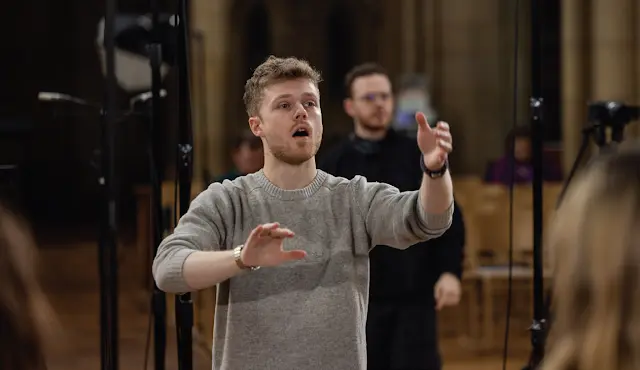
Conductor Adam Whitmore noted that the music on the disc requires a very specific type of listening environment, one that contrasts sharply with the hyper-stimulating landscape of modern media. By employing young artists from the Phoenix Consort, Whitmore sought to capture an unadorned, pure choral tone that serves the text rather than exploiting it for vocal showmanship.
"The music here is not overtly demanding in terms of aggressive modernist complexity, but it deeply repays close, sustained attention," Whitmore observed. "It asks the listener to sit still, breathe, and enter into the acoustic space created by the composers."
Future Outlook
As Choral Contemplations – Sacred Introits & Duets enters public circulation, its impact is expected to resonate across two distinct communities: contemporary classical consumers looking for contemplative listening material, and choral directors seeking fresh, accessible sacred repertoire.
The deliberate preservation of works by non-professional composers—many of whom spent their lives in classrooms, journalism, or parallel creative industries—proves that profound musical statements do not require an ivory-tower pedigree. Furthermore, the inclusion of pieces tailored for specific liturgical moments, ranging from upper-voice austerity to full romantic harmony, establishes this album as a practical manual for parish and amateur choir directors aiming to expand their service libraries.
Looking ahead, Convivium Records plans to leverage the release to champion further explorations of ‘modist’ composition and natural intonation tuning systems. As audiences increasingly seek out art that counters the noise of contemporary digital life, Choral Contemplations offers a timely blueprint for how modern musicians can quiet the ego and allow art to emerge from stillness.