Executive Overview
In the sprawling, borderless landscape of contemporary global music, few curators map the subterranean frequencies of the underground with the precision and adventurous spirit of Rebel Up. Their flagship monthly dispatch, Nightshop, returns for October 2026 with an expansive, genre-defying sonic journey that traverses the mist-shrouded peaks of the Andes, the bustling markets of Accra, the hypnotic trance-states of Istanbul, and the deep, reverberating bass chambers of Brussels and London.
True to its reputation as an uncompromised radar for trans-global expression, the October 2026 edition of Nightshop acts as a cultural bridge. It connects traditional acoustic preservation with avant-garde electronic manipulation, reminding listeners of the deep, ancestral threads that bind disparate musical traditions. This month’s broadcast opens with an evocative triad of songs of the day, before plunging headfirst into a meticulously curated slate of Albums of the Month. From the chill, hypnotic grooves of Peruvian chicha-cumbia to the fierce, politically charged broken-beat collages of the Iranian-Irish underground, this edition offers a masterclass in modern musicology.
As urban centers like Brussels continue to serve as crucibles for hybrid artistic movements, Nightshop anchors its global exploration with a localized pulse, rounding out the episode with a comprehensive live concert and party agenda for the Belgian capital. For sound-system aficionados, ethnomusicologists, and open-eared music lovers alike, the October 2026 installment—available now for public download—stands as an essential documentation of the earth’s evolving sonic palette.
Detailed Chronology: A Global Journey Through Sound
The October 2026 Nightshop experience unfolds in distinct, carefully paced movements. It begins with an eclectic introduction featuring foundational tracks of the day before transitioning into deep-dive segments dedicated to the month’s premier long-form releases.
The Overture: Songs of the Day
The broadcast commences by establishing a transcontinental dialogue. The initial tracks pull from diverse cultural archives and contemporary production houses:
- Abelardo Carbono & Frente Cumbiero – "Kambamba Liki": A masterclass in modern-traditional Colombian synergy, merging vintage coastal guitar styles with contemporary cumbia revivalist energy.
- Matthew Herbert – "Pasta (is not a luxury)": A sharp, socio-politically minded electronic composition from the British auteur, showcasing how avant-garde sound design can intersect with everyday socio-economic commentary.
- Dorival Caymmi – "Canoeiro (Pescaria)": A timeless piece of Brazilian maritime folklore that grounds the opening trio in the rich, poetic songwriting traditions of South America.
The Albums of the Month: Deep Dives
1. Oriente Tio – Canto (Self-Released)
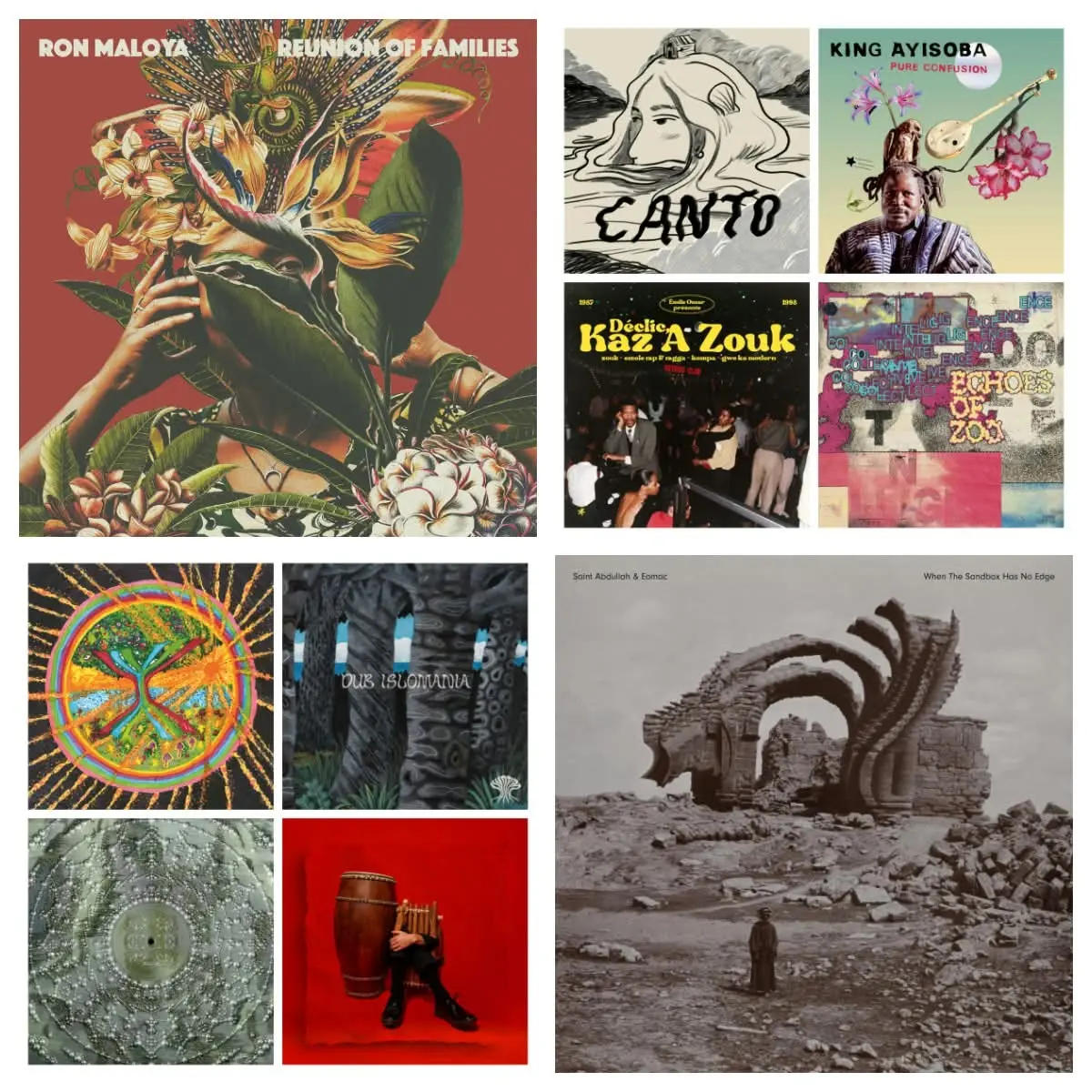
The album showcases begin in South America with the Peruvian band Oriente Tio. Their signature sound—a breezy, hypnotic brand of chill chicha-cumbia—conjures images of mist rolling over Andean cloud forests and humid Amazonian lowlands alike. Tracks such as "Ballon," "Cumbia del Desierto," and "Cumbión Del Fin" demonstrate the ensemble’s knack for blending shimmering, reverb-heavy electric guitar lines with infectious, undulating percussion.
2. King Ayisoba – Pure Confusion (Mais Um)
From Peru, the journey leaps across the Atlantic to Ghana. Legendary minstrel King Ayisoba brings his thunderous, uncompromised folk-pop sound to the forefront with Pure Confusion. Armed with his traditional two-stringed kologo lute and a voice that carries the weight of generations, Ayisoba delivers tracks like "Property," "Dey Come," and "Memsoh." The music is raw, urgent, and deeply spiritual, effortlessly bridging rural Ghanaian traditions with modern, driving rhythms.
3. V/A – Ron Maloya: Reunion of Families (JuJu Sounds)
The exploration of island traditions continues with Ron Maloya: Reunion of Families, a landmark compilation released via JuJu Sounds. This collection gathers generational practitioners of Maloya—the traditional music, song, and dance of Réunion Island. Featuring contributions from artists such as Maëlle Philéas, Kozman Ti Dalon, and Etinsèl Maloya, the release acts as a living archive, honoring the resilience and joyous communal spirit of the Réunion diaspora.
4. Various Artists (Curated by Émile Omar) – Déclic, Kaz A Zouk: Zouk – Créole Rap & Ragga – Kompa – Gwo Ka Modern (1987 – 1998) (Heavenly Sweetness)
Stepping back into the vibrant Caribbean soundscapes of the late 20th century, this compilation curated by Émile Omar shines a brilliant light on the Golden Era of island and diaspora sounds. Spanning the years 1987 to 1998, tracks like Van Lévé’s "Invitation à la Danse," Sylviane Cédia’s "La Guyanaise," and Zshea’s "Rozalie, Rozalie" capture the explosive cross-pollination of zouk, kompa, ragga, and modern gwo ka that defined Caribbean nightlife during the decade.
5. Echoes Of Zoo – Collective Intelligence (Zephyrus & Rebel Up)
Moving into contemporary European hybridity, Belgian powerhouse Echoes Of Zoo present Collective Intelligence. Known for their fierce global jazz-rock ethos, the band utilizes tracks like "Higher Levels," "Wolf Pack Telepathy," and "Multicellularity" to push the boundaries of improvisation. Their music fuses the structural complexity of jazz with the driving force of rock and the polyrhythmic intricacies of non-Western musical traditions.
6. BaBa ZuLa – XXX (Glitterbeat)
No survey of global psychedelic music is complete without Istanbul’s premier sonic architects, BaBa ZuLa. With their latest release XXX, the Turkish band delivers another masterclass in Anadolu psychedelic trance rock. Cuts like "Cñrtlak 9," "Kutsal Zeytin Halayñ," and "Hak Bitmez Güç Bitee" blend traditional Turkish folk instruments—such as the electric saz and darbuka—with heavy, hypnotic basslines and futuristic analog synthesizer explorations.
7. Harikuyamaku – Dub Islomania (Self-Released)
From the subtropical Japanese island of Okinawa comes producer Harikuyamaku, whose album Dub Islomania reinterprets traditional Okinawan folk melodies through the heavy, atmospheric lens of global dub. Tracks like "Kubagasa Gwaa," "Turubaimun," and "Pacific Dub" create a vast, oceanic soundscape where deep bass frequencies and spatial delays converse seamlessly with indigenous Japanese stringed instruments and island chants.
8. Le Motel – Pozo de Agua (Constellation Tatsu)
Brussels-based producer Le Motel offers a moment of reflective respite with his soft, texturally rich electronic album Pozo de Agua. Released via Constellation Tatsu, tracks such as "Mangrove," "Sundogs," and "Cabane" utilize field recordings, delicate synth pads, and ambient sound design to construct intimate, organic electronic environments that evoke both tranquility and wonder.
9. Saint Abdullah & Eomac – When The Sandbox Has No Edge (Planet Mu)
Providing one of the most intense sonic experiences of the month, the Iranian-Irish duo Saint Abdullah join forces with producer Eomac for a fierce, uncompromising broken-beat collage. Released on Planet Mu, collaborative highlights such as "As We Are" (featuring Armand Hammer), "Eyes See What The Camera Cannot Feel," and "Willing In The Name Of" (featuring Seraphim) merge heavy industrial rhythms with evocative Middle Eastern sonic motifs, resulting in a turbulent, deeply political masterpiece.
10. Roscius & Loya – B‐Sides (Nomadic Recordings)
Concluding the album showcases, French-Réunionese collaborators Roscius and Loya present B‐Sides via Nomadic Recordings. The release reimagines traditional Maloya through a sophisticated club lens. Tracks like "Grit (club rework)" and the "Carnawar (Loya Remix)" demonstrate how acoustic island rhythms can be effectively translated into warehouse-ready, peak-time electronic anthems without losing their cultural soul.
Supporting Context & Metrics: The Anatomy of Modern Global Underground Radio
To understand the cultural significance of Nightshop‘s October 2026 dispatch, one must examine the broader socio-musical ecosystem that sustains it. Independent radio shows and podcast curation platforms like Rebel Up have become vital counterweights in an era dominated by hyper-algorithmically generated streaming playlists.
The Shift Toward Transnational Collaboration
The catalog highlighted in this month’s Nightshop points to a definitive industry trend: the decentralization of musical innovation. Historically, global music was filtered strictly through Western metropolitan hubs (London, Paris, New York). However, releases like Saint Abdullah & Eomac’s trans-cultural collaboration (linking Iranian heritage, Irish production, and American underground hip-hop via Armand Hammer) demonstrate a horizontal network of artistic production.
Archival Preservation vs. Club Utility
Another critical metric observed in the October 2026 tracklist is the harmonious coexistence of historical preservation and contemporary club utility. Compilations such as Ron Maloya and Émile Omar’s Déclic, Kaz A Zouk serve an archival purpose—rescuing regional sounds from obscurity and re-contextualizing them for modern audiences. Simultaneously, club-focused reworks by artists like Roscius, Loya, and Echoes Of Zoo prove that heritage music is not a static museum artifact, but a living, breathing catalyst for contemporary dancefloor culture.
Official Statements & Curatorial Vision
While underground music curation often resists corporate public relations speak, the ethos of Rebel Up and its contributing artists remains anchored in principles of sonic exploration, cross-cultural solidarity, and archival integrity.
Reflecting on the motivations behind Nightshop, underground musicologists and global beat curators consistently emphasize the necessity of active listening in an increasingly fragmented media landscape. By compiling disparate styles—ranging from the folk-pop minimalism of King Ayisoba to the heavy dub architecture of Harikuyamaku—the platform advocates for a unified global community of sound.
"Music does not merely reflect the world; it builds alternative geographies where borders dissolve, and historical lineages are heard rather than read."
— Global Sonic Archivists Statement on Trans-Cultural Curation
Furthermore, the inclusion of Brussels-based concert and party agendas underscores a commitment to local infrastructure. Global underground music cannot survive purely in digital ether; it requires physical spaces—clubs, community centers, and DIY venues—where audiences can experience the collective pulse of these diverse traditions firsthand.
Future Outlook: The Horizon of Global Underground Sounds
As the final quarter of 2026 unfolds, the trajectory of underground global music points toward increasingly fluid hybrids. The boundaries separating acoustic folk traditions, field recordings, and heavy electronic sound-system culture are continuing to blur.
Future editions of Nightshop and similar platforms are expected to lean even further into decentralized production models, where artists across remote geographies collaborate instantaneously through digital networks while maintaining deep ties to their local roots. The success of albums like Pure Confusion and Collective Intelligence signals a growing appetite among international audiences for music that demands active intellectual and emotional engagement.
For those eager to dive into this month’s complete sonic catalog, the full episode is available for digital acquisition and streaming via Rebel Up’s dedicated archive link: https://tinyurl.com/Night142. As listeners continue to tune in from London, Brazil, Brussels, and beyond, Nightshop remains an indispensable lighthouse guiding ships safely through the vast, uncharted oceans of contemporary global sound.