Executive Overview
Operating out of Rollag in the rugged Numedal valley of Norway, Motvind Records has steadily carved out a vital niche in the European avant-garde. Functioning as the sister label to the renowned Motvind festival, its catalogue moves freely between the rustic cadences of Norwegian folk music, cutting-edge contemporary compositions, and the high-wire acts of spontaneous free improvisation. For aficionados of uncompromising sound, the label carries a profound weight—not least because it is the home of Håkon Thelin’s Slåtter på kontrabass, widely regarded as a watershed moment in modern contrabass recording. Thus, any release bearing the Motvind imprint commands absolute attention.
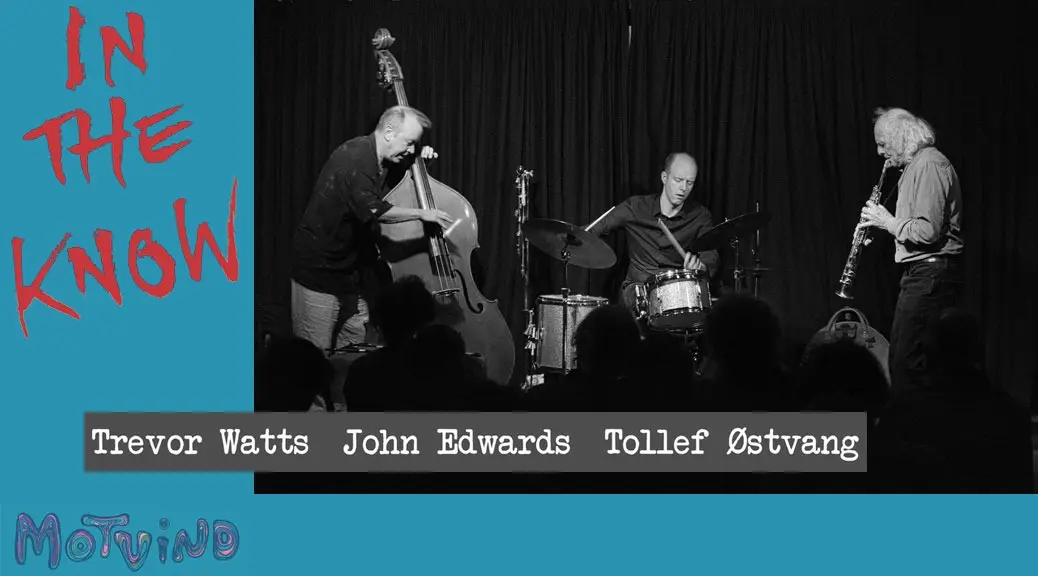
The latest jewel in this avant-garde crown is In the know, an explosive document of transnational free jazz at its most telepathic. Born out of a special festival commission for the 2022 edition of the Motvind Festival staged at the historic Numedal medieval centre, Norwegian drummer Tollef Østvang was tasked with assembling a cross-border ensemble. He reached across the North Sea to enlist two titans of the British free improvisation underground: saxophonist Trevor Watts and double bassist John Edwards.
The resulting album, recorded live on February 13, 2024, at Oslo’s Kafé Hærverk during the city’s celebrated Blow Out series, captures a rare lightning-in-a-bottle chemistry. Spanning three distinct musical generations, the trio—Watts (born 1939), Edwards (emerging in the 1980s scene), and Østvang (a product of the modern Nordic jazz apparatus)—merges foundational European free jazz history with contemporary vitality. The resulting album presents a masterclass in spontaneous architecture: a single, uninterrupted, white-hot improvisation that challenges listeners while rewarding them with a profound journey through texture, velocity, and unbridled acoustic power.
Detailed Chronology: The Genesis and Live Trajectory of In the know
The evolutionary trail of In the know traces a path across decades of European jazz history, converging in the winter of 2022 when Tollef Østvang assembled his dream trio for the Motvind Festival. While the ensemble configuration—saxophone, double bass, and drums—hearkens back to the classic line-ups of 1960s British free jazz, the dynamic interplay between these three specific players introduces a distinctly modern friction and release.
Following their initial Norwegian pairing, the trio refined their telepathy through rigorous international touring. Late 2023 saw the ensemble take to German stages, testing the waters of their transatlantic collaboration before undertaking a high-profile February 2024 tour. This mid-winter run yielded the recording for In the know, captured live by engineer Stig Gunnar Ringen at Kafé Hærverk for the Blow Out improvised music series.
The logistical reality of their live performances offers a fascinating window into their compositional approach. The very next night after their Oslo recording, the trio touched down at London’s iconic Cafe OTO, followed rapidly by stops at Birmingham’s Midlands Arts Centre (MAC) and Hastings. Promoters noted a compelling structural fluidity across these dates: while the Oslo performance manifested as a single, uninterrupted, forty-five-minute monolith of sound—a format uniquely suited to the CD medium to avoid the disruption of an LP flip—the English dates adapted in real-time. At Cafe OTO, the set fractured into three distinct pieces; in Birmingham and Hastings, it expanded into one massive, sprawling improvisation anchored by a concise coda.
Following their UK assault, the trio’s trajectory pointed outward across the globe. An extensive United States tour in early 2025 brought their ferocious acoustic dialogue to audiences in cities such as Madison, Wisconsin, exposing American listeners to a lineage of European improvisation that few living musicians can authentically trace back to the source. Most recently, in April 2026, the trio made a triumphant pilgrimage back to where it all began: the Numedal medieval centre, performing under the auspices of the Rollag Folk & Jazzklubb. Sixty years after the inception of London’s Little Theatre Club, Trevor Watts, at 87 years of age, remains an indefatigable force on the global highway.
Supporting Context & Metrics: A Lineage Forged in Fire
To fully appreciate the weight of In the know, one must understand the towering historical lineages embodied by its personnel. At the center of the storm is Trevor Watts, whose personal narrative is inextricably linked to the birth of European free improvisation itself.
Born in York in 1939 and largely self-taught, Watts crossed paths with drummer John Stevens and trombonist Paul Rutherford while serving in Royal Air Force bands stationed in Germany. Upon their return to London in 1965, Stevens assumed the drum chair in a quintet co-led by Watts and Rutherford. When the legendary Little Theatre Club opened its doors at the dawn of 1966, that very group transformed into the legendary Spontaneous Music Ensemble (SME), the crucible from which British free improvisation was born.
With Stevens having passed away in 1994 and Rutherford in 2007, Watts stands today as the last surviving founder of the SME. His restless creative spirit led him to form Amalgam in 1967. The group’s debut, Prayer for Peace, recorded at Advision in London in May 1969, was a foundational trio session for alto saxophone, bass, and drums—featuring Jeff Clyne on bass (with Barry Guy stepping in for the title track) and John Stevens at the kit. Remarkably, when In the know was taped in Oslo, Watts was a mere fortnight short of his 85th birthday, stepping back into the exact saxophone, bass, and drums configuration of that historic first Amalgam record some fifty-five years prior.
Watts’ subsequent ventures include Moiré Music, established in 1982, which incorporated the largely Ghanaian percussion line-up of the Moiré Music Drum Orchestra (documented brilliantly on ECM’s A Wider Embrace), alongside his long-running "Dialogues" duo with pianist Veryan Weston.

Enter double bassist John Edwards. Taking up the instrument in 1987, Edwards had by the mid-1990s become an indispensable linchpin of the London avant-garde scene. Over a prolific career, he has shared stages and recording studios with free jazz royalty, including Evan Parker, Peter Brötzmann, Louis Moholo-Moholo, and Joe McPhee. Crucially, Edwards and Watts were far from strangers when Østvang made his call; Edwards previously held the bass chair in the Trevor Watts Quartet, alongside Veryan Weston and drummer Mark Sanders. Their 2019 Cafe OTO residency, captured on the Polish label Fundacja Słuchaj as The Real Intention, proved their profound affinity. In essence, Østvang’s festival commission preserved the saxophone and bass axis of that quartet, dropping the piano and seating Østvang himself behind the drum kit.
Rounding out the trio is Tollef Østvang, affectionately dubbed Trollmannen fra Os ("The Wizard of Oz") by the Motvind team, referencing the Norwegian title of the classic American tale. Growing up in Os, a small mountain town in Østerdalen where he resides today, Østvang completed his master’s degree at the prestigious NTNU jazz program in Trondheim, supplemented by formative studies in Paris and Amsterdam. He remains an anchor of Oslo’s improvising community, curating the Fri resonans festival and the FRI FORM concert series. His extensive recording and touring CV includes forward-thinking outfits such as Friends & Neighbors, All Included, and Universal Indians (the latter featuring free jazz icon Joe McPhee, whom Motvind brought to Rollag as artist-in-residence in 2024). Furthermore, Østvang maintains a trans-Atlantic creative partnership in Chicago alongside saxophonist Dave Rempis.
Bridging three distinct generations of avant-garde practice, this trio is not merely a pickup band of seasoned veterans; it is a living conduit of jazz history.
Official Statements & Critical Perspectives
The critical reception of the trio’s live performances and recorded output underscores the unique gravity of their collaboration. Promoters and critics alike have remarked on the shape-shifting nature of their stage presence, where spontaneous composition meets telepathic precision.
Reflecting on the English leg of their 2024 tour, veteran promoter and jazz authority Tony Dudley-Evans observed the structural elasticity that defines the ensemble’s live ethos. Observing their performance at Birmingham’s Midlands Arts Centre, Dudley-Evans noted that while each UK date was mapped out as a single, continuous performance arc, the internal architecture shifted night by night. Where the London audience at Cafe OTO experienced a set divided into three distinct movements, the Birmingham and Hastings crowds were treated to a massive, sprawling opening improvisation followed by a brief, cathartic coda.
In similar fashion, reviewing the definitive Oslo recording captured by Stig Gunnar Ringen, critics have marveled at the sheer physical intensity of the session. The album commences with jagged bass stabs and a piercing, feral screech from Watts, who initially deploys the soprano saxophone. As his linear ideas congeal into ferocious shapes, Østvang’s frenetic drumming erupts, underpinned by Edwards’ driving, tactile pizzicato work.
As the performance unfolds past the twenty-minute mark, the sonic landscape shifts dramatically. The dense wall of sound recedes into minimalist territory, driven by sparse shaker textures and high-register bass squeaks before plunging into what reviewers have described as "the gates of hell opening"—a moment where all three musicians unleash maximum acoustic fury. Yet, it is the closing passages of the set that have garnered the highest critical praise. Here, despite blinding velocities, Østvang locks into an unshakeable rhythmic grid that serves as a physical anchor for the listener. When Watts finally lowers his soprano saxophone, the silence is met with an immediate, rapturous eruption of shouts and applause from the Kafé Hærverk crowd—a testament to a musical journey successfully completed.
Future Outlook: The Enduring Legacy of Transnational Free Jazz
As the dust settles on their international touring cycle—from the historic stones of the Numedal medieval centre in Rollag to the bustling underground venues of Oslo, London, and the American Midwest—the impact of Watts, Edwards, and Østvang resonates far beyond a single album release. In the know stands as a masterwork of modern improvised music, proving that the avant-garde traditions forged in the 1960s British and European underground are not relics of a bygone era, but living, breathing methodologies capable of infinite regeneration.
For Motvind Records, the release cements the label’s status as an essential custodian of uncompromising European sound. By facilitating the convergence of Trevor Watts’ octogenarian wisdom, John Edwards’ peerless bass architecture, and Tollef Østvang’s driving Nordic percussion, the label has captured a rare historical artifact that looks simultaneously backward into the genesis of free improvisation and forward into its boundless future.
As Trevor Watts continues his relentless touring schedule well into his late eighties, and as Østvang and Edwards expand their respective transnational networks, In the know serves as an emphatic reminder that spontaneous music, at its highest level, requires no safety net—only deep listening, absolute trust, and an unwavering commitment to the truth of the present moment.