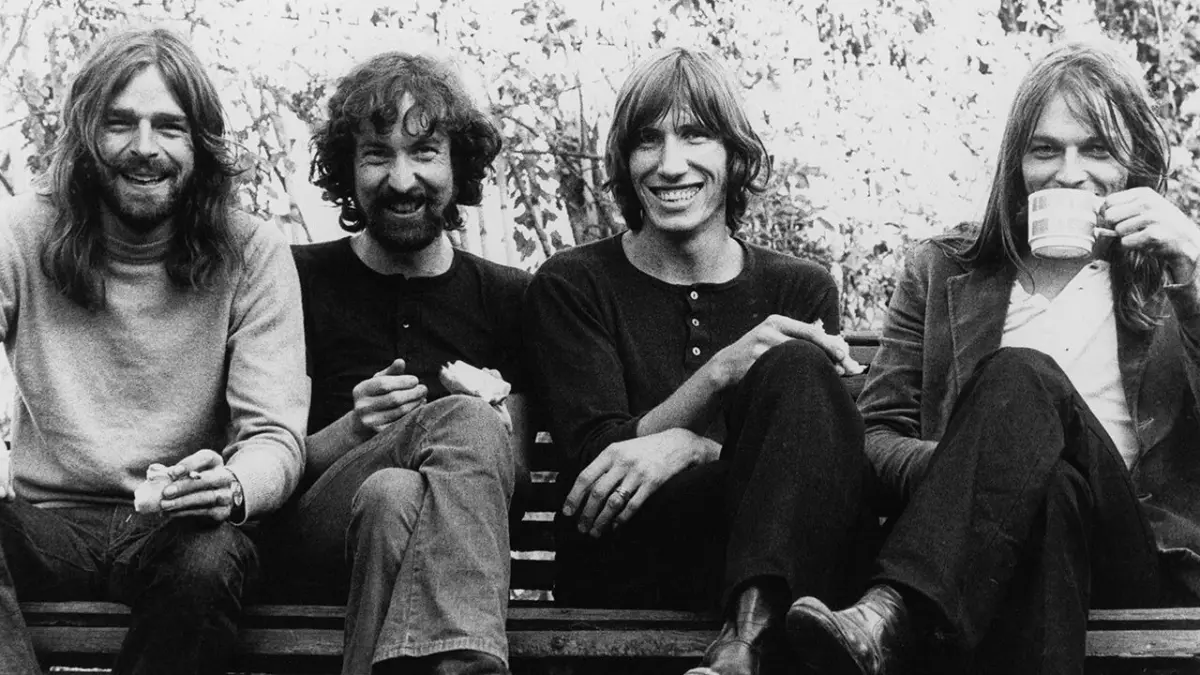
In a milestone archival event bridging progressive rock history and pioneering cinema, Pink Floyd has officially released a newly restored, high-resolution visual edition of their 23-minute masterpiece, "Echoes." The updated footage features the iconic, inside-the-wave cinematography from George Greenough’s seminal short film sequence, originally featured in the 1973 Australian surf documentary Crystal Voyager.
The digital restoration arrives alongside the announcement of a physical media release timed for National Album Day. On October 17, Sony Music will issue a limited-edition San Tropez Orange Marble vinyl pressing of Pink Floyd’s landmark 1971 album Meddle, the studio release on which "Echoes" occupies the entirety of Side Two.
       PINK FLOYD: "ECHOES" & 'MEDDLE' HISTORICAL TIMELINE
===================================================================
 [Jan–Aug 1971]   Band records 'Meddle' at Abbey Road & Morgan Studios
 [Nov 13, 1971]   'Meddle' released; "Echoes" occupies full Side Two
 [1971–1972]      George Greenough invents inside-the-wave camera rigs
 [1973]           'Crystal Voyager' premieres featuring 23-min "Echoes"
 [Oct 17, 2024]   San Tropez Orange Marble vinyl release via Sony Music
===================================================================
This release highlights a historic convergence of avant-garde oceanography and experimental music. When filmmaker David Elfick and surfer-cinematographer George Greenough sought a soundtrack capable of matching the hypnotic rhythm of ocean waves captured from within the barrel, they turned to Pink Floyd’s extended composition. The resulting partnership—struck via an informal barter system—yielded one of the most celebrated synergies of sight and sound in 1970s counterculture, establishing visual backdrops that would define Pink Floyd’s legendary stadium projection shows.
Detailed Chronology: From Abbey Road to the Australian Barrel
+-------------------------------------------------------------------+
|                  THE PATHWAY TO COLLABORATION                     |
+-------------------------------------------------------------------+
| 1. Sonic Experimentation (1971)                                   |
|    Pink Floyd builds "Echoes" from isolated studio fragments       |
|    dubbed "Nothings, Parts 1-36" at Abbey Road.                   |
|                                                                   |
| 2. Oceanic Innovation (1971–1972)                                 |
|    George Greenough builds custom waterproof housing and chest    |
|    mounts to shoot 16mm film inside breaking ocean waves.         |
|                                                                   |
| 3. The Discovery & Synchronization (1973)                         |
|    Greenough listens to a record purchased by his mother and      |
|    discovers "Echoes" matches his 23-minute visual sequence.     |
|                                                                   |
| 4. The Barter Agreement (1973)                                    |
|    Lacking licensing funds, filmmakers offer sync rights in      |
|    exchange for Floyd using the film as concert background visuals|
+-------------------------------------------------------------------+
1971: The Genesis of Meddle and "Echoes"
In early 1971, following the release of Atom Heart Mother, members David Gilmour, Roger Waters, Richard Wright, and Nick Mason convened at EMI’s Abbey Road Studios and Air Monitor Studios in London without pre-written material. Adopting a blank-slate approach, the band recorded individual sonic experiments, cataloged meticulously as "Nothings, Parts 1–36."
Through weeks of improvisation and technical manipulation, these fragments coalesced into "Return of the Son of Nothing," which ultimately became "Echoes." Taking up the entire second side of Meddle at 23 minutes and 32 seconds, the track represented a foundational leap forward in sonic architecture, anchored by Richard Wright’s famous single piano note fed through a Leslie rotating speaker enclosure.
1971–1972: Greenough’s Camera Innovations
Simultaneously in Australia, American-born surfer, boat designer, and oceanographer George Greenough was attempting what many cinematographers considered impossible: capturing point-of-view footage from deep within the vortex of breaking barrel waves.
Utilizing hand-crafted, waterproof camera housings mounted to a customized chest harness and carrying heavy 16mm camera gear onto his kneeboard, Greenough logged hundreds of hours in the ocean. His footage allowed audiences to look out from inside the curl of a wave for the first time in cinematic history.
1973: The Birth of Crystal Voyager and the Historic Trade
Director David Elfick assembled Greenough’s footage into Crystal Voyager, a feature-length documentary showcasing Greenough’s unconventional life and ocean pursuits. Searching for an extended piece of music to accompany a continuous 23-minute sequence inside the surf, Greenough sampled an LP brought home by his mother. Upon playing "Echoes," he realized the track’s spatial cadence, surging dynamics, and exact running length perfectly mirrored the movement of his ocean footage.
Lacking the capital required to purchase commercial sync rights from a major label like EMI, Elfick and Greenough approached Pink Floyd directly during the band’s 1973 tour of Australia. A reciprocal deal was struck:
The Band’s Grant: Pink Floyd permitted Elfick and Greenough to use "Echoes" as the climax of Crystal Voyager.
The Filmmakers’ Grant: Greenough granted Pink Floyd exclusive theatrical distribution rights to use the ocean sequence as visual backdrops during their live concert performances worldwide.
Supporting Context & Critical Analysis
+-------------------------------------------------------------------+
|               "ECHOES" SONIC & VISUAL SYNERGY                     |
+-------------------------------------------------------------------+
| MUSICAL DYNAMICS                 VISUAL CORRELATE (GREENOUGH)    |
| ----------------                 ----------------------------     |
| Single Piano Ping (Leslie Cab)   First droplets breaking surface  |
| Soaring Guitar Slide (Gilmour)   Ascending the wave crest         |
| Mid-Song Funk Groove             Riding deep within the barrel    |
| Reversed Wah-Wah "Seagulls"      Turbulent white water & foam     |
| Ascending Keyboard Harmony       Emerging back into sunlight      |
+-------------------------------------------------------------------+
The Sonic Architecture of "Echoes"
To understand why Greenough’s visuals matched Pink Floyd’s music so closely, one must examine the composition’s structural design:
The Musical "Ping": The piece opens with Richard Wright playing a High B note on a Steinway baby grand piano, routed through a Leslie 145 speaker cabinet. This underwater-like sound creates an acoustic impression of sonar pinging in an oceanic abyss.
The Atmospheric Ascent: David Gilmour’s slide guitar enters alongside Roger Waters’ subtle bassline and Nick Mason’s understated cymbal work, echoing the swelling rhythm of distant sea tides.
The Central Jam: The track shifts into an aggressive, funk-infused 4/4 rhythm driven by Waters and Mason, supporting Gilmour’s blues-inflected lead runs. In Crystal Voyager, this section accompanies high-speed, close-up tracking shots inside the barrel of the wave.
The Avant-Garde "Seagull" Sequence: The mid-section features abstract soundscapes produced by reversing the input/output cables on Gilmour’s Vox Wah pedal. This produces high-pitched, vocal-like screeches that evoke sea birds circling above turbulent water.
                  MEDDLE: ALBUM STRUCTURE & PROFILE
+-------------------------------------------------------------------+
| TRACK                  | DURATION | CORE INSTRUMENTATION          |
+------------------------+----------+-------------------------------|
| 1. One of These Days   |  5:57    | Dual Tremolo Bass, Pedal Steel|
| 2. A Pillow of Winds   |  5:10    | Acoustic Guitars, Slide Guitar|
| 3. Fearless            |  6:08    | Acoustic Guitar, Field Audio  |
| 4. San Tropez          |  3:43    | Piano, Jazz Bass, Wurlitzer   |
| 5. Seamus              |  2:16    | Acoustic Blues, Harmonica     |
| 6. Echoes              | 23:32    | Piano (Leslie), Organ, Guitar |
+-------------------------------------------------------------------+
Meddle as the Critical Bridge Album
Meddle occupies a pivot point in Pink Floyd’s discography. Positioned between the post-Syd Barrett psychedelic experimentation of Ummagumma (1969) and Atom Heart Mother (1970), and the commercial success of The Dark Side of the Moon (1973), Meddle represents the moment where the four band members consolidated their collective identity.
Without an outside producer steering the sessions, the group took full ownership of the production process alongside Abbey Road engineers John Leckie and Peter Bown. This period of creative independence established the recording techniques—such as multi-track sound-effects layering and expansive dynamic contrasts—that defined their multi-platinum releases later in the decade.
Official Statements & Archival Reflections
Reflecting on the historical union between the track and Greenough’s footage, Pink Floyd drummer Nick Mason shared insights into the band’s reaction upon first viewing the film during their 1973 tour:
"We watched it for the first time when we were on tour in Australia and we were all blown away by it. It was absolutely sensational. Nowadays everyone’s got a GoPro fixed to their wetsuit, but at the time it was mind-blowing to see the guy with the camera strapped to his chest, going through the water tunnel."
Mason further expanded on the atmosphere within the studio during the Meddle sessions, pointing out how the band’s self-production fostered a unique creative environment:
"It did feel experimental at the time because basically we were left to our own devices, and we didn’t have a producer as such. We sort of made the album ourselves, and of course that meant that the engineering staff in Abbey Road were very happy to come along and see what they could do.
The great thing with Meddle is that it’s the band playing for the enjoyment of it. It probably is one of the freest albums of all in terms of how we played it. It was one of those things that we really looked forward to playing."
+-------------------------------------------------------------------+
|                     NICK MASON ON 'MEDDLE'                        |
|                                                                   |
|  "The great thing with Meddle is that it's the band playing for  |
|   the enjoyment of it. It probably is one of the freest albums   |
|   of all in terms of how we played it."                           |
|                                                                   |
|   — Nick Mason, Pink Floyd Drummer / Co-Founder                   |
+-------------------------------------------------------------------+
Future Outlook & Cultural Resonance
The Modern Restoration
The newly restored footage of "Echoes" utilizes advanced digital re-scanning techniques to clean and color-grade Greenough’s original 16mm ocean footage frame-by-frame. By removing film grain artifacts while preserving the natural lighting of the aquatic environment, the restoration offers clarity that matches high-definition audio remasters.
                   AUDIO-VISUAL RESTORATION METRICS
+-------------------------------------------------------------------+
| METRIC                 | ORIGINAL (1973)    | RESTORATION (2024)  |
+------------------------+--------------------+---------------------+
| Film Source            | 16mm Kodachrome    | High-Res Digital Scan|
| Color Space            | Analog Projection  | Extended Gamut Digital|
| Audio Master           | 1971 Stereo Mix    | Remastered High-Res |
| Primary Media Format   | 35mm Theatrical    | Stream / Marble LP  |
+-------------------------------------------------------------------+
The 2024 Vinyl Collector’s Reissue
The release of the San Tropez Orange Marble vinyl edition of Meddle through Sony Music reflects the continued vinyl revival among physical media collectors.
               'MEDDLE' SAN TROPEZ ORANGE MARBLE SPECIFICATIONS
+-------------------------------------------------------------------+
| Label                  | Sony Music                               |
| Release Date           | October 17, 2024                          |
| Campaign Event         | National Album Day                       |
| Disc Format            | 12-inch Heavyweight Colored Vinyl         |
| Variant Name           | San Tropez Orange Marble                 |
| Audio Source           | Original Stereo Remaster Master Tapes    |
+-------------------------------------------------------------------+
Legacy and Influence
The synthesis of Greenough’s visual work and Pink Floyd’s music left a lasting imprint on both surf culture and rock concert production:
Concert Production: By projecting Greenough’s inside-the-wave footage onto massive circular screens (the "Mr. Screen" rig) during their mid-1970s stadium tours, Pink Floyd helped establish immersive backdrops as a standard feature of modern rock concerts.
Extreme Sports Cinema: Greenough’s chest-mounted camera work set the structural template for modern action-sports videography, directly influencing generations of filmmakers and hardware developers who created contemporary point-of-view cameras.
Decades after its original release, the pairing of "Echoes" and Crystal Voyager remains a high watermark of rock-and-roll visual storytelling—a seamless alignment of physical human endurance, pioneering film technology, and progressive musical soundscapes.