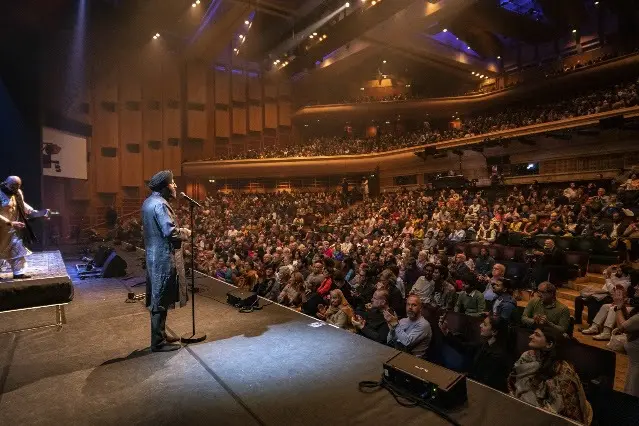
The Barbican Centre in London is set to transform once again into a sanctuary of profound acoustic resonance as the Darbar Festival returns for its landmark 21st year. Running from 28 October to 1 November, this five-day celebration stands as the premier UK showcase for Hindustani and Carnatic classical music. Spanning the prestigious spaces of Barbican Hall and Milton Court, the 2026 iteration introduces a gripping conceptual framework: The Shock of the New. This year’s curation deliberately stretches the boundaries of traditional South Asian classical arts by spotlighting debut performances, rare genre-crossing collaborations, and, for the first time in the festival’s illustrious history, a dedicated late-night concert series.
Far from being a static museum piece of cultural heritage, Indian classical music under the Darbar banner emerges as a living, breathing, and aggressively evolving art form. The 2026 programme carefully bridges the gap between ancient lineage and modern innovation. It features world-renowned maestros alongside pioneering artists stepping onto the Barbican stage for the very first time. By integrating immersive talks, educational workshops, documentary screenings, and a comprehensive wellness strand featuring live-music yoga and raga meditation, Darbar continues to redefine what a contemporary music festival can achieve.
At the helm of this cultural titan is Artistic Director Sandeep Virdee, whose personal journey from a young boy listening to his father’s tabla in Kenya to the curator of the largest Indian classical music festival outside of India anchors the event in deep emotional authenticity. As the festival prepares to open its doors, this comprehensive report examines the structural layout, artistic ambitions, historical lineage, and broader cultural implications of the 2026 Darbar Festival.
Detailed Chronology: A Five-Day Masterclass in Hindustani and Carnatic Traditions
The 2026 programme is meticulously structured across five intensive days, offering audiences an immersive dive into the intricate microtones, complex rhythmic cycles (talas), and deeply evocative melodic frameworks (ragas) of South Asian classical traditions.
Opening Wave and Foundational Debuts (28 October – 29 October)
The festival launches with an explicit nod to The Shock of the New, immediately introducing audiences to artists making their long-overdue festival debuts. Opening night sets a high bar with masterclasses in instrumental and vocal dexterity.
The acclaimed sarod duo Amaan Ali Bangash and Ayaan Ali Bangash bring their peerless command of the Senia Bangash lineage to Barbican Hall, weaving intricate melodic conversations through the fretless wooden frame of the sarod. Sharing the spotlight are esteemed vocalists such as Sandeep Narayan, whose mastery of Carnatic music brings southern warmth and structural rigor to the London stage, and sitar maestro Ustad Irshad Khan, alongside the formidable vocal styling of Pandit Prasad Khaparde.

Mid-Festival Explorations and Rare Pairings (30 October – 31 October)
As the festival progresses into its middle days, the programming dives deeper into unexpected artistic pairings and rare, endangered performance arts. One of the crown jewels of the mid-festival lineup is a rare dhrupad performance by Ustad Wasifuddin Dagar. Dhrupad, the oldest surviving form of North Indian classical music, demands extraordinary breath control, unwavering vocal pitch, and spiritual surrender—qualities that Dagar delivers with masterclass precision.
Simultaneously, the festival champions genre-crossing collaborations and innovative duos designed to challenge conventional listening habits. Sitar virtuoso Jasdeep Singh Degun joins forces with legendary tabla player Sukhvinder Singh Pinky in a cross-generational summit of rhythm and melody. Fresh pairings further enrich the schedule: sitar and sarod proponents Debanjan Bhattacharjee and Spoorthi Rao lock into dynamic dialogue, while vocalist Sunanda Sharma collaborates with tabla soloist Ustad Shahbaz Hussain to explore the emotive depths of regional North Indian repertoires.
Breaking New Ground: The Midnight Ragas (1 November)
In a historic departure from tradition, the 2026 festival shatters temporal boundaries by introducing Darbar’s first-ever late-night concert series, titled Midnight Ragas. Historically, certain ragas in the Indian classical tradition are strictly bound to specific times of day or night, designed to evoke the psychological states of twilight, deep night, or dawn.
To honor this ancient performance tradition, the festival’s grand finale features a transcendent late-night session led by violin virtuoso Kala Ramnath and acclaimed veena player Jayanthi Kumaresh. This unprecedented midnight journey invites audiences to experience the meditative, hypnotic potency of late-night ragas within the state-of-the-art acoustic architecture of Milton Court—a fittingly immersive climax to five days of musical revelation.
Supporting Context, Educational Outreach, and Metrics
The impact of the Darbar Festival extends far beyond the ticketed concert hall. Recognizing that Indian classical music can occasionally feel daunting to uninitiated listeners, the organization has institutionalized a multi-layered educational and accessibility framework.
Dismantling Barriers: Appreciation Courses and Screenings
To foster genuine engagement, the 2026 edition features the Indian Classical Music Appreciation Course, explicitly designed to demystify the complex grammar of ragas and talas for newcomers. This academic and experiential offering is complemented by a series of intimate artist talks. Highlights include A Voice Without Borders featuring Sandeep Narayan, which explores the universal communicative power of Carnatic vocal traditions, and The Benaras Gharana with Sunanda Sharma, shedding light on the historical stylistic lineage of North India’s musical heartland.

Adding a poignant socio-documentary dimension to the arts programme is a special screening of India’s Vanishing Voice, a filmic exploration of the challenges facing traditional practitioners and rural maestros whose generational knowledge risks fading into obscurity amidst rapid modernization.
The Holistic Dimension: Yoga, Meditation, and Breathwork
Understanding that South Asian classical music and holistic wellbeing share a common philosophical root in ancient Vedic traditions, Darbar 2026 features a dedicated Yoga and Wellbeing strand. These sessions bypass passive listening, inviting participants to actively engage their bodies and minds through live-music yoga classes, guided raga meditation, and specialized breathwork workshops. By synchronizing physical movement and conscious breathing with live classical improvisation, the festival operationalizes the therapeutic and healing properties inherent in raga music.
Grassroots Education: Cultivating the Next Generation
The festival’s educational commitment is not limited to London’s elite arts spaces. Alongside the main event, Darbar operates a robust music education project targeting primary school children aged 8 to 11 in Leicester. This initiative honors the legacy of Sandeep Virdee’s late father, Bhai Gurmit Singh Virdee, who served as a peripatetic tabla teacher in Leicester for 22 years. By planting the seeds of rhythmic literacy and melodic appreciation in British classrooms, Darbar ensures that the future of Indian classical music in the UK is supported by an informed, diverse, and passionate younger demographic.
Official Statements and Institutional Vision
The conceptual backbone of the 2026 festival is articulated clearly by its founder and artistic director, Sandeep Virdee, whose lifelong dedication to the art form has shaped Darbar into a globally recognized institution. Reflecting on the ethos of this year’s gathering, Virdee notes:
"Darbar Festival exists to bring the depth, discipline and sheer emotional power of Indian classical music to the widest possible audience. This year, under the banner of ‘The Shock of the New’, we’re introducing UK audiences to extraordinary artists they will never have heard perform before, and pushing the festival itself into new territory with our first-ever midnight concert. It’s a programme that reflects both the tradition’s rich heritage and its constantly evolving present, with performances that will resonate with lifelong connoisseurs and first-time listeners alike."
Virdee’s personal trajectory remains the emotional engine driving the festival. Born in Nakuru, Kenya, Virdee’s earliest auditory memories were shaped by his father, Bhai Gurmit Singh Virdee, practicing the tabla. When the family relocated to London in 1975, the young Sandeep experienced his first live Indian classical concert—an epiphany that permanently welded his identity to the art form.

Following his father’s passing in 2005, Virdee organized a memorial tribute concert. That single evening of remembrance catalyzed an extraordinary institutional evolution. Over the past two decades, Darbar has burgeoned from a grassroots community gathering in Leicester into the largest festival of Indian classical music outside of India, earning international critical acclaim for its curatorial integrity and technical production standards.
Future Outlook: Legacy, Evolution, and Global Resonance
As the Darbar Festival looks ahead to its milestone 21st anniversary in 2026, its trajectory offers a masterclass in cultural stewardship. In an era where global arts festivals frequently pander to commercial homogenization, Darbar stubbornly champions an art form that demands patience, active listening, and deep emotional investment.
By introducing The Shock of the New, the festival proves that traditional arts do not need to dilute their purity to remain relevant; rather, they can expand their vocabulary by embracing fresh voices, cross-genre dialogues, and unconventional timeframes like the Midnight Ragas.
The institutional roadmap for Darbar points toward sustained expansion—not merely in audience numbers, but in geographical footprint and educational depth. Through continued investment in school outreach programs in Leicester and London, ongoing academic partnerships, and innovative wellness integrations, Darbar is institutionalizing a sustainable ecosystem for South Asian classical arts in the West.
When the final notes fade at the Barbican Centre on the night of 1 November 2026, the resonance will linger far beyond the brutalist concrete walls of the arts center. It will echo in the minds of first-time attendees newly awakened to the majesty of a raga, in the disciplined hands of young students striking the tabla in Leicester classrooms, and in the global dialogue proving that ancient musical traditions hold vital, life-affirming truths for the modern world.