Executive Overview
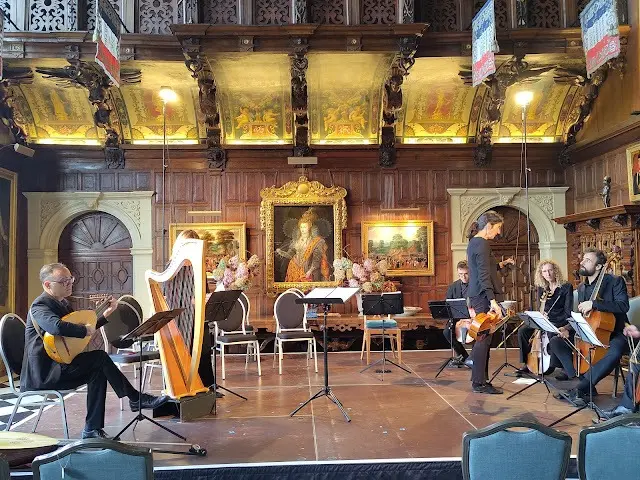
The historic Marble Hall of Hatfield House provided a breathtaking backdrop for a milestone cultural event as the Hatfield House Music Festival officially launched its 15th-anniversary season. Under the watchful gaze of the iconic "Rainbow Portrait" of Queen Elizabeth I, an assembled audience was treated to an immersive early-seventeenth-century sonic landscape titled "Music which pleaseth myne ear."
Curated to celebrate multiple historic milestones—including the 15th anniversary of the festival under artistic director and cellist Guy Johnston, the 80th birthday of the current Lord Salisbury, and the quadricentennial of the death of master lutenist John Dowland—the opening concert transported listeners back to the very era in which the Jacobean mansion was completed in 1611.
The opening night performance bridged centuries through a meticulously crafted programme featuring the works of William Byrd, Thomas Morley, John Dowland, Tobias Hume, William Lawes, and John Coprario. The artistic collaboration brought together some of the finest exponents of early music: Harry Christophers leading members of the renowned vocal ensemble The Sixteen, the esteemed viol consort Fretwork, period harpist Joy Smith, and lutenist Eligio Luis Quinteiro.
What transpired was a masterclass in historical performance practice. The evening successfully resurrected the domestic and courtly auditory experiences intended for the original Lord Salisbury, utilizing the Marble Hall’s celebrated acoustics to showcase the profound, multifaceted genius of William Byrd and his Elizabethan and Jacobean contemporaries.
Detailed Chronology: A Journey Through Jacobean Soundscapes
The musical journey commenced precisely at 5:00 PM on October 8, immediately establishing an atmosphere of vibrant courtly entertainment and intimate devotional reflection.
The Opening Flourish and Lyrical Wit
The concert opened with Thomas Morley’s lively madrigal, I love, alas, I love thee. Brimming with rhythmic felicity, the performance played playfully with text-setting nuances—evoking an intentional double entendre of "I love, a lass, I love thee" that delighted the audience and set an accessible, engaging tone for the evening.
This was swiftly followed by John Dowland’s elegant instrumental dance, My Lord Willoughby’s Welcome Home. Here, the luminous timbre of Joy Smith’s period harp blended seamlessly with the delicate plucking of Eligio Luis Quinteiro’s lute. The resulting sonic texture was intensely seductive, prompting listeners to imagine the grand welcomes echoing through the estate centuries prior.
The vocal forces of The Sixteen then introduced a contrasting layer of gravity with William Byrd’s Retire my soul. Conceived as a serious, moral devotional song intended for private domestic performance, it highlighted the introspective dimension of Renaissance spiritual life.
Textures and Intertwining Lines
As the programme progressed, instrumental combinations expanded to include the deep, plangent tones of the viol consort. Richard Boothby and Sam Stadlen, operating on bass viols, brought out the intricate, intertwined voice-leading in Tobias Hume’s Sweet musicke. Subtitled Earle of Salisburies favoret delight, the piece proved that early-seventeenth-century music was frequently driven less by a dominant melody and more by a rich, democratic weaving of texture.
The Sixteen returned to contrast the outward-facing melancholy of Dowland’s Weep no more sad fountains with the exuberant rhythmic vitality of Up merry mates. This dynamic interplay continued with Byrd’s introspective Come woeful Orpheus and the more intimate, three-voice domestic song In winter cold. Households of the Elizabethan and Jacobean eras frequently employed servants specifically for their musical capabilities, creating communal artistic circles where masters and staff sang side by side—a spirit mirrored in the collaborative energy on stage.
Lute Intimacies and Consort Masterpieces
Eligio Luis Quinteiro offered an exquisite solo reading of Dowland’s melancholic lute piece Robin, before being joined by Joy Smith’s luminous harp for the sprightly galliard My Lord Chamberlain, his Galliard.
Fretwork then took center stage for William Byrd’s In nomine a 5. The viol consort demonstrated a unified, homogenous voice that remained distinctly Byrdian, paving the way for the toe-tapping rhythmic liveliness of Byrd’s Pauana, The Earle of Salisbury and Galiardo.
John Coprario (Cooper), a composer historically tied to the first Lord Salisbury’s Hatfield circle, was represented by Illicita Cosa. This five-viol fantasia broke conventional compositional rules of the period with deliberate, delightfully eccentric harmonies that challenged and captivated the modern ear.
Rare Live Encounters: William Lawes’s Harp Consorts
Among the evening’s highest scholarly and aesthetic points were two rare performances of works by William Lawes for harp consort—consisting of harp, lute, treble viols, and bass viols. Setting bass themes by J. Cormacke and John Coprario respectively, these pavans functioned essentially as elaborate sets of variations.

For many in attendance, this marked the first time hearing these specific harp consort pieces performed live rather than via studio recordings. The arrangement allowed the plangent, singing upper and lower lines of the viols to frame the rich, glowing infilling of the harp, creating an arresting spatial and textural dynamic within the Marble Hall.
The Grand Synthesis
As the concert neared its conclusion, the various ensembles united. The Sixteen joined Fretwork for Byrd’s Have mercy upon me O God, an adaptation of Psalm 51 drawn from the composer’s 1911 publication Psalmes, songs and sonnets. The dark, chestnut timber of the viols provided a stunning foundation for the crystalline clarity of the vocal lines, featuring solo alto Elisabeth Paul transitioning effortlessly into full choral texture.
Katy Hill then delivered a striking soprano solo in Byrd’s Ah, silly soul, her expressive, serious vocal line dancing above the mobile counterpoint of five interweaving viol lines. Consort songs of this caliber remain a rare and unjustifiably neglected jewel in the modern classical concert repertoire.
The evening culminated in a collective triumph: Byrd’s consort song O God that guides the cheerful sun. Featuring verses led by soprano soloist Katy Hill alternating with full choral choruses, and accompanied by the full complement of viols, harp, and lute, the piece balanced deep spiritual solemnity with infectious rhythmic buoyancy. As soloists and instrumentalists traded rhythmic motifs in joyous echo, the performance encapsulated the very essence of artistic synergy.
Supporting Context & Metrics: A Legacy in Stone and Sound
To fully appreciate the significance of the Hatfield House Music Festival’s opening night, one must examine the historical and institutional framework supporting it:
- Architectural Heritage: Completed in 1611 by Robert Cecil, the 1st Earl of Salisbury, Hatfield House has long functioned as a repository of British history. Its Marble Hall remains structurally unaltered in its core Jacobean grandeur, offering natural acoustic decay that flatters Renaissance polyphony and consort music.
- Festival Longevity: Founded 15 years ago under the artistic direction of acclaimed cellist Guy Johnston, the festival has grown from a localized classical music series into a premier fixture on the British cultural calendar, drawing international performers and discerning audiences alike.
- Repertoire Significance: The programming heavily emphasized the synthesis of domestic and public music-making in the early 17th century. As musicologist Stephen Johnson noted in the programme notes, William Byrd’s ability to navigate political and religious pressures through coded messages of hope and consolation in his music draws striking parallels to the creative compromises faced centuries later by Soviet composer Dmitri Shostakovich.
- Collaborative Scale: The opening concert brought together nearly two dozen world-class early music specialists, combining elite choral voices (The Sixteen), premier viol consort players (Fretwork), and specialized continuo artists (harp and lute) in a configuration rarely witnessed outside major capital cities.
Official Statements and Artistic Vision
Reflecting on the milestone 15th anniversary and the conceptual framework of the opening programme, organizers and performers emphasized the deep emotional and historical resonance of the event.
"When the first Lord Salisbury constructed this house, music was woven into the very fabric of daily life, performed by resident consorts in halls just like this one. To bring this specific repertoire back into the Marble Hall, surrounded by the iconography of Elizabeth I, is not merely a historical exercise—it is an act of cultural restoration."
— Festival Representative
Artistic Director Guy Johnston, whose vision has steered the festival’s growth over the past decade and a half, has consistently championed the integration of world-class chamber music within historic Kent and Hertfordshire landmarks. The decision to anchor the festival’s opening night in the music of William Byrd and John Dowland underscored a commitment to honoring Britain’s rich polyphonic heritage while celebrating contemporary performance excellence.
Harry Christophers, directing members of The Sixteen, echoed the sentiment of acoustic synergy:
"The Marble Hall possesses a rare acoustic fingerprint that honors vocal clarity while allowing instrumental consorts to bloom. Performing Byrd and his contemporaries here feels less like stepping onto a stage and more like stepping through a portal into the domestic chambers of the Jacobean court."
Future Outlook
With such a triumphant and scholarly ambitious opening night, the Hatfield House Music Festival has set an exceptionally high benchmark for the remainder of its 15th-anniversary season.
As the festival continues its run, it reinforces its dual mandate: preserving and revitalizing early British musical heritage while offering contemporary audiences world-class interpretations within breathtaking architectural spaces. The success of Music which pleaseth myne ear demonstrates that public appetite for historically informed, intellectually engaging early music remains robust.
Looking forward, the festival’s enduring partnership with historic spaces like Hatfield House ensures that future iterations will continue to unearth neglected masterpieces, foster elite cross-disciplinary collaborations, and maintain Hatfield’s historic reputation as a vital sanctuary for the living arts.