Executive Overview
In a powerful display of mentorship, community engagement, and musical excellence, acclaimed British cellist Sheku Kanneh-Mason recently brought a triumphant tour with the Royal Northern Sinfonia to a memorable close. Following a series of critically lauded performances traversing Middlesbrough, Kendal, and Gateshead—where he interpreted Camille Saint-Saëns’ Cello Concerto No. 1 under the baton of conductor Dinis Sousa—Kanneh-Mason turned his focus from the formal concert hall to the vibrant heart of music education.
Arriving at The Glasshouse International Centre for Music, the world-renowned soloist joined forces with an extraordinary ensemble of 24 young cellists for a massed public performance. This unique collaboration served as the crowning jewel of The Glasshouse’s Make Music Young People initiative and its popular Sunday Lunchtime Concert series. The ensemble brought together participants from the institution’s Young Sinfonia and Centre for Advanced Training (CAT) programmes, alongside dedicated tutors, professional players from the Royal Northern Sinfonia, and alumni of the venue’s far-reaching educational pathways.
Against the striking architectural backdrop of The Glasshouse’s public concourse, the intergenerational ensemble delivered a rich, eclectic repertoire spanning classical masterworks and rhythmic folk-inspired arrangements, including works by Heitor Villa-Lobos, George Gershwin, and Scott Joplin. This event underscored the vital role of grassroots music education in nurturing emerging talent, offering students an unprecedented opportunity to share the stage with one of the defining classical artists of their generation. As cultural institutions across the globe grapple with how to engage younger demographics and make classical music accessible, this collaboration stands as a masterclass in community integration, artistic mentorship, and the enduring power of shared musical experiences.
Detailed Chronology: From Orchestral Masterpieces to Concourse Collaboration
The events leading up to Sunday’s unforgettable massed performance were characterized by intense artistic collaboration, rigorous preparation, and a deep-seated commitment to regional cultural enrichment.
The Northern Tour
Kanneh-Mason’s week began on the road with the prestigious Royal Northern Sinfonia. Under the dynamic musical direction of conductor Dinis Sousa, the ensemble embarked on a regional tour that showcased Saint-Saëns’ emotionally resonant and technically demanding Cello Concerto No. 1 in A minor, Op. 33. The tour made stops in Middlesbrough and Kendal before arriving at The Glasshouse in Gateshead. Critics and audiences alike praised Kanneh-Mason for his characteristic warmth, technical precision, and deeply expressive phrasing. Performing the Romantic-era masterpiece across multiple venues allowed the soloist to connect with diverse audiences throughout Northern England, reinforcing the Royal Northern Sinfonia’s reputation as a cornerstone of the region’s cultural landscape.
The Rehearsal Process
However, the climax of Kanneh-Mason’s residency extended far beyond the traditional proscenium arch. On Sunday morning, the focus shifted from solo virtuosity to collective harmony inside The Glasshouse’s acoustically pristine Northern Rock Foundation Hall. Here, 24 young cellists gathered for an intensive rehearsal session.
The ensemble was a cross-section of The Glasshouse’s thriving musical ecosystem. It featured current students from the Young Sinfonia and the Centre for Advanced Training (CAT)—rigorous developmental programmes designed for exceptionally gifted young musicians—alongside seasoned tutors, professional orchestral players from the Royal Northern Sinfonia, and alumni who had themselves risen through The Glasshouse’s educational ranks.
The rehearsal was marked by an atmosphere of focused camaraderie. Rather than maintaining a rigid hierarchy, Kanneh-Mason integrated seamlessly into the ensemble, offering gentle encouragement, practical technical advice, and shared insights on phrasing and tone production. For the young musicians, many of whom are in the formative stages of their professional development, working shoulder-to-shoulder with an internationally renowned artist provided an invaluable, confidence-building experience.
The Concourse Performance
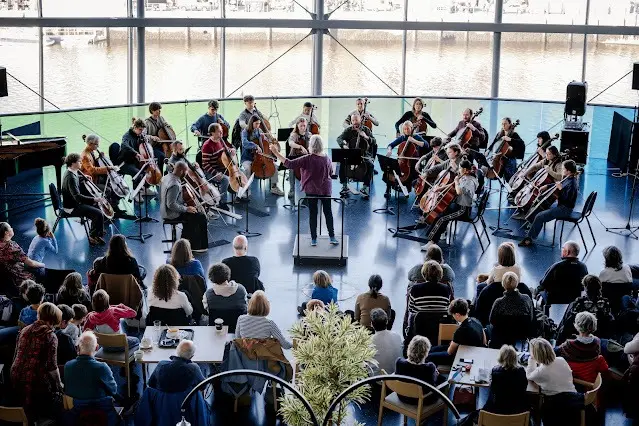
Following the morning rehearsal, the 24-piece cello ensemble transitioned to the bustling public concourse of The Glasshouse for a free, informal lunchtime concert. Part of the venue’s ongoing Sunday Lunchtime Concerts series, the performance was designed to break down the traditional barriers between classical performers and casual passersby.

Surrounded by the natural light and striking architecture of the venue, the massed cello choir delivered a captivating and diverse programme. The setlist was carefully curated to highlight the versatility of the instrument, opening with a movement from Heitor Villa-Lobos’s evocative Bachianas Brasileiras No. 1—a piece originally scored for an orchestra of cellos that bridges Brazilian folk idioms with classical counterpoint. The ensemble then pivoted to the American songbook, performing infectious arrangements of music by George Gershwin and ragtime pioneer Scott Joplin.
The performance drew a substantial and enthusiastic audience, transforming the public concourse into an intimate chamber hall. Spectators ranged from dedicated classical music aficionados to families and weekend visitors experiencing live orchestral music for the very first time. The rich, resonant timbre of 24 cellos reverberating through the open space created an arresting sonic experience, cementing the event as a triumph of public-facing arts programming.
Supporting Context & Metrics: The Architecture of Music Education
To fully appreciate the significance of Sheku Kanneh-Mason’s collaboration at The Glasshouse, one must examine the institutional framework that made it possible. The Glasshouse International Centre for Music (formerly Sage Gateshead) has long been a beacon for arts education in the United Kingdom, operating on the philosophy that world-class performance and grassroots participation should exist in a continuous, mutually reinforcing loop.
The Make Music Young People Programme
At the heart of this educational mission is the Make Music Young People initiative. This comprehensive framework encompasses a wide array of ensembles, weekend schools, and specialized training programs tailored to young people from diverse socioeconomic and geographic backgrounds. The initiative is built on the premise that early access to high-level musical training fosters not only technical proficiency but also essential life skills, including discipline, teamwork, active listening, and creative problem-solving.
The Centre for Advanced Training (CAT) and Weekend School
Central to the weekend’s events were the students of The Glasshouse’s Centre for Advanced Training and Young Sinfonia. The CAT programme represents a rigorous, government-supported pathway for young people demonstrating exceptional musical potential and dedication. These students receive advanced instrumental tuition, mentoring, and performance opportunities designed to prepare them for conservatoire education and professional careers in the arts.
Simultaneously, The Glasshouse operates inclusive, non-auditioned weekend schools featuring bands, choirs, and multi-instrumental ensembles for young people of all ages and skill levels. With applications open on a rolling, year-round basis, these programmes ensure that financial barriers or prior experience do not preclude participation. By integrating CAT students, Young Sinfonia members, and alumni into the same performance as Sheku Kanneh-Mason, The Glasshouse effectively mapped out a developmental continuum, showing young musicians a clear, tangible pathway from local student ensembles to the international concert stage.
The Sunday Lunchtime Concert Series
The venue’s Lunchtime Concerts series plays a crucial strategic role in community engagement. Taking place on Sundays throughout the year, these free mini-performances offer a public platform for the work developed within the CAT and weekend programs. By placing young musicians in public-facing performance environments, The Glasshouse demystifies classical and folk music, inviting the broader community to witness the fruits of sustained educational investment. The integration of a superstar soloist like Kanneh-Mason into this established series dramatically amplified its reach, generating significant local, national, and digital media attention.
Official Statements and Reflections
The collaboration elicited profound reflections from both the headlining artist and the educational leaders who facilitated the residency, highlighting the mutual inspiration that defined the weekend.
Reflecting on the conclusion of his tour and the subsequent youth collaboration, Sheku Kanneh-Mason shared his enthusiasm:

"After my concerts in Middlesbrough, Kendal, and then here at The Glasshouse this week, it was a really special conclusion to hear the young cellists play in the rehearsal and then to join them out on the Concourse, on Sunday morning. The next generation of musicians matters so much, and I loved seeing all the enthusiasm and hearing the talent."
Kanneh-Mason’s words capture a core ethos of his artistic identity. Beyond his historic accomplishments—such as becoming the first Black musician to win the BBC Young Musician award in 2016 and performing at the wedding of Prince Harry and Meghan Markle—he has consistently prioritized music education and advocacy. By actively mentoring young musicians and stepping outside the traditional boundaries of the concert hall, he serves as an accessible role model for aspiring artists worldwide.
Educational administrators and orchestral leaders at The Glasshouse echoed this sentiment, emphasizing the profound psychological and artistic impact such collaborations have on developing musicians. Faculty members noted that seeing a musician of Kanneh-Mason’s stature willingly rehearse and perform alongside students validates the young people’s hard work and dispels the intimidating aura that often surrounds classical music culture.
Future Outlook: Sustaining Momentum in Regional Arts
The success of the massed cello performance at The Glasshouse offers a compelling blueprint for the future of classical music programming and youth arts education in the UK and beyond. As cultural institutions face mounting financial pressures and shifting audience habits, the model demonstrated in Gateshead—combining high-profile orchestral touring with deeply rooted community engagement—proves to be a resilient and impactful path forward.
Bridging Excellence and Accessibility
For decades, classical music has occasionally struggled with perceptions of elitism or inaccessibility. Events like the Sunday concourse performance actively dismantle these barriers. By bringing world-class artists directly into public spaces and pairing them with local students, venues can humanize the art form, inviting broader community ownership.
Furthermore, initiatives like The Glasshouse’s CAT and Make Music Young People programmes demonstrate that investing in regional talent yields long-term cultural dividends. When young musicians are given access to top-tier mentorship, instruments, and performance platforms, the entire cultural ecosystem is enriched. Many alumni of these programs go on to populate professional orchestras, teach future generations, or simply remain passionate, lifelong arts advocates and audience members.
Next Steps for The Glasshouse and Regional Outreach
Building on the momentum generated by Kanneh-Mason’s residency, The Glasshouse plans to expand its outreach offerings, aiming to reach even more young people across the North East of England. Plans are already underway to scale up the Sunday Lunchtime Concerts series, introduce new intergenerational collaborative projects, and deepen partnerships with local schools and community groups.
As Kanneh-Mason returns to his international touring schedule—taking his profound musicianship to concert halls across Europe, North America, and beyond—the echoes of 24 cellos ringing out across the Gateshead concourse will undoubtedly continue to inspire the young musicians who took part. In a world often characterized by division, the sight of a global virtuoso sitting shoulder-to-shoulder with students to make music for the public serves as a powerful reminder of the unifying, transformative potential of the arts.