Executive Overview
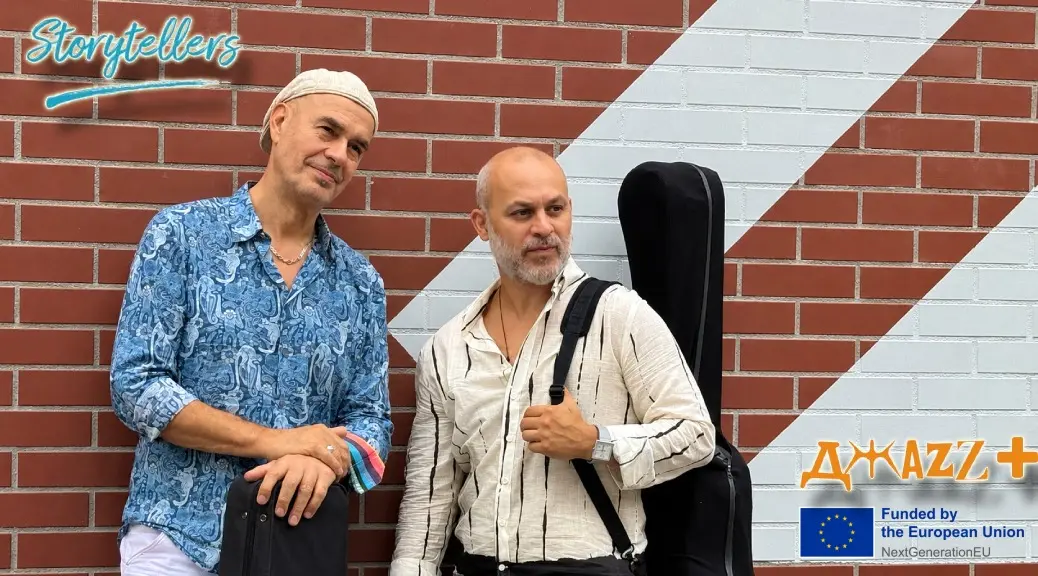
In the contemporary landscape of global instrumental music, few collaborations possess the profound geographical, cultural, and temporal weight found in Storytellers, the newly minted album by master guitarists Antonio Forcione and Cenk Erdoğan. Recorded over the summer of 2025 at Pekarnata Studio in Sofia, Bulgaria, and released with the backing of the European Union’s NextGenerationEU recovery programme, this ten-track masterwork represents far more than a simple meeting of musical minds. It is the culmination of a quarter-century-long delayed creative journey, a bridge connecting the rhythmic, Western nylon-string traditions of Southern Italy to the evocative, microtonal landscapes of the Turkish fretless guitar.
For music enthusiasts who have followed the distinct trajectories of both virtuosos—Forcione’s illustrious career spanning busking roots in Covent Garden to landmark collaborations with bass icon Charlie Haden, and Erdoğan’s trailblazing innovations on the baritone fretless guitar rooted in the lineage of Erkan Oğur—Storytellers serves as a monumental synthesis. Across its ten meticulously sequenced tracks, evenly split between the two composers, the album challenges conventional notions of genre fusion. It offers an intimate, highly cinematic sonic experience that demands to be absorbed not merely as background listening, but as a deeply immersive physical and emotional artifact.
This review-feature investigates the rich history of the duo, the technical innovations underpinning their distinct instruments, a rigorous track-by-track analysis of their recorded dialogue, and the broader cultural implications of a project that proves some artistic partnerships are simply too vital for bureaucracy to permanently silence.
Detailed Chronology: From an Istanbul Masterclass to the Sofia Sessions
The genesis of Storytellers stretches back to an autumn afternoon in Istanbul in 2001. Cenk Erdoğan, then a dedicated composition student at İstanbul Bilgi University, attended a masterclass hosted by Antonio Forcione during an international guitar festival. Even at that early stage in Erdoğan’s development, Forcione recognized an extraordinary vocal quality inherent in the young Turk’s fretless guitar phrasing. Impressed by the distinct microtonal capabilities and emotional depth of Erdoğan’s playing, Forcione extended an invitation for him to travel to London to collaborate.
However, the ambitions of international artistic exchange frequently collide with administrative roadblocks. Bureaucratic hurdles, visa restrictions, and the rigid walls of international red tape kept the proposed collaboration in administrative limbo for the best part of twenty years. While both musicians continued to forge formidable independent paths—Forcione releasing roughly twenty albums and touring globally, and Erdoğan establishing himself as an international authority on fretless technique, even contributing to Grammy-winning projects—the anticipated transatlantic union remained an unrealized potential.
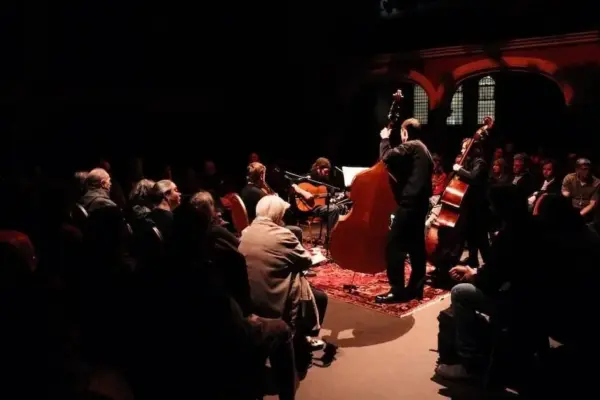
The turning point finally arrived in 2019, when Bulgaria’s Sofia Jazz Plus festival succeeded in cutting through the institutional red tape, bringing Forcione and Erdoğan together on stage for their long-awaited live debut. The immediate chemistry shared under the spotlights in Sofia catalyzed a series of subsequent live performances across Bulgaria and broader Europe. These concerts tested the waters for a studio recording, proving that their initial theatrical spark had only deepened over two decades of individual artistic maturation.
The culmination of this delayed journey occurred between July and August 2025 at Pekarnata Studio in Sofia. Operating under the meticulous engineering, mixing, and mastering supervision of Ivan Boshev, the duo recorded ten original compositions that capture the raw immediacy of their live performances alongside the pristine acoustic warmth of top-tier studio craftsmanship. Significantly, the project’s journey from administrative frustration to European cultural triumph is officially acknowledged on the album’s physical packaging, which carries a funding credit from the European Union’s NextGenerationEU recovery programme. In a poetic twist of modern arts administration, the bureaucracy that once delayed their meeting ultimately helped subsidize its permanent preservation on vinyl and digital formats.
Supporting Context & Metrics: The Architecture of Two Distinct Voices
To fully appreciate the auditory landscape of Storytellers, one must understand the distinct pedagogical, geographical, and instrument-building philosophies that inform Forcione and Erdoğan’s respective approaches to the fretboard.
Antonio Forcione: The Italian-Londoner’s Nylon-String Mastery
Born in the rugged region of Molise, Italy, in 1960, Antonio Forcione relocated to London in 1983. Like many legendary artists before him, his early days in the British capital were defined by the grit and grind of busking in Covent Garden—an environment that forces a musician to develop absolute command over audience engagement, acoustic projection, and rhythmic drive without the luxury of studio amplification. Over the subsequent decades, Forcione transformed this street-level dynamism into a globally celebrated recording career comprising approximately twenty albums. Among these, his 2006 collaboration with legendary double bassist Charlie Haden on Heartplay (Naim Records) stands as a testament to his ability to converse fluidly with jazz royalty. Forcione’s playing style relies on a western nylon-string acoustic approach, characterized by crisp articulation, percussive body-slapping techniques, and an innate knack for accessible, deeply emotional melodies that evoke both Mediterranean warmth and contemporary European jazz sensibilities.
Cenk Erdoğan: The Fretless Pioneer of Istanbul
Born in Istanbul in 1979, Cenk Erdoğan’s sonic identity is inextricably linked to a revolutionary moment in Turkish music history. In 1976, master musician Erkan Oğur famously removed the frets from a classical guitar to accurately reproduce the elusive microtones—the intervals smaller than a semitone—crucial to traditional Turkish makam music. Inspired by Oğur’s pioneering act, a young Erdoğan pulled the frets from his own instrument, dedicating himself to mastering the unforgiving, precise intonation required for fretless guitar performance. Erdoğan’s technical prowess eventually led him to academic and international stages, teaching fretless technique and Turkish modal theory at esteemed institutions as far afield as the Berklee College of Music. Furthermore, his virtuosic touch has graced major international works, including Jim “Kimo” West’s Grammy-winning album More Guitar Stories. Erdoğan’s baritone fretless guitar introduces a warm, vocal, almost weeping timbre to Storytellers, blurring the boundaries between a guitar, a Turkish oud, and an Indian sitar.
Physical Packaging and Sequencing Metrics
The physical release of Storytellers honors the tactile rituals of traditional album listening. Housed in a meticulously designed gatefold sleeve, the release bridges the visual and the auditory: Forcione provides a heartfelt introductory welcome, while both composers furnish personal annotations for every single piece. These liner notes read like diary entries, offering insights into childhood memories, cooking philosophies, and dedications to loved ones.
The ten tracks are split precisely down the middle—five compositions per artist—and arranged in an alternating running order that dictates the emotional arc of the vinyl experience:
- Side A: Features a 3-to-2 composition split favoring Forcione, opening with his "Folk Song for Two" and moving through flamenco-tinged and Turkish-influenced soundscapes.
- Side B: Tips the compositional balance back toward Erdoğan, commencing with his atmospheric "Dilemma" and culminating in a poignant, cyclical journey through memory and companionship.
Track-by-Track Artistic Analysis
The interplay between Forcione’s crisp, rhythmic Western nylon-string styling and Erdoğan’s flowing, microtonal Eastern fretless design creates a continuous stylistic tension that defines the record’s ten tracks.
Side A: Establishing the Dialogue
Side A opens with Forcione’s “Folk Song for Two,” a piece explicitly written with the spirit of Brazilian acoustic master Egberto Gismonti in mind. The intimacy between the two players is established immediately; strings resonate with a rich, organic warmth as Forcione anchors the foundational Western nylon-string rhythm, neatly contrasting against Erdoğan’s fluid, bending modal lines. They navigate the central theme simultaneously, yet their radically different timbres prevent any sonic muddiness.
Erdoğan counters with “Da Capo,” a composition paying homage to the fiery traditions of flamenco. Here, Erdoğan introduces a distinct Spanish twang to his fretless instrument, which is immediately reined in and anchored by Forcione’s steady rhythmic pulse. The resulting hybrid genre sounds remarkably contemporary while paying subtle homage to historical fusion pioneers.
The energy shifts slightly with Forcione’s “Children of the World.” While melodically pleasant, it leans into a more comfortable, comforting territory after the exhilarating tension of the first two tracks. Fortunately, momentum is rapidly restored by Erdoğan’s “4 Hands on the Table.” Taking its title from a professional culinary expression describing two chefs working seamlessly in tandem at a busy kitchen station, this piece is unmistakably Turkish in its structural DNA. For fans of contemporary Turkish jazz fusion—evoking the spirited DNA of Önder Focan and Okay Temiz—this track is an absolute masterclass in kinetic interplay.
Side A concludes with Forcione’s “Petals in the Ashes.” Evoking the festive, communal atmosphere of a folk wedding celebration taking place in a bustling rural town square, the music possesses a hypnotic quality that makes listeners feel as though they have stumbled upon an intimate village gathering.

Side B: Deepening Tides and Intimate Reflections
Side B opens with Erdoğan’s “Dilemma,” a compositional highlight of the entire record. Conceived as a musical exploration of the eternal struggle between heart and head, the track unfolds as an atmospheric, breathtaking trade-off between the two guitarists. At moments, Erdoğan’s string-bending reaches such an evocative pitch that the guitar mimics the melancholic resonance of an Indian sitar.
This sense of cinematic storytelling continues into Forcione’s “Nena.” While contemporary jazz critics frequently default to invoking the legendary "ECM sound" to describe ambient, European acoustic jazz, the descriptor genuinely fits the spacious, narrative-driven architecture of this piece.
The emotional center of the record arrives with Erdoğan’s “Leaving Home,” written to honor the loved ones left behind while an artist is out on the relentless touring circuit. Forcione commands the opening sequence with a resolute, driving motif before Erdoğan enters, weaving deep, resonant layers of sorrow and longing into the arrangement.
Forcione’s “Turning Pages” brings a deeply personal perspective to the tracklist, transporting the listener back to his childhood in southern Italy. Raised by his grandparents while his parents worked abroad, Forcione spent hours leafing through family photo albums to bridge the physical distance. The resulting timbre is heavy, imbued with a subtle studio echo that grants the piece a dreamlike, nostalgic quality. It is a masterclass in economic composition, working absolute magic out of a singular, recurring melody and a handful of gorgeous chords.
The album closes with Erdoğan’s “Luna.” Dedicated to the moon in its various cyclical phases, the track carries a charming personal double-meaning for listeners familiar with the artists’ personal lives (serving also as a nod to a beloved canine companion). Here, the strings lead the listener through busy urban intersections, evoking fleeting flamenco sketches painted on city walls as the traveler pauses at every street corner. It is a fittingly transcendent conclusion to an album that leaves an indelible mark on the listener.
As the needle finally drifts toward the run-out groove of the vinyl, a casual, spoken-word studio snippet provides the final word of the record: “I think we have a good vibe, man.” Given the breathtaking artistry captured across these forty-odd minutes, it is an understatement impossible to dispute.
Official Statements and Critical Reception
While Storytellers is primarily celebrated as an intimate acoustic dialogue, the broader artistic community and institutional backers have recognized its cultural significance. In promotional materials accompanying the release, the European Union’s NextGenerationEU program highlighted the project as a stellar example of cross-border artistic resilience:
"By uniting the rich folk and jazz traditions of Southern Europe and the Near East, Forcione and Erdoğan demonstrate that cultural barriers are ephemeral, and that artistic collaboration remains one of the most powerful unifying tools of our shared European heritage."
Reflecting on the decades-long wait to bring the project to fruition, Antonio Forcione noted in the gatefold liner notes:
"Music has its own internal clock. What was interrupted by paperwork in Istanbul twenty years ago was simply allowed to marinate, growing richer, deeper, and infinitely more patient by the time we finally set up our microphones in Sofia."
Cenk Erdoğan echoed this sentiment in interviews surrounding the album’s release, emphasizing the philosophical alignment of their instruments:
"When you remove the frets from a guitar, you remove the artificial limitations imposed by Western temperament. Antonio understands this fluidity intuitively. Playing with him is not about adjusting to another player; it is about finding a shared vocal language that existed long before either of us picked up an instrument."
Early critical reception from jazz and world music publications has been uniformly rapturous, with reviewers praising Pekarnata Studio engineer Ivan Boshev for achieving a masterclass in acoustic transparency. Boshev’s engineering successfully captures every subtle squeak of nylon against fingerboard, every microtonal pitch bend, and every percussive body tap, ensuring that the listener feels physically seated between the two performers in the Sofia studio.
Future Outlook
The release of Storytellers in late 2025 is not intended as a solitary, isolated studio experiment, but rather as the opening salvo of an ongoing international partnership. With the structural backing of European cultural grants and a newly established touring apparatus, Forcione and Erdoğan are slated to take their live show across major jazz festivals and intimate acoustic venues throughout Europe, the United Kingdom, and the Middle East through 2026 and beyond.
Industry insiders and fans of both artists are already speculating on the potential for future recording iterations. Given that the duo accumulated a wealth of improvisational material during their Sofia sessions that ultimately did not fit the strict ten-track vinyl format, the possibility of a Storytellers: Volume 2 remains a tantalizing prospect.
Furthermore, the pedagogical impact of this collaboration cannot be overstated. By demonstrating the seamless integration of Western nylon-string counterpoint with Turkish fretless microtonality, Forcione and Erdoğan have provided a masterclass for a new generation of global guitarists. They have proven that stylistic purity is far less interesting than honest, cross-cultural vulnerability.
As the global music community increasingly looks toward borderless collaborations to foster cross-cultural empathy, Storytellers stands as a definitive blueprint. It is a triumph of patience over bureaucracy, a dialogue of strings that speaks fluently across languages, and, above all else, an undeniably good vibe.