Executive Overview
Pierre-Auguste Renoir (1841–1919) has long suffered a paradoxical legacy in the popular imagination. To the modern observer, he is frequently pigeonholed as a slightly compromised painter of mass-marketed kitsch, celebrated for his late-period, voluptuous nudes that float in timeless, decontextualized landscapes. For contemporary audiences—particularly women viewers navigating the complexities of the male gaze—these later canvases can feel problematic, even alienating.
Enter Renoir and Love, a landmark exhibition at the National Gallery in London that decisively cuts through a century of critical baggage. Curated with surgical precision, the exhibition deliberately bypasses Renoir’s later output to focus on a hyper-focused, intensely experimental 20-year window: from his mid-20s to his mid-40s. By centering this golden era of discovery, invention, and technical audacity, the exhibition challenges the prevailing cultural consensus, reframing Renoir not as a purveyor of saccharine domesticity, but as one of the most radical, boundary-pushing artistic innovators of the 19th century.
Detailed Chronology
To understand Renoir’s radical evolution, one must step back into the crucible of mid-to-late 19th-century France. The exhibition anchors its narrative in a strict yet expansive chronology, tracing the artist’s trajectory from an impoverished artisan to a titan of the Impressionist avant-garde.
The Artisan Beginnings (1841–1860s)
Unlike many of his bourgeois Impressionist peers—such as Edgar Degas or Paul Cézanne—Renoir emerged from a distinctly working-class background. His family were skilled artisans, and by the tender age of 14, Renoir was earning a living painting porcelain. This rigorous, commercial training required absolute precision and immersed him in the decorative elegance of Rococo masters like Jean-Antoine Watteau and Jean-Honoré Fragonard. The lightness of touch, theatrical staging, and fluid grace learned during these formative years would echo throughout his entire oeuvre.
Tavern Fellowships and Bohemian Circles (1866)
The earliest major work featured in the exhibition is Mother Anthony’s Tavern (1866). Capturing an intimate gathering of fellow painters Alfred Sisley and Jules Le Coeur alongside friend Henri Bos, the painting offers a glimpse into Renoir’s early social network. A young woman clears a table in the background, where the wall bears a caricature of Henri Murger, author of Scenes of Bohemian Life (the literary bedrock for Puccini’s La Bohème). Prominently displayed before them is the newspaper L’Événement, which carried the vehement and radical art criticism of Émile Zola. Far from a solitary studio artist, Renoir’s world was defined by fierce fraternal camaraderie.
The Crucible of War and the Breakthrough (1870–1876)
History often views Impressionism as a sun-drenched, inevitable expression of the Belle Époque (1871–1914). In reality, the movement was forged in absolute catastrophe. The outbreak of the Franco-Prussian War (1870–1871) upended French society. Renoir was drafted into military service; his close friend and vital supporter, Frédéric Bazille, was killed in action; and the early Impressionist canvases of Camille Pissarro were systematically destroyed by invading forces.
Yet, upon returning to a Paris torn apart by the bloody civil war of the Commune—where corpses literally littered the Haussmannian boulevards—Renoir engaged in an act of staggering artistic defiance. Rather than painting the grim realities of urban ruin, he channeled his energy into recording the transient, shimmering joys of ordinary life.
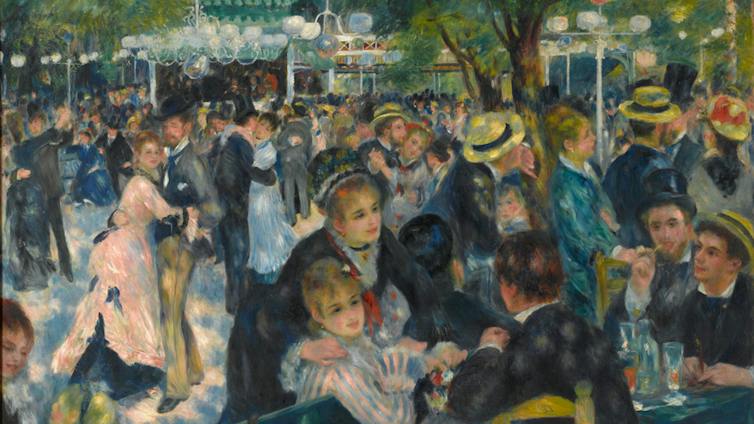
This culminated in his 1876 masterwork, Dance at the Moulin de la Galette (Bal du moulin de la galette), making its historic first-ever exhibition appearance in London. Depicting working-class residents of Montmartre relaxing at a weekend dance, the canvas stands as the absolute centerpiece of the exhibition.
Supporting Context & Metrics
The curatorial framework of Renoir and Love relies heavily on spatial design, material scarcity, and socioeconomic context to reshape public perception.
Spatial Dramaturgy and Exhibition Metrics
- The 20-Year Window: Curators deliberately restricted the selection to Renoir’s strongest decades (roughly 1866 to 1886), avoiding the stylistic stagnation of his final decades.
- The Scale of Ambition: In 1876, canvases the size of Dance at the Moulin de la Galette (roughly 1.3 meters by 1.75 meters) were strictly reserved for high-status academic history paintings, biblical scenes, or mythological allegories—such as William-Adolphe Bouguereau’s Pietà, painted that same year. Renoir subverted this academic hierarchy by declaring his depiction of working-class leisure to be "a page of history"—the history of the common people.
- Financial Precarity: Despite painting images of post-prandial luxury and sunlit indulgence, Renoir lived in grinding poverty well into his 50s. Archival correspondence and self-portraits—such as his haunting, gaunt, and high-strung Self-Portrait of 1875—reveal an artist frequently staring down starvation, battling acute financial stress while maintaining an unyielding commitment to painting beauty.
Technical Innovation: The Optics of Dappled Light
Visitors encountering Dance at the Moulin de la Galette in person rather than through digital reproductions or textbook prints are invariably startled by its optical complexity. While the painting maintains a conventional recessional depth—where dancing figures naturally diminish in scale as they recede—Renoir applies a revolutionary pattern of broken, dotted light.
Rendered in hues lighter than the dominant purply-mauve tones that bind the composition together, this dappled sunlight appears to advance toward the viewer like a tangible veil. It mimics the physiological reality of perception: the sudden, flickering adjustment of the human eye opening to an outdoor scene. Combined with a clever compositional gap between two benches in the lower-left corner—giving the viewer the subconscious impulse to step directly onto the dance floor—the painting collapses the barrier between spectator and subject.
Official Statements
The emotional and intellectual journey of the curatorial team mirrors the psychological transformation designed for the exhibition visitor.
"I grew up hating Renoir somehow," confesses Chiara di Stefano, co-curator of Renoir and Love, offering a remarkably candid assessment of contemporary art historical biases. She acknowledges that “it can be troubling for some, especially women viewers, to see his nudes.”
Rather than defending the later paintings, di Stefano and her fellow curators shifted the spotlight to the artist’s foundational decades. Explaining the curatorial philosophy behind the layout, di Stefano notes:
"The idea was really to let people encounter the works and let the works do the talking by themselves, and understand how innovative and daring he was as a painter, and how he experimented with technique so much in just 20 years."
The National Gallery’s staging reinforces this hands-off, immersive philosophy. Eschewing dense, didactic wall texts, the exhibition relies on brief, framing panels. Visitors descend the grand staircase into a foyer featuring a subtle, mottled light projection redolent of the dappled forest floors of Renoir’s 1870s masterpieces. Framed vistas through open doorways immediately pull the eye toward major loans, establishing an atmosphere of generous conviviality long before the visitor reads a single curatorial label.
Future Outlook
Renoir and Love does not attempt to rewrite the entirety of the artist’s biography. Visitors will not exit the National Gallery with a radically overhauled understanding of Renoir’s political affiliations or his domestic life. The later, controversial nudes are largely left outside the narrative boundary, and the artist’s complex, sometimes contradictory social views remain untouched.
Instead, the exhibition achieves something far more valuable for art history: a thorough reclamation of technical mastery. By isolating the kinetic, light-drenched experiments of Renoir’s youth, the National Gallery proves that Impressionism was not merely a passive celebration of bourgeois comfort, but a radical, optically daring, and courageous act of survival.
As institutions globally grapple with how to re-exhibit canonical 19th-century masters for modern audiences, Renoir and Love offers a masterclass in curation. By letting the brushwork speak, stripping away decades of lazy cultural clichés, and restoring Renoir to his rightful place as an avant-garde pioneer, the exhibition ensures that viewers will never look at a dappled shadow—or a dance hall canvas—in quite the same way again.