Executive Overview
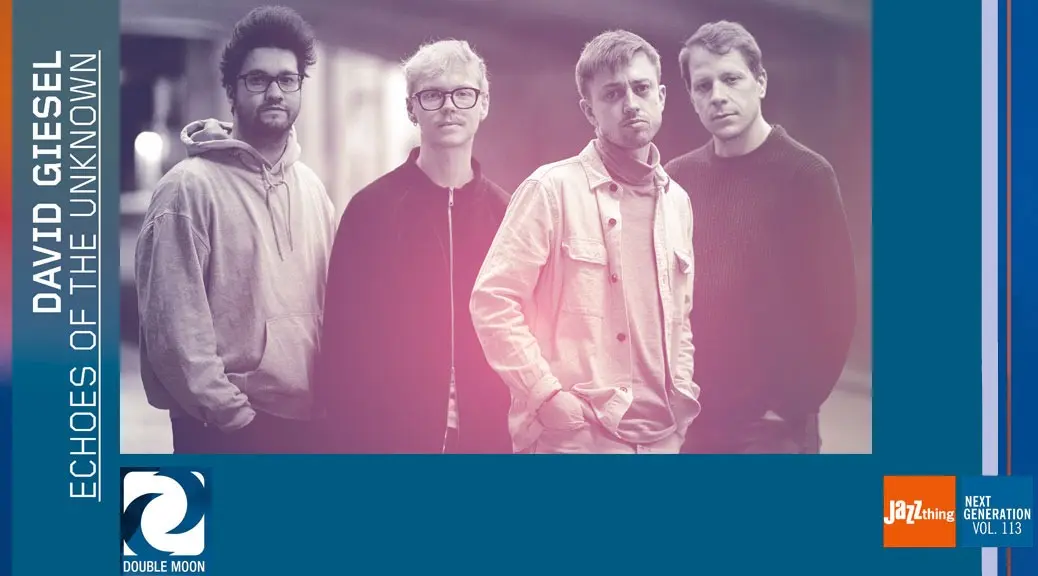
The contemporary European jazz landscape is undergoing a silent yet seismic generational shift. As legacy institutions slowly adapt to an era defined by genre-fluidity and cross-border digital collaboration, a new cohort of artists is emerging from elite European academies, equipped with both conservatory precision and an unbridled appetite for sonic exploration. At the forefront of this movement is German-born, Basel-trained drummer and composer David Giesel. With the release of his debut album, Echoes of the Unknown—issued as Volume 113 of Double Moon’s prestigious Jazz thing Next Generation series—Giesel establishes himself not merely as a technically proficient time-keeper, but as a holistic bandleader with a mature, structural vision for modern improvised music.
Recorded live in a single room at the renowned Jazzcampus studio in Basel, Echoes of the Unknown captures the kinetic energy of a tightly knit quartet operating on absolute mutual trust. Alongside Giesel, the ensemble features longtime friend and collaborator Moritz Langmaier on piano and keyboards, Swedish-born Copenhagen-based guitarist Albin Ormegard, and English bassist Thomas Fuller.
What distinguishes Giesel’s debut from the standard conservatory-trained showcase is its deliberate subversion of traditional hierarchy. Rather than utilizing the project as a vehicle for self-aggrandizement, Giesel—whose formative musical awakening was sparked by the high-voltage arena rock of AC/DC—concedes the melodic frontline to Ormegard’s guitar. The result is an eight-track journey that effortlessly bridges the gap between the structured complexity of modern academic jazz and the visceral, heavy-groove impact of rock, metal, and hip-hop. This comprehensive review examines Giesel’s artistic trajectory, the structural anatomy of the album, the cultural and academic networks that birthed the project, and the broader implications of this release for the future of European contemporary jazz.
Detailed Chronology: From Freiburg Rock Convert to Basel Jazz Innovator
To understand the sophisticated architecture of Echoes of the Unknown, one must retrace the unlikely developmental arc of its creator. Born in Freiburg, Germany, in 1996, David Giesel’s entry into music did not begin with the canonical recordings of Max Roach, Art Blakey, or Elvin Jones. Instead, the foundational spark occurred at the age of ten in front of a television screen, watching high-octane concert footage of hard-rock legends AC/DC. Transfixed by the unyielding backbeat of the rhythm section and the electrifying theatricality of lead guitarist Angus Young, young Giesel found himself instinctively tapping out rhythms on any available surface.
This initial immersion in rock and metal created a visceral relationship with the drums—one prioritized physical impact, raw energy, and the hypnotic power of the groove over intricate polyrhythmic displacements. However, the trajectory shifted during his adolescent years when he encountered an amateur big band. The expansive arrangements, the interplay of horns, and the sophisticated harmonic language of the big band tradition opened a new sonic horizon. What started as an intuitive, rock-fueled compulsion quickly evolved into a disciplined pursuit of jazz pedagogy.
Giesel’s formal training began in earnest in Stuttgart, a crucible of German contemporary music education, where he refined his technical vocabulary, sight-reading, and ensemble dynamics. Yet, the definitive turning point in his artistic maturation occurred when he relocated to Switzerland to attend the prestigious Jazzcampus Basel.
At Jazzcampus, Giesel was thrust into an intense incubator of international talent, studying under some of the most formidable percussionists and improvisers in contemporary jazz, including Jeff Ballard, Jorge Rossy, and Paulo Almeida. Each mentor left an indelible mark on his playing: Ballard instilled a fearless approach to texture and space; Rossy imparted a deep, melodic understanding of the drum kit rooted in his legendary tenure with the Brad Mehldau Trio; and Almeida provided invaluable structural guidance. Almeida’s mentorship extended beyond the classroom; he ultimately stepped into the role of producer for Echoes of the Unknown, overseeing the transition from academic concept to commercial release.
It was within the vibrant, cosmopolitan ecosystem of Basel that the quartet crystallized. Moritz Langmaier, handling piano and synthesizer duties, represents Giesel’s deepest creative alliance—a musical partnership forged through years of shared exploration in rehearsal rooms. The rhythm section was cemented with the inclusion of English bassist Thomas Fuller, whose harmonic stability and elastic time-keeping anchor the ensemble’s more adventurous flights. Finally, the recruitment of Swedish guitarist Albin Ormegard introduced a crucial counterweight to Giesel’s percussion-driven mindset, completing an international lineup poised to challenge conventional genre boundaries.
Supporting Context & Metrics: The Anatomy of a Cross-Border Collaboration
The collaborative infrastructure behind Echoes of the Unknown reflects the hyper-connected reality of twenty-first-century European jazz. Jazzcampus Basel functions as a geopolitical nexus where young musicians from across the continent converge, cross-pollinating distinct national and stylistic traditions.
The rhythm-guitar axis of Giesel and Ormegard, in particular, highlights a fascinating generational trend: the contemporary jazz musician who treats heavy metal, rock, and hip-hop not as guilty pleasures, but as foundational pillars of their musical identity. Ormegard’s personal journey mirrors Giesel’s; he spent his formative years absorbing rock, metal, and hip-hop before a transformative encounter with legendary Swedish saxophonist Nisse Sandström redirected his path toward jazz. Ormegard’s recent debut album, Look Up, released on the Clap Your Hands imprint in April, cemented his reputation as a formidable bandleader in his own right, characterized by textural inventiveness and a distinct lack of dogmatism regarding genre purity.
This shared background in rock and hip-hop manifests directly in the compositional methodology of Echoes of the Unknown. Out of the eight tracks comprising the album, Giesel penned six, while Ormegard and Langmaier contributed one composition apiece. Crucially, the entire album was recorded live in a single room at the Jazzcampus studio. This production choice is vital: rather than relying on modern multitrack isolation and digital sweetening, Giesel opted for acoustic bleed and real-time eye contact. The resulting soundstage is remarkably immediate; the listener can hear the wood of the drum shells, the resonant thrum of Fuller’s upright bass, and the subtle amplifier hums of Ormegard and Langmaier blending organically into a unified room acoustic.
The compositional philosophy driving the project is perhaps best encapsulated by Giesel’s approach to the opening track, "Trial and Error." According to the drummer, the track’s central groove did not emerge from meticulous pencil-and-paper arrangements on a writing desk. Instead, it arrived unbidden during a practice session, his hands and feet moving in complex metric alignments before his analytical mind could decode what time signature he was actually playing. The formal structure—the arrangement, the transitions, and the harmonic markers—was mapped out after the physical performance had already taken place. This "play first, then understand" paradigm flips traditional academic composition on its head, favoring visceral, kinetic discovery over cerebral pre-planning.

This organic approach permeates the tracklist. Ormegard’s contribution, "My Heart Is Dancing into the Universe," follows as the first external composition, showcasing the guitarist’s ability to weave cosmic, spacious harmonic textures that contrast sharply with Giesel’s muscular rhythmic drive. Conversely, Giesel’s own "Day Dream" was born from improvisational explorations over one of French modernist composer Olivier Messiaen’s synthetic modes. Eschewing the driving guitar-led energy of the surrounding tracks, "Day Dream" leans heavily on Langmaier’s cascading piano lines, offering a moment of serene, impressionistic introspection.
Official Statements & Critical Analysis: Navigating the Unknown
As Echoes of the Unknown enters the public sphere via Double Moon’s renowned Jazz thing Next Generation series—an imprint historically responsible for launching the careers of many of Europe’s finest contemporary jazz artists—it has invited rigorous critical evaluation.
The album’s centerpiece, the self-titled track "Echoes of the Unknown," represents the longest and most compositionally ambitious piece on the record. Here, the traditional boundaries between soloist and accompanist dissolve entirely. All four players are afforded extended conversational space, demonstrating a telepathic interplay that defies the musicians’ relative youth. Fuller’s bass lines provide a deep, rolling anchor, while Langmaier shifts effortlessly between acoustic grand piano voicing and atmospheric synthesizer pads, creating a shimmering sonic cushion for Ormegard’s soaring guitar lines and Giesel’s polyrhythmic drumming.
However, the album also invites debate regarding its structural pacing and conceptual choices—most notably on the track "Moods." Deliberately placed at the exact center of the running order as an emotional and dynamic anchor, "Moods" takes an unexpected turn toward its conclusion when spoken-word artist Dae Bryant delivers a series of lines. Specifically, the track incorporates the famous ethical maxim long attributed to the eighteenth-century English preacher John Wesley: "Do all the good you can, by all the means you can…"
Giesel’s stated intention behind this inclusion was pedagogical and humanistic—he wanted listeners to walk away from the album with a tangible philosophical anchor, a verbal compass to hold onto amidst the abstract musical explorations. Yet, critically speaking, the integration of spoken-word text within an otherwise tightly coiled instrumental jazz framework remains a point of contention. While some listeners may appreciate the thematic gravity it brings to the center of the album, others may find that the spoken interlude disrupts the immersive momentum established by the preceding tracks, occasionally reading as an extraneous narrative layer in an otherwise purely sonic dialogue.
A similar minor structural critique applies to the album’s closer, Moritz Langmaier’s composition, "Where Nothing Is Certain and That’s Okay." Boasting a gorgeous, melancholic harmonic progression that captures the bittersweet sentiment of parting ways after an intense creative period, the piece nonetheless prompts questions regarding sequence. Placed at the very end of the record, it leaves the listener with a lingering sense of quiet resignation. Some analysts have argued that its distinct emotional weight might have functioned even more effectively as a transitional suite earlier in the running order, leaving a high-energy statement to close out the performance.
Despite these minor sequencing debates, critical consensus remains overwhelmingly positive. What elevates Echoes of the Unknown above the myriad of standard post-bop conservatory releases is the radical selflessness of its leader. In an industry where young instrumentalists—particularly drummers—frequently succumb to the temptation of endless, high-velocity solos designed to impress academic panels, Giesel consistently prioritizes the collective health of the group. His drumming serves the composition, lifting his bandmates up, creating dynamic swells that flatter Ormegard’s guitar leads, and maintaining an unwavering commitment to groove and textural variety.
Future Outlook: The Next Phase of David Giesel’s Artistic Evolution
As Echoes of the Unknown circulates internationally, establishing its presence on radio playlists, streaming platforms, and jazz publications across Europe, David Giesel stands at a crucial crossroads in his burgeoning career. The release marks the successful transition from student to professional bandleader, but more importantly, it signals the arrival of a distinct compositional voice capable of synthesizing disparate cultural influences into a cohesive aesthetic.
The future outlook for Giesel and his quartet hinges on their ability to translate the intimate, single-room magic of the Jazzcampus studio onto larger international stages. Festival circuits across Europe, which are increasingly eager to embrace genre-fluid acts that can appeal to both traditional jazz aficionados and younger, rock-schooled audiences, provide an ideal platform for this ensemble. The cross-pollination of Giesel’s rock-infused rhythmic sensibilities, Ormegard’s Scandinavian guitar textures, Langmaier’s harmonic sophistication, and Fuller’s rock-solid foundation offers a blueprint for how twenty-first-century jazz can remain vital, accessible, and intellectually rigorous simultaneously.
In his own reflections on the project, Giesel has characterized Echoes of the Unknown quite modestly: he views the album primarily as a "snapshot"—a high-definition freeze-frame capturing a specific group of friends at a precise moment in their artistic development, documenting where their heads and hands were at that exact point in time.
If this debut album is merely a snapshot, it is a remarkably sharp and vivid one. It reveals an artist who is unafraid to let his hands move before his mind fully comprehends the meter, who is secure enough in his leadership to hand the spotlight to his guitarist, and who possesses the architectural maturity to build a cohesive, transnational band identity from scratch. As Giesel takes these compositions on the road and begins conceptualizing his next studio venture, the jazz world will be listening closely. If Echoes of the Unknown is any indication of his foundational capabilities, the subsequent captures promise to be nothing short of extraordinary.