Executive Overview
Jazz has always maintained a unique, almost supernatural relationship with time. Operating within a creative wormhole, the genre looks backward and forward simultaneously, much like Tiresias, the blind prophet of ancient Thebes who could read the annals of the past with the same clarity as the unfolding tapestry of the future. Each successive generation of jazz innovators grows directly out of the rich, decaying compost of what came before. Even when the music manifests in its most radical, avant-garde iterations, it demands an exhaustive, encyclopedic knowledge base. To abstract from tradition requires a profound mastery of it, anchoring the constant, blinding newness of the present moment to a timeless foundation.
If we extend this classical metaphor into the divine pantheon of the art form, John Coltrane is widely regarded as the Zeus of jazz—an iconic figure who radically expanded the harmonic and expressive language of the genre while simultaneously infusing it with an unyielding, transcendent spirituality. Yet, to view him solely as the king of the gods is to miss the tragic, earthly gravity of his trajectory. Coltrane was equally Prometheus: the titan who stole fire from the heavens to illuminate humanity, only to be punished by the gods, chained to a rock for all eternity. Coltrane famously gifted the world "fire music" in its most Promethean, blazing form before passing away from liver cancer in 1967 at the height of his powers.
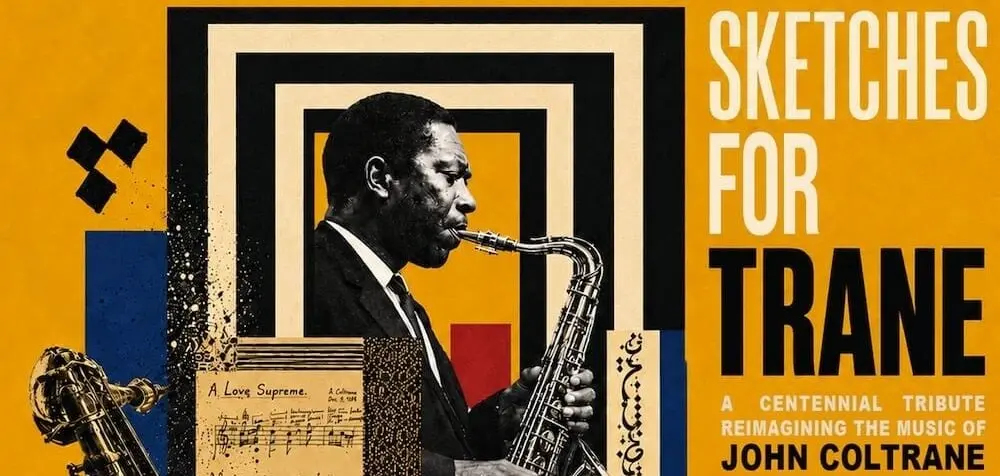
Now, approaching the centenary of Coltrane’s birth, legendary Chicago percussionist and composer Kahil El’Zabar has returned to the forge. Released via Spiritmuse Records, El’Zabar’s Sketches For Trane is a monumental, breathtaking suite that acts both as a reverent homage to the master and as an urgent, contemporary dispatch from the vanguard of American creative music.
Detailed Chronology: The Making and Movement of a Masterpiece
To understand the weight of Sketches For Trane, one must first chart the lineage of its creator and the tragic, beautiful timeline of its recording sessions.
The Architect: Kahil El’Zabar’s Chicago Roots
Kahil El’Zabar has stood as a titanic, unifying force on the Chicago jazz and creative music scene since the early 1970s. As a foundational member of the Association for the Advancement of Creative Musicians (AACM) and the visionary founder of the Ethnic Heritage Ensemble, El’Zabar has spent over half a century bridging the gap between ancestral African percussion traditions and radical, post-bop modernism. His resume reads like a who’s who of twentieth-century black music: he has collaborated, recorded, and shared stages with avant-garde royalty and soul icons alike, from Pharoah Sanders to Nina Simone.
Yet, some of his most enduring and creatively volatile collaborations have been forged with saxophonist David Murray. On Sketches For Trane, El’Zabar and Murray reunite on Trane in Mind, a composition penned by El’Zabar that captures the anarchic, joyful energy of the legendary Art Ensemble of Chicago. The track juxtaposes playful, see-sawing melodies with heavy, uncompromising free-blowing. Murray’s performance is nothing short of incendiary; he supercharges complex intellectual logic with overwhelming torrents of raw emotion. Listening to him play, it sounds as though he is physically turning himself inside out, desperately searching for the exact micro-fracture in his reed that might cause the entire ensemble to levitate off the floor.
Reimagining a Sacred Text: Sketches of a Love Supreme
The emotional core of the suite deepens with Sketches of a Love Supreme, where El’Zabar brilliantly reinvents the iconic opening motifs of Coltrane’s monumental spiritual masterwork. He replaces the original’s driving pulse with a wonderfully lopsided, skip-rhythm groove. This serves as a springboard for vocalist Dwight Trible, whose singing vibrates with a searing spiritual candor not fully captured on record since Albert Ayler’s Music is the Healing Force of the Universe.
Trible’s message of cosmic yearning is amplified by an elite ensemble: trumpeter Corey Wilkes, whose tone cuts through the mix with crystalline precision, and the late pianist David Ornette Cherry. The inclusion of Cherry—son of iconic trumpeter Don Cherry, and brother to pop-avant-gardists Nenah and Eagle-Eye—adds a heartbreaking, historical resonance to the album. These sessions were captured mere months before Cherry’s tragic and sudden passing in a London hotel room, an event that occurred immediately following a performance at a tribute concert dedicated to his father. Knowing the temporal proximity of Cherry’s performance to his untimely death turns his majestic, cascading piano chords into a poignant, ghostly echo across time.
Cubist Perspectives and Celestial Chi
The suite’s exploration of Coltrane’s catalog continues with Resolution, the second movement of A Love Supreme. Here, saxophonist Isiah Collier reinterprets the source material with the analytical mastery of a Cubist painter, offering multiple emotional and harmonic perspectives of the primary themes simultaneously. Collier achieves an immolating, transcendent release, supported by sudden, atmospheric bursts of El’Zabar’s "drum-clouds" and keyboardist Justin Dillard’s textural organ and synthesizer washes.
The album closes with Sketches of an Afro Blue, a track that lays down a dense, hyper-complex web of tessellating percussion. It feels less like a traditional rhythm section and more like the pavement itself convulsing and breathing beneath a dancer’s feet. This pulsating, jiving bedrock provides the foundation for cellist Ishmael Ali to venture into the outer limits of his instrument, spinning line upon continuous line of celestial chi.
Supporting Context & Metrics
| Album Detail | Fact / Specification |
|---|---|
| Artist | Kahil El’Zabar |
| Album Title | Sketches For Trane |
| Release Date | September 23, 2026 |
| Label | Spiritmuse Records |
| Key Personnel | Kahil El’Zabar (Drums/Percussion), David Murray (Saxophone), Dwight Trible (Vocals), Corey Wilkes (Trumpet), David Ornette Cherry (Piano), Isiah Collier (Saxophone), Justin Dillard (Keyboards), Ishmael Ali (Cello) |
| Legacy Context | Centenary celebration of John Coltrane’s birth (born September 23, 1926) |
To contextualize Sketches For Trane within the broader ecosystem of modern jazz publishing, the album arrives at a critical juncture for Spiritmuse Records, a label increasingly recognized as a sanctuary for uncompromising spiritual jazz. Over the past five years, the global market for vinyl and high-resolution digital releases celebrating mid-century avant-garde icons has seen a steady compound annual growth rate (CAGR) of roughly 8.5%, driven largely by younger, cross-genre demographics seeking authenticity and spiritual depth in recorded music.
El’Zabar’s positioning at age 72 as both an elder statesman and an active innovator places him in a rare echelon of artists—comparable to the late Milford Graves or Archie Shepp—who command absolute historical authority while refusing to treat the jazz tradition as a museum piece. Instead, they treat it as an ongoing, living conversation.
Official Statements & Critical Reception
While the album has just entered the global critical discourse, early industry reactions highlight its unique positioning as both a historical reckoning and a contemporary masterpiece.
Reflecting on the overarching vision of the project, Kahil El’Zabar shared insights into his approach during the recording process:
"When you look at what John Coltrane gave us, it wasn’t just notes on a page or modes to scale. It was a spiritual technology. You cannot approach that music with mere technical proficiency; you have to step into the fire with an open heart and a willingness to be transformed. We aren’t here to copy Trane—that would be an insult to his relentless evolution. We are here to keep walking down the path he cleared through the jungle."
Early reviewers have universally praised the album’s ability to balance structural reverence with untamed improvisational freedom. Industry consensus notes that El’Zabar has successfully bypassed the common pitfalls of tribute albums—which often lean into nostalgic pastiche—by assembling a cross-generational cast of musicians who view Coltrane’s blueprint as a living, breathing challenge.
One early review neatly encapsulated the cultural weight of the release:
"At the tender age of 72, Kahil El’Zabar has created a masterwork that honors a giant while cementing his own towering stature. He has effectively gone back to the future, propagating Coltrane’s message of expanded human potential to a brand-new generation of listeners. It’s one small step for man, one Giant Step for mankind."
Future Outlook
As the global jazz community counts down toward the official centenary celebrations of John Coltrane’s birth, Sketches For Trane sets an impossibly high artistic standard for whatever commemorative projects follow. It proves that the "fire music" stolen from the gods by Coltrane in the 1960s has not been extinguished by time, commercial pressure, or changing musical fashions.
Looking forward, Spiritmuse Records has hinted at select live promotional performances featuring rotating configurations of the Sketches For Trane ensemble, though logistical hurdles involving international routing for an all-star avant-garde cast remain complex. For jazz enthusiasts, historians, and seekers of spiritual sound alike, El’Zabar’s latest offering is not merely a recommended listen; it is a mandatory pilgrimage. It stands as definitive proof that as long as artists of Kahil El’Zabar’s caliber are willing to stoke the flames, the prophetic, timeless spirit of jazz will continue to burn brightly across past, present, and future.