Executive Overview
In the storied annals of post-bop jazz history, certain live recordings occupy a mythical status, capturing master musicians at the absolute apex of their creative synergy. Among these, few possess the historical intrigue, instrumental novelty, and profound musicality of tenor saxophonist Clifford Jordan’s Night of the Mark VII. Captured live in Paris on March 26, 1975, this legendary performance documents a pivotal moment in Jordan’s mid-decade artistic resurgence. More than that, it serves as the baptismal recording for a piece of jazz history: Jordan’s brand-new Selmer Mark VII tenor saxophone, delivered to him just as he touched down in the French capital.
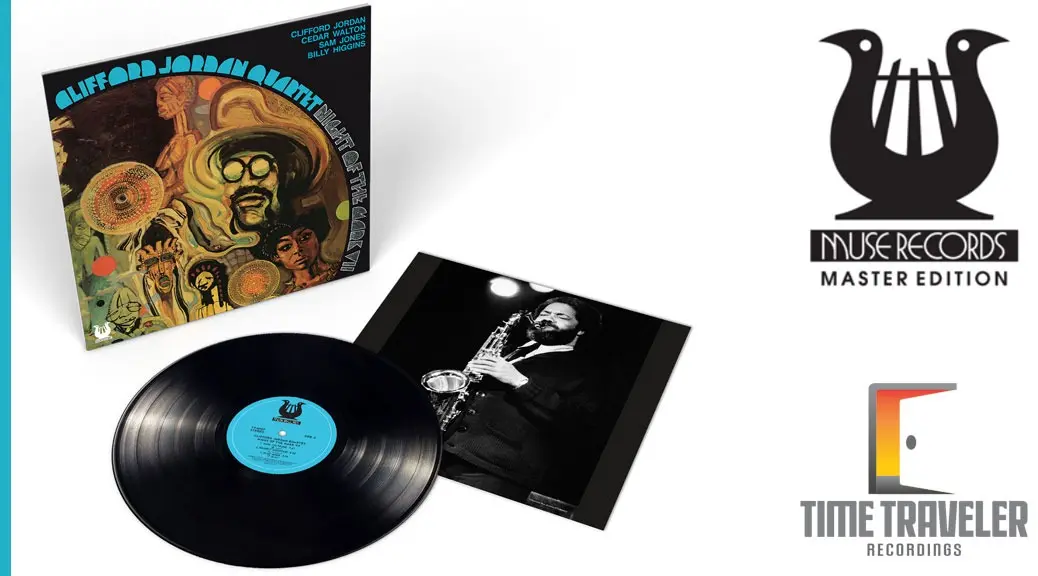
Now, decades after its initial, hard-to-find release, this quintessential performance is receiving the ultimate archival treatment. Spearheaded by jazz reissue mastermind Zev Feldman under Time Traveler Recordings’ Muse Master Edition Series, Night of the Mark VII has been meticulously rescued from obscurity. Remastered from the original analog tapes by mastering authority Matthew Lutthans at The Mastering Lab, pressed on heavyweight 180-gram vinyl at Furnace, and housed in a deluxe, hand-numbered Stoughton tip-on jacket, this release bridges the gap between historical artifact and audiophile treasure.
Accompanied by evocative new liner notes from renowned jazz journalist Willard Jenkins, rare period photography by Raymond Ross, and the original period liner notes, this reissue offers modern listeners a front-row seat to an intimate, high-stakes club performance. Featuring an elite rhythm section comprised of pianist Cedar Walton, bassist Sam Jones, and drummer Billy Higgins—musicians who formed the bedrock of modern jazz innovation in the 1970s—this release is far more than a routine archival dusting-off. It is a vital documentation of a working band operating at the zenith of its powers, navigating complex harmonic territory with telepathic ease and fiery grace.
Detailed Chronology: Paris, March 1975
To fully understand the weight of Night of the Mark VII, one must step back into the brisk Parisian spring of March 1975. Clifford Jordan was experiencing a profound creative renaissance. A stalwart of the hard-bop movement who had cut his teeth alongside legends like Max Roach, Sonny Rollins, and Charles Mingus, Jordan was evolving his sound, seeking new expressive avenues that married the soulful, blues-drenched urgency of Chicago hard-bop with the expansive, modal explorations of the post-Coltrane era.
When Jordan arrived in Paris in late March 1975, a gleaming, factory-fresh Selmer Mark VII tenor saxophone was waiting for him. At the time, the Mark VII was a controversial and transitional horn for Selmer, succeeding the legendary Mark VI and drawing mixed reviews from players accustomed to the older model’s ergonomic quirks and focused core sound. For Jordan, however, the horn represented a fresh palette. Eager to test its capabilities in front of a discerning European audience—one that had long championed American jazz masters with an almost academic fervor—he took the stage on March 26 before an intimate, rapturous crowd of roughly 300 patrons in a classic, close-quarters club setting.
The atmosphere in the room was electric. According to recollections shared by Jordan himself, the quartet did not ease into the evening with standard warm-up fare. Instead, they opened "out of left field," launching directly into Cedar Walton’s intoxicating modal composition, "Midnight Waltz." Jordan described the effect as surreal, noting how the performance felt as though "eight o’clock had suddenly turned into midnight," effectively beginning the concert "from the middle out."
However, when the session was originally mastered and sequenced for LP release, the running order was dramatically altered to optimize the dynamic flow of vinyl sides. The original LP sequence bypassed the theatrical punch of the live opener, instead thrusting the listener headfirst into Bill Lee’s churning, soulful tribute, "John Coltrane," while holding back Walton’s "Midnight Waltz" for the dramatic opening of side two.
The live set list was a masterclass in repertoire curation, blending deep cuts from the band members’ personal songbooks with canonical jazz literature. Side one of the original LP run-through navigated Bill Lee’s "John Coltrane," Jordan’s knotty modal workout "Highest Mountain," and Thelonious Monk’s perennial Parisian favorite, "Blue Monk." Side two belonged entirely to the compositional prowess of the rhythm section’s architects, housing Walton’s "Midnight Waltz" and Sam Jones’s rip-roaring bop burner, "One For Amos."
Supporting Context & Metrics: The Anatomy of a Working Band
To evaluate Night of the Mark VII purely as a live gig is to miss the intricate web of musical and personal relationships that birthed it. The quartet backing Jordan was not a temporary pick-up band assembled for a European tour; it was an organic, highly refined organism comprising four master craftsmen who spoke a unified musical language.
The Interconnected Web of Composition and Personnel
The interconnection between the players and the material performed on March 26, 1975, is staggering:
- "One For Amos": Composed by bassist Sam Jones, this driving tune had been recorded by this exact configuration of musicians just seventeen months prior, in October 1973, during the legendary sessions for Glass Bead Games—the Strata-East double album that remains a touchstone for Jordan aficionados worldwide.
- "John Coltrane": Penned by bassist and composer Bill Lee (father of filmmaker Spike Lee), this piece also emerged from the Glass Bead Games creative orbit, featuring Jordan and Billy Higgins anchoring a parallel quartet configuration from those sessions. (The tune’s enduring legacy is further underscored by saxophonist Nat Birchall dedicating an entire side of his 2014 double album Live In Larissa to the composition).
- "Highest Mountain": A notoriously complex piece dating back to Jordan’s 1965 Atlantic Records outing, These Are My Roots. Furthermore, Muse Records had recently captured Jordan, Walton, and Jones playing both "Highest Mountain" and "Blue Monk" during live dates at Boomer’s in New York, with drummer Louis Hayes rounding out the kit on those volumes of A Night at Boomer’s.
- Eastern Rebellion Link: Intriguingly, these four musicians—Jordan, Walton, Jones, and Higgins—constituted the foundational, embryonic line-up of Cedar Walton’s celebrated cooperative venture, Eastern Rebellion, when it first formed in 1974. By the time Eastern Rebellion entered the studio for its debut recording in December 1975, tenor titan George Coleman had taken over the saxophone chair. Thus, Night of the Mark VII captures the transitional twilight of an iteration of Eastern Rebellion that was truly a working band playing its own tightly curated book.
Musical Breakdown of the Set
Side One: Soul, Complexity, and Swagger
Side one establishes an immediate, visceral connection between stage and audience.
- "John Coltrane": Opening the original LP, this version possesses a soulful elegance fused with a distinct Latin twist—a rhythmic coloration entirely absent from the Glass Bead Games studio rendition. The performance opens with a grounding, hypnotic bass line laid down by Sam Jones before Jordan steps forward to state the theme. Soon, the entire ensemble engages in a mesmerizing, chant-like invocation of Coltrane’s name, turning the performance into an act of communal reverence.
- "Highest Mountain": Clocking in as the shortest piece on the record, it is paradoxically its most harmonically and structurally labyrinthine. Built upon two distinct sections running 23 bars apiece, the tune is notoriously tricky to navigate. Cedar Walton, who performed on the 1965 original studio recording, famously confessed that it took him five full years of playing the tune to feel entirely comfortable with its eccentric contours. On this live recording, Jordan’s tone undergoes a fascinating metamorphosis: dropping deep into the lower register, his sound turns raw, guttural, and searching. While original session notes claimed a seamless transition to the new Selmer horn, critical listening reveals a player actively wrestling with the intonation and resistance of a brand-new instrument—a struggle that adds an undeniable, human edge of high-wire tension. Following a typically immaculate, economic solo by Billy Higgins, the theme sweeps back in, driving the tune to a close on a soaring cascade of "Amen" cadences.
- "Blue Monk": Thelonious Monk’s classic blues structure was a certified holy grail for the Parisian jazz cognoscenti. Here, the quartet delivers a masterclass in swing and swagger, honoring the pianist-composer’s eccentricities while injecting the performance with an irrepressible, driving momentum.
Side Two: Modal Expansiveness and Bop Fury
Side two shifts the compositional focus to the rhythm section’s heavy hitters, housing the two most expansive and extended workouts of the evening.

- "Midnight Waltz": Cedar Walton’s modal masterpiece stands undisputedly as the artistic summit of the entire concert. Built on shifting modal centers and an undulating rhythmic pulse, the piece draws spontaneous eruptions of applause from the Parisian audience—not merely at the conclusion of the track, but erupting midway through Sam Jones’s muscular, melodically rich bass solo, and repeating enthusiastically after each subsequent soloist takes his turn at the wheel.
- "One For Amos": Sam Jones’s composition brings the evening to a roaring, breathless close. A rip-roaring bop vehicle, it pushes Jordan to the absolute perimeter of his technical and emotional capabilities, forcing him to wring every ounce of resonance out of his new Mark VII tenor as the rhythm section drives him relentlessly forward.
Official Statements and Archival Vision
The resurrection of Night of the Mark VII is part of a broader, highly curated campaign by Time Traveler Recordings and producer Zev Feldman to rescue crucial, underexposed jazz history from the vaults of independent labels like Muse. Known colloquially in audiophile circles as the archeologist of modern jazz, Feldman’s curation of the Muse Master Edition Series has continually rewritten the narrative of 1970s jazz, bringing long-out-of-print masterworks back to the marketplace with uncompromising production values.
In the official press rollout accompanying the reissue, Feldman emphasized the historical imperative of documenting artists like Clifford Jordan during their creative zeniths:
"Clifford Jordan was a pillar of architectural strength in jazz—a saxophonist who combined the earthy roots of the blues with a peerless modern intellect. Capturing him on the exact night he unpacks a brand-new horn, surrounded by soulmates like Cedar Walton, Sam Jones, and Billy Higgins, isn’t just releasing a concert; it’s preserving a lightning-in-a-bottle moment of instrumental discovery."
Complementing the sonic restoration are the extensive physical packaging contributions. Veteran jazz historian Willard Jenkins provides an illuminating liner note essay that contextualizes Jordan’s career trajectory within the socio-cultural landscape of mid-1970s jazz, exploring the challenges and triumphs of independent-minded artists working away from the commercial mainstream. Furthermore, the package features a striking, previously unpublished period photograph of Jordan captured by legendary jazz photographer Raymond Ross, preserving the visual aesthetic of the era to match its sonic profile.
To achieve the gold standard in analog preservation, the project enlisted mastering engineer Matthew Lutthans at the legendary Mastering Lab. Working exclusively from the original, first-generation analog master tapes, Lutthans eschewed digital compression shortcuts in favor of a pure, dynamic transfer that honors the transient speed of Higgins’s drum kit, the woody resonance of Jones’s double bass, and the crystalline, bell-like chimes of Walton’s piano. The resulting lacquers were subsequently pressed onto dead-quiet, 180-gram virgin vinyl at Furnace Record Pressing, ensuring that every micro-detail of the original club environment is transmitted without interference.
Future Outlook: The Resurgence of Deep-Catalog Analog Reissues
The arrival of Night of the Mark VII arrives at a fascinating inflection point in the modern recorded music marketplace. While mainstream music consumption continues to be dominated by algorithmic streaming and compressed digital files, the physical audiophile market—led by high-end vinyl reissues of deep-catalog jazz—is experiencing an unprecedented renaissance.
Labels specializing in boutique, high-end archival excavation, such as Time Traveler Recordings, Blue Note (via the Tone Poet series), and Impulse! (via Vital Vinyl), are proving that there is a voracious, globally distributed audience for historically rigorous, impeccably mastered editions of overlooked masterworks.
Critical Assessment of the Audio Landscape
It is worth noting, however, that historical archival preservation involves honest critical reckoning with source material limitations. As keen-eared jazz critics have noted regarding this specific recording, Night of the Mark VII remains what it fundamentally was on March 26, 1975: a recording captured using a modest, budget-oriented mobile set-up inside a bustling, intimate European jazz club, rather than a pristine, multi-track studio isolation session.
The piano—likely an upright resident to the club—rings through with undeniable clarity, yet possesses the distinct harmonic limitations and boxy resonance inherent to club acoustics of that vintage. The bleed of the room, the clinking of glasses, and the murmured anticipation of 300 Parisian jazz devotees are all woven into the acoustic fabric of the tapes. Yet, far from being detrimental, these sonic footprints serve as an immersive time machine. They remind the listener that jazz is, at its core, a communal, vernacular art form born in smoke, sweat, and close-quarters interaction.
The Lasting Legacy
Without relying on the original 1976 Muse vinyl pressings for direct A/B comparison, the consensus among modern vinyl collectors is clear: Matthew Lutthans’s restoration work at The Mastering Lab extracts the maximum possible dynamic fidelity from the source tapes, widening the soundstage and anchoring the rhythm section with newfound stability and warmth.
Ultimately, Night of the Mark VII stands as a triumph of historical preservation. It captures four titans of modern jazz—Jordan, Walton, Jones, and Higgins—at a moment of uncalculated, transcendent synergy. As this deluxe reissue finds its way onto turntables worldwide, it cements Clifford Jordan’s rightful place in the pantheon of tenor saxophone royalty, proving that true artistry, much like a brand-new horn in the hands of a master, only grows more resonant with the passage of time.