Executive Overview
Having previously explored the brutal realities of life within high-security men’s and women’s prisons, the BBC’s critically acclaimed anthology drama Time turns its unblinking lens toward the youth justice system for its third series. Written by master of gritty social realism Jimmy McGovern, this new installment arrives at a critical cultural and political juncture. With the United Kingdom’s prison system caught in an ever-deepening crisis marked by chronic underfunding, staff shortages, and systemic overcrowding, McGovern’s relentless and uncompromising storytelling feels more urgent and relevant than ever.
Set within the fictional HMYOI Alderwick—a young offender institution located somewhere near Liverpool—the series dives headfirst into the lives of teenagers trapped in the system and the beleaguered staff tasked with managing them. Headlined by David Tennant as a troubled prison guard and Siobhan Finneran reprising her role as the itinerant chaplain Marie-Louise, the drama captures the agonizing moral compromises required to survive in a failing institution.
However, the series also invites a broader critical debate that shadows much of contemporary prestige television: When fiction ventures this close to real-world trauma, does it lose some of its raw, systemic impact? Or must the dramatic stakes be artificially heightened to shock a desensitized viewing public into awareness? Balancing stellar, grounded performances with occasional dips into melodramatic contrivance, Time offers a scintillating, urgent look at a youth custody estate operating on the absolute brink.
Detailed Chronology: Inside HMYOI Alderwick
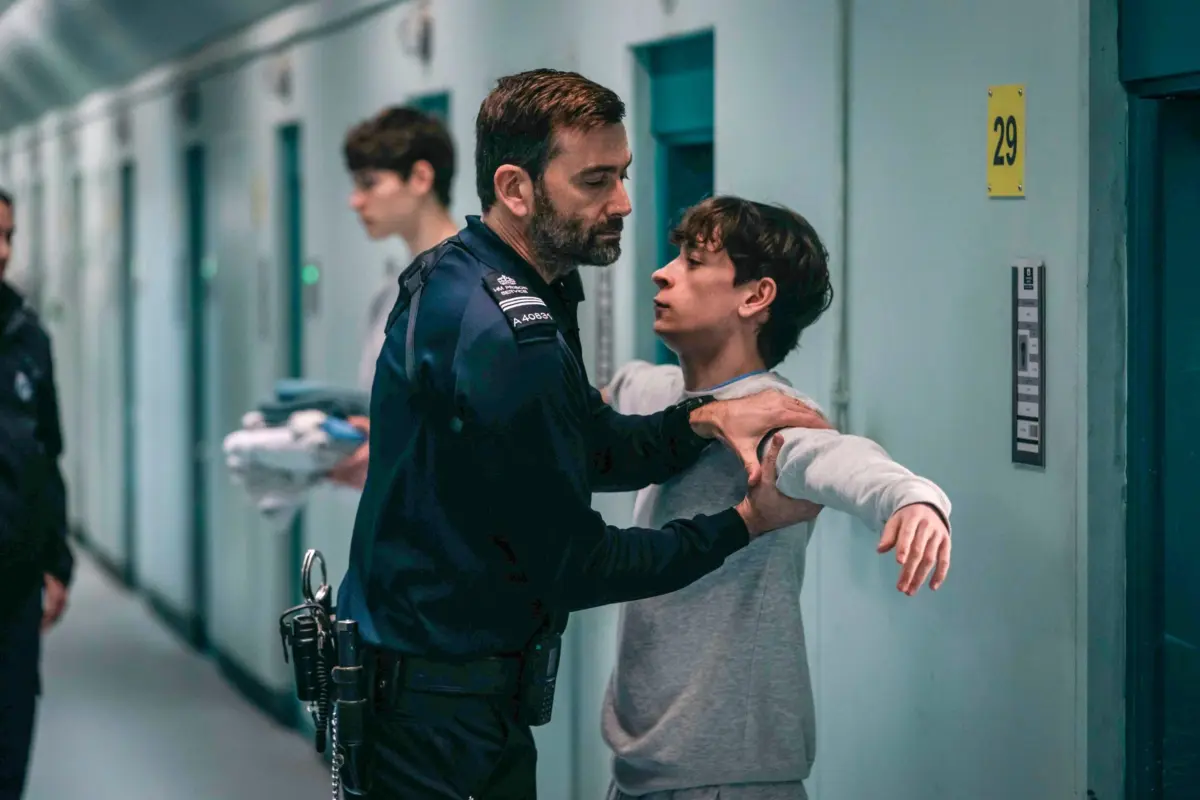
The narrative framework of Time’s third series is anchored by a constellation of damaged characters navigating the labyrinthine horrors of youth custody. At the center of the staff dynamic is Bobby Bailey, played with world-weary restraint by David Tennant. Bailey is a guard fighting battles on two fronts. Outside the prison gates, his personal life is in freefall: he is struggling to overcome a severe drinking problem, and his wife has recently left him for another man. Inside the facility, his professional reality is no less punishing.
The pressure inside Alderwick ratchets up with the arrival of new inmates James (portrayed with fragile intensity by Louis McCartney) and Peter (Ollie McNulty), both of whom bring fresh vulnerabilities and volatilities into the ecosystem. Simultaneously, long-standing resident Christopher (Chukwubuikem Molokwu) is forced to confront deep-seated identity issues after making contact and reconnecting with his birth mother on the outside.
Tying this harrowing narrative tapestry together is Marie-Louise (Siobhan Finneran), the itinerant chaplain whose presence has served as the moral spine across all three iterations of McGovern’s Time. In Alderwick, Marie-Louise’s faith—already severely tested by years of witnessing institutional decay—takes another battering. A random, tragic act of violence erupts within the facility, starkly demonstrating both the hopeless nihilism of the prison community and the fundamentally shaky moral framework of the penal system holding it together.
The ideological battleground of the institution is laid bare in clashes between security and pastoral care. Confronted with a controversial "keep apart" order designed to physically separate teenagers prone to violent clashes, Bailey protests the logistical impossibility. "If we allow them to mix, they’ll attack each other," Bailey argues, before conceding, "There’s no way we can do it." Conversely, Marie-Louise counters that these harsh, restrictive measures are merely compounding the tension, generating a pressure cooker environment where explosions are inevitable.
These ethical quandaries represent McGovern’s signature writing style at its absolute best. There are no easy answers provided, mirroring the intractable complexities of the real-world criminal justice system. When inmate factions inevitably collide, the resulting violence is visceral and shocking. Following one particularly gruesome assault, Bailey attempts to rationalize the horror to his governor, claiming, "The attack was violent, not the boy himself." Yet, the exhaustion in his voice betrays his own skepticism. He holds little faith in the safety protocols, nor does he harbor blind trust in his colleague Freddie Jennings (Daniel Ryan), despite the sobering reality that the two men must trust their lives to one another every single shift. Compromise, compromise, compromise—the daily bread of a broken, underfunded system.
For the young residents of Alderwick, social hierarchy is erected on a brittle foundation of unearned machismo. They bark transactional expressions of obedience like "yes, boss" at Bailey, but this compliance is paper-thin. McGovern expertly captures the metastatic despair of young men who simply cannot visualize a viable path forward. Bolstered by the grounded, empathetic performances of Tennant and Finneran, the younger cast members—most notably Louis McCartney—inject the ensemble with remarkable emotional depth. They are frustratingly verbose yet fundamentally inarticulate; brimming with volatile emotion yet entirely denied a safe vent for their frustrations.
McGovern weaves a compelling moral maze: Do you throw your lot in with friends and associates who might keep you physically safe inside the walls, or do you turn against them in a desperate gamble for a fresh start, risking everything once you cross the prison threshold? For Time, it is precisely these grey areas—as stark and monotonous as the concrete blocks of the prison itself—that yield the most profound dramatic dividends.
Supporting Context & Metrics: The Reality of Youth Custody
To appreciate the gravity of Time, one must examine the grim statistical and sociological landscape of the United Kingdom’s youth secure estate. Secure Children’s Homes (SCHs), Secure Training Centres (STCs), and Young Offender Institutions (YOIs) house some of the most vulnerable, traumatized, and challenging adolescents in society.
Independent oversight bodies, including HM Inspectorate of Prisons and the Youth Justice Board, have repeatedly sounded the alarm over chronic understaffing, soaring rates of self-harm, and the proliferation of illicit drugs within youth custody facilities. When staffing ratios drop, regimes are inevitably locked down, restricting access to education, rehabilitation programs, and mental health support—thereby turning institutions meant for rehabilitation into incubators for hardened criminality.
However, television drama must inevitably balance sociological accuracy with narrative propulsion, occasionally leading to structural friction. Consider the trajectory of recent prestige dramas, such as The Pitt, the widely acclaimed medical series whose emergency room realism was championed by frontline doctors across the globe. Despite its authenticity, critics noted that The Pitt crammed so many catastrophic events into single shifts that the accumulation of trauma felt statistically implausible.
A similar dynamic is at play in Time. While young offender institutions certainly suffer from high rates of assault, intimidation, and self-harm, fatal incidents within the secure estate for children and young people remain statistically rare. Data covering the decade between 2015 and 2025 records three deaths across the entire national youth secure estate. Consequently, by centering its narrative around extreme acts of violence and institutional collapse, Time is inherently playing at the absolute margins of the typical youth prison experience.
Furthermore, dramatic tropes occasionally strain credulity in pursuit of emotional resonance. Over the course of the three-episode arc, three separate inmates experience the devastating loss of a parent on the outside. This narrative repetition can feel calculated to extract cheap pathos rather than organic character development. The inclusion of a third-act twist—featuring yet another shocking, violent death—feels similarly misjudged and gratuitously dark. This is a genuine creative pity, because Time excels so brilliantly at mapping the quiet, quotidian moral corrosiveness of the daily prison routine that it hardly requires these melodramatic plot contrivances to command our attention.
Official Statements and Industry Reception
The release of Time’s third series has sparked widespread discourse among television critics, penal reform advocates, and broadcasting executives alike, highlighting the delicate tightrope walked by issue-led public service broadcasting.
In promotional materials released by BBC Studios, writer Jimmy McGovern emphasized his enduring commitment to humanizing populations that society prefers to lock away and forget. "We look at concrete walls and iron bars, but we rarely look at the human cost ticking away behind them," McGovern noted. "These are not just offenders; they are children—frightened, damaged, and failed by every social safety net put in front of them long before they ever stepped foot in a cell."
Television critics have similarly praised the production for refusing to offer neat, comfortable resolutions. Writing in industry trade reviews, commentators have drawn direct thematic parallels between Time and other recent British television milestones, such as Shane Meadows’ Adolescence. Where Adolescence examines the societal pipelines that channel young boys toward violence and systemic punishment, Time acts as its desperate, harrowing coda—a reminder that the handing down of a custodial sentence is not the end of a tragedy, but merely the terrifying prologue to another.
Penal reform charities have welcomed the drama’s willingness to spotlight the systemic failures of the youth justice estate, though some have urged audiences to separate the hyper-concentrated violence of television fiction from the day-to-day realities faced by frontline workers. A spokesperson for a leading UK prison reform advocacy group remarked:
"While dramas like Time employ dramatic license to grip Saturday-night viewers, they succeed fundamentally in exposing the invisible rot of an underfunded system. Until the government commits sustainable, long-term investment into mental health provision, educational rehabilitation, and staff retention within youth custody, institutions like Alderwick will remain warehouses of despair rather than houses of correction."
Future Outlook: Entertainment, Empathy, and Primetime Compromise
Ultimately, Time confronts the eternal compromise inherent in prestige entertainment. Whether examining the chaotic trauma bays of emergency medicine in The Pitt or the concrete cells of a youth offender institution, unadulterated realism can easily curdle into something emotionally crushing for a home audience.
Perhaps in recognition of this fatigue, this third installment of Time concludes on a note of convenient optimism—complete with a metaphorical, if not literal, walk off into the sunset. While this narrative softening tempers the absolute rawness of the preceding hours, it is likely a necessary concession for primetime television audiences seeking a pathway to sleep soundly after witnessing such profound human suffering.
Yet, even with its dramatic flourishes and neat resolutions, Time at its most angry and incisive remains scintillating, urgent television. It forces a comfortable public to bear witness to the grinding gears of a justice system in freefall. By illuminating the grey, moral wasteland where guards, chaplains, and children alike fight for survival, Jimmy McGovern’s drama leaves an indelible mark—proving that while television may compromise for the sake of entertainment, its underlying message of systemic neglect remains painfully, unforgettably true.