Executive Overview
In the sprawling landscape of contemporary improvised music and modern jazz, few sonic frontiers remain as intensely challenging—and as rarely mastered—as the solo double bass album. Stripped of the protective cushion of a drum kit, the harmonic safety net of a piano, or the textural shelter of a horn section, the solo bassist stands completely exposed. Every scrape of rosin, every intonation shift, and every percussive thud on the wooden body of the instrument is laid bare for the listener.
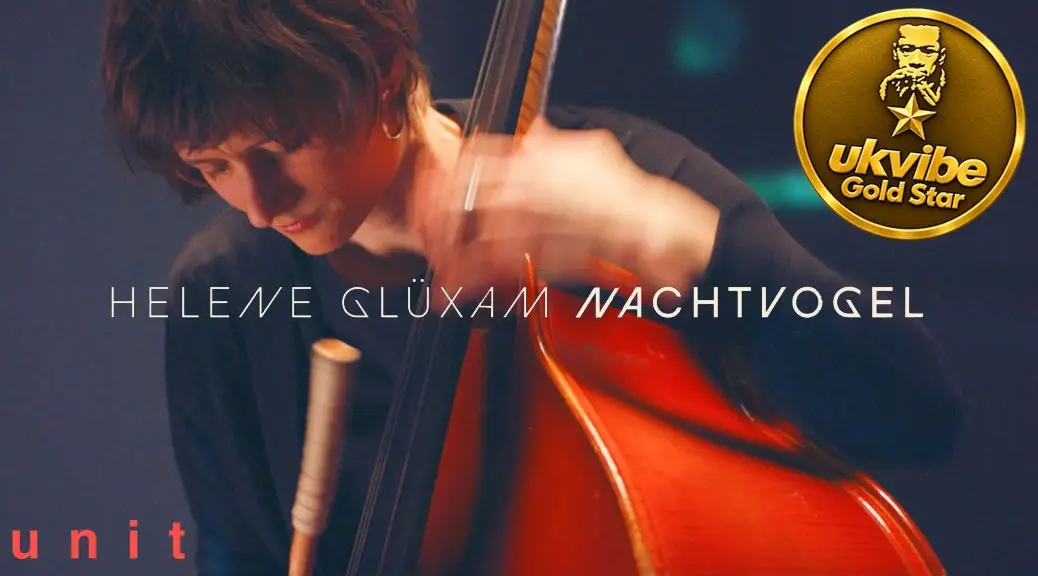
It takes an artist of rare vision, ironclad technique, and profound emotional depth to sustain this format across an entire LP without inducing listener fatigue. With her astonishing debut solo record, Nachtvogel, Viennese bassist and composer Helene Glüxam has not only met this formidable challenge—she has redefined the parameters of what a single double bass and a human voice can achieve.
Released on Unit Records—the esteemed Swiss label helmed by bassist-directors Andreas Waelti and Luca Sisera—Nachtvogel comprises eight original compositions split evenly across two sides. The album arrives on the heels of a massive career milestone for Glüxam: winning the prestigious Best Newcomer category at the Austrian Jazz Awards. Yet, accolades aside, it is the music itself that demands immediate, global attention. Blending extended techniques, custom-crafted wooden beaters, unconventional string percussions, and haunting, choral-like vocal layering, Glüxam has delivered a masterclass in acoustic architecture. For critic Steve Williams, who has spent over three decades searching for the raw, visceral thrill he felt watching Alex Blake alongside Randy Weston in 1993, Nachtvogel represents a once-in-a-generation revelation.
Detailed Chronology: The Genesis and Evolution of Nachtvogel
The journey toward Nachtvogel did not begin in a high-tech recording studio or a buzzing metropolitan jazz club; it was born in the quiet isolation of pandemic-era lockdowns. Like many artists, Glüxam turned inward, using her instrument as a psychological and creative anchor.
The Lockdown Spark: "Wellensturm"
The foundational stone of the entire project was a solitary piece titled "Wellensturm." Conceived initially as a pure instrumental exploration for unaccompanied double bass, the track began to take on a new life when Glüxam played a home recording for her father. Listening to the deep, resonant vibrations of the wood and the intricate rhythmic interplay, her father posed a simple, catalytic question: Might she consider adding her voice to the mix?
Initially resistant, Glüxam viewed her voice and her bass as separate artistic domains. However, a few weeks later, curiosity won out. When she finally layered her vocal cords over the subterranean hum of the strings, a door blew wide open. The voice ceased to be an afterthought and instead became a structural pillar, expanding the music’s spatial dimensions and emotional resonance.
The Mentorship and Lineage
This breakthrough did not occur in a vacuum. Glüxam’s rigorous artistic foundation was forged during her master’s studies in Linz under the tutelage of Peter Herbert, an avant-garde luminary whose own trailblazing solo bass recordings served as a vital beacon for her. Herbert taught her to view the double bass not merely as a rhythm-section anchor, but as an orchestral ecosystem unto itself.
The recording process for Nachtvogel involved careful, intentional choices designed to capture the raw power of Glüxam’s vision. While she performs the bass and vocal components simultaneously in her spellbinding live shows, a pivotal studio decision made after the first day of tracking saw the bass and voice recorded in distinct layers. This separation allowed for pristine acoustic clarity, giving the electronics applied to her voice enough breathing room to weave seamlessly around the gritty, industrial timbres of the strings.
Supporting Context & Metrics: Deconstructing the Sound
To truly appreciate Nachtvogel, one must examine the physical and technical lengths to which Glüxam goes to conjure her unique sonic palette. At first glance, a listener might suspect a pedalboard loaded with digital delay, loopers, and pitch shifters. The reality is far more impressive: the overwhelming majority of the sound originates from organic physics, tactile ingenuity, and meticulous preparation.

Extended Techniques and Custom Craftsmanship
Glüxam’s approach to the double bass transcends traditional bowing and pizzicato. Among her arsenal is a custom wooden beater—an artifact crafted years prior during a university instrument-building workshop from which she has never parted. Striking the strings with this wooden mallet yields a sharp, percussive attack that cuts through the room like a struck anvil.
Furthermore, her right hand frequently treats the massive wooden body of the instrument like a hand drum, conjuring complex polyrhythms that suggest a phantom percussionist is hiding in the shadows. She delves into the short, high-tension strings located below the bridge—a notoriously temperamental zone where string pitch varies wildly from instrument to instrument. Indeed, during the creation of the record, a routine string change caused one of her favorite micro-tonal motifs to temporarily vanish until she painstakingly engineered a way to retune them back.
Side A: Structure and Texture
- "Wellensturm": Serving as the gateway to the album, this track opens with deep, resonant bass groans punctuated by light vocal jabs. As the rhythm gains momentum, Glüxam’s voice multiplies, transforming into a lush, wordless choir that dialogues dynamically with the slapping strings.
- "Flattern": Translating roughly to "fluttering" or "flutter," this piece is aggressively metallic and gritty. One hand delivers industrial stabs while the other contours an erratic, breathless rhythm. The track constantly tests the listener’s perception of the word "solo," blurring the line between a lone instrument and a chaotic ensemble.
- "Vor und Zurück": Easily the most recognizable jazz-leaning cut on the record, this track features subtle echo effects on the vocal track. It unfurls with the explosive energy of a mid-set trio bass solo that would ordinarily bring a jazz club audience to its feet. Yet, it exists entirely in a vacuum, a monument to solitary dedication that famously took Glüxam a year and a half of iterative writing, shelving, and revisiting to complete.
- "Lichtungen": The shortest and perhaps most immediately memorable piece on Side A. Played entirely unaccompanied on the micro-tonal strings below the bridge, its fragile, crystalline beauty lingers long after the needle lifts.
Side B: Cinematic Landscapes and Atmospheric Depth
- "Nachtvogel" (Title Track): Opening the second half of the record, this piece pairs bowed bass work with airy, almost angelic vocals and delicate rim taps. It was during the composition of this specific work that percussion first organically infiltrated Glüxam’s solo framework.
- "Winter": Evoking stark imagery of a dusty main street in a classic Spaghetti Western shootout, this track pairs sombre, drooping bass lines with haunting whistling. While Glüxam has noted that she hears the piece as fundamentally peaceful, its cinematic tension is impossible to ignore—a brilliant collision of subjective listener interpretation and compositional intent.
- "Echolot": Named after the marine echo sounders used to measure ocean depths, this track comes closest to traditional "song-form," with the human voice taking primary melodic shape over a brooding, abyssal bassline.
- "Mondflut": The album’s longest and most emotionally shattering conclusion. Born out of a frustrating day of writer’s block, Glüxam decided to break her muscle memory by retuning her strings at random. The resulting chaos captured lightning in a bottle. Because mid-set retuning is logistically cumbersome, this tour-de-force naturally closes out her live performances, leaving audiences breathless.
Official Statements & Industry Reception
The critical reception of Nachtvogel has positioned Helene Glüxam at the vanguard of a quiet European renaissance in solo acoustic performance. The decision by Unit Records—led by bassist-directors Andreas Waelti and Luca Sisera—to release the album underscores a broader industry shift toward artist-driven, uncompromising acoustic curation.
In a recent artist statement regarding her compositional process, Glüxam reflected on the friction between habit and innovation:
"When you play an instrument for decades, your hands naturally seek out the paths they know best. You have to actively construct traps for yourself—whether through arbitrary retuning, custom wooden tools, or forcing the voice into spaces where it doesn’t comfortably fit—just to break your own habits and discover what is hiding on the other side of the fretboard."
Critics have been quick to place Nachtvogel into an elite echelon of modern bass masterworks. Reviewer Steve Williams notes that the album rightfully claims a spot on his shelf alongside Wojtek Mazolewski’s solo, Kham Meslien’s Fantômes… Futurs, and his all-time favorite, Håkon Thelin’s Slåtter på kontrabass.
Future Outlook & Live Performance Itinerary
For an album born out of meticulous studio layering and raw acoustic experimentation, the ultimate test lies in the crucible of the live stage. Glüxam has proven time and again that her studio wizardry is no illusion; she executes these complex, multi-layered textures in real-time, utilizing voice, body percussion, and extended bow techniques simultaneously.
To celebrate the release of Nachtvogel, Glüxam is embarking on an extensive live tour across Austria, offering audiences a rare chance to witness the alchemy of solo double bass performance up close:
- Tuesday, 22 September: ORF RadioKulturhaus (Studio 3), Vienna — Official Album Launch
- Thursday, 22 October: Raumschiff, Linz
- Friday, 6 November: Markt der Zukunft, Graz — Featuring special guest Avin Ahmadi
- Wednesday, 16 December: openspace, Innsbruck
As contemporary music continues to grapple with digital saturation, over-production, and algorithmic homogenisation, artists like Helene Glüxam remind us of the staggering power inherent in wood, horsehair, human breath, and raw human grit. Nachtvogel is not merely a debut album; it is a declaration of independence for the modern double bass.