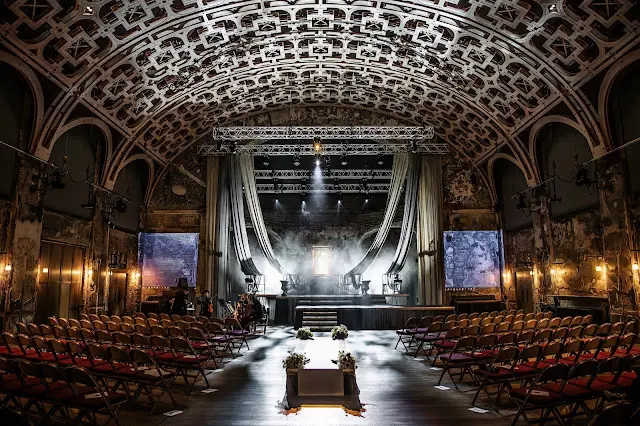
London’s operatic landscape is set to welcome a rare and compelling resurrection this autumn as Gothic Opera prepares to stage Fromental Halévy’s 1850 masterwork, La Dame de Pique. Opening appropriately at the end of October to coincide with the eerie atmosphere of Halloween, this highly anticipated production will occupy the crumbling, evocative architecture of the Battersea Arts Centre’s Grand Hall. For contemporary classical music enthusiasts, the staging offers a generational opportunity to evaluate a composer who was once the beating heart of the Parisian lyric stage, yet has since slipped into near-total obscurity.
Halévy (1799–1862), a decorated pupil of Luigi Cherubini and a dominant force in nineteenth-century French musical life, wrote over thirty operas. His grand opus La Juive (1835) was so monumental that it was chosen to inaugurate the magnificent Palais Garnier in 1875. Yet, outside of rare European revivals, his broader catalog remains gathering dust in library archives. Gothic Opera’s upcoming production of La Dame de Pique—featuring a bespoke chamber orchestration by composer Leon Haxby for seven instruments, direction by Jonny Danciger, and a conducting baton wielded by Hannah von Wiehler—aims to challenge this historical neglect. By transporting audiences to the twilight of the Ancien Régime, where class warfare plays out like a high-stakes card game, the company promises an immersive theatrical experience that marries nineteenth-century French lyricism with modern, site-specific staging.
Detailed Chronology
The Rise, Reign, and Eclipse of Fromental Halévy
To understand the significance of Gothic Opera’s undertaking, one must retrace the meteoric trajectory of Jacques François Fromental Elie Halévy. Born in Paris in 1799 to a Jewish family of modest means, Halévy entered the Conservatoire de Paris at a remarkably young age. He quickly distinguished himself under the tutelage of Cherubini, winning the prestigious Prix de Rome in 1819.
- 1835: Halévy reaches the absolute pinnacle of his career with the premiere of La Juive at the Paris Opéra. The grand opera becomes an instant international sensation, celebrated for its staggering vocal demands, dramatic heft, and lavish orchestration. It establishes Halévy alongside contemporaries like Giacomo Meyerbeer as a titan of French Grand Opera.
- 1850: Seeking to explore a more intimate yet dramatically rich idiom, Halévy turns to La Dame de Pique, with a libretto crafted by theatrical doyenne Eugène Scribe. Premiering at the Opéra-Comique, the work runs for a respectable 47 performances. Although it is loosely based on Alexander Pushkin’s famous short story, Scribe injects a dizzying array of tonal shifts, blending comedy, tragedy, and grand spectacle.
- 1862: Halévy passes away in Nice, leaving behind an immense legacy, though the tides of musical fashion are already beginning to shift. While Hector Berlioz deeply admired his scores and Richard Wagner famously pointed to Halévy as an archetype for composers seeking music "springing from the most intimate and powerful depths of human nature," harsh critics like Heinrich Heine famously dismissed him as an artist "without the slightest spark of genius."
- 1875: La Juive is selected to open the grand Palais Garnier, cementing its status as a French national treasure. However, as the twentieth century dawns, shifting tastes toward verismo, modernism, and German expressionism push Halévy’s extensive catalog out of the active repertory, leaving La Juive as a lonely island in an unmapped sea.
- 2019–2022: Modern glimmers of a Halévy renaissance begin to surface. Operatic travelers journey to Antwerp for a celebrated revival of La Juive, while Wexford Festival Opera stages his Shakespearean adaptation La Tempesta (1850) in 2022, reminding international audiences of the composer’s melodic invention and textural brilliance.
- Late October 2024–Present: Gothic Opera steps into the breach. Following their acclaimed work on Donizetti’s Maria di Rudenz, the company sets its sights on La Dame de Pique, scheduling a limited run from October 29 to November 1 at the Battersea Arts Centre.
Supporting Context & Metrics
The Score, The Libretto, and The Pushkin Departure
While music lovers familiar with Pyotr Ilyich Tchaikovsky’s famous 1890 operatic masterpiece The Queen of Spades might expect a direct adaptation of Pushkin’s gothic tale of obsession, gambling, and ghostly retribution, Scribe and Halévy’s 1850 creation operates under entirely different rules.
Contemporary critics struggled to categorize Scribe’s multifaceted libretto. It was alternately reviewed as a confusing hybrid of drama, comedy, opéra-comique, tragédie lyrique, and féerie. Yet, beneath the dramaturgical eccentricities lay a musical landscape of profound elegance. Halévy possessed an uncanny gift for soaring melody, seductive vocal writing, and sophisticated orchestration. Contemporary Parisian reviews praised the work’s scale, vitality, and instrumental brilliance.
One of the most remarkable structural features of the opera—and a prime candidate for Gothic Opera’s atmospheric staging—is its radical tonal and geographical shifts. The narrative sweeps effortlessly from aristocratic salons down into subterranean mining communities. Act 2 features a breathtaking duet that erupts into a turbulent miners’ chorus, an episode that Halévy’s contemporaries regarded as one of the most powerful inventions in the entire French lyric canon.

Production Metrics & Artistic Roster
Bringing a sprawling nineteenth-century grand opera into an intimate, site-specific environment requires radical artistic engineering. Gothic Opera has assembled a formidable creative team to tackle the logistical and musical hurdles of La Dame de Pique:
- Venue: Battersea Arts Centre (Grand Hall), utilizing its distressed, fire-scarred architecture to evoke the decaying grandeur of late-eighteenth-century France.
- Director: Jonny Danciger, praised for his inventive staging of Strauss’s Die Fledermaus for St Paul’s Opera in 2024.
- Musical Reduction: Composer Leon Haxby, who previously collaborated with Gothic Opera on Donizetti’s Maria di Rudenz, has custom-built a brand-new chamber orchestration tailored specifically for an ensemble of just seven instruments.
- Conductor: Hannah von Wiehler, tasked with steering the instrumental ensemble and vocal cast through Halévy’s intricate textures.
- Design & Lighting: Celeste Langrée (Set & Costume Design) and Luca Panetta (Lighting Design), crafting a visual world that bridges aristocratic luxury with subterranean gloom.
- Run Dates: October 29 through November 1.
The Proustian Connection: A Fascinating Dynasty
Beyond his musical output, Halévy’s bloodline anchors him firmly in the mythology of European high culture. In 1869, Halévy’s daughter, Geneviève Halévy, married the brilliant composer Georges Bizet, who had studied under Halévy at the Conservatoire (and famously completed Halévy’s unfinished opera Noé).
Following Bizet’s untimely death and subsequent personal chapters, Geneviève evolved into one of the most prominent Parisian salonnières of the late nineteenth century. Among the regular attendees at her glittering soirées was a young, aspiring writer named Marcel Proust. Captivated by her wit, elegance, and social magnetism, Proust immortalized aspects of Geneviève Halévy by using her as one of the primary literary models for the iconic Duchesse de Guermantes in his monumental masterwork, In Search of Lost Time. Thus, the artistic lineage of Fromental Halévy stretches in a direct, unbroken line from the stages of the Paris Opéra straight into the foundational canons of modern literature.
Official Statements
While the creative team has been tight-lipped about the specific narrative twists in their upcoming adaptation, production notes and promotional releases from Gothic Opera emphasize a thematic exploration of societal collapse:
"By staging the piece in the crumbling architecture of Battersea Arts Centre’s Grand Hall, we intend to transport the audience directly to an era of profound decay and dissolution at the end of the Ancien Régime in France. Here, relentless tussles of power play out relentlessly between the ruling elites and the working classes—resembling nothing less than a high-stakes card game being violently reshuffled."
— Gothic Opera Production Statement
Director Jonny Danciger, reflecting on the challenges of mounting rare nineteenth-century repertoire in non-traditional spaces, noted the vitality of the score:

"Halévy’s music does not merely accompany the action; it breathes life into the social tensions of the period. By stripping the orchestration down to seven players through Leon Haxby’s brilliant reduction, we expose the naked emotional raw-nerve of the composition, allowing audiences to experience the psychological claustrophobia of Scribe’s libretto in terrifyingly close quarters."
Future Outlook
The revival of La Dame de Pique by Gothic Opera represents far more than a localized Halloween novelty; it serves as a critical test case for the viability of rediscovering the broader nineteenth-century French repertory. For decades, opera companies globally have relied on a heavily constricted "core canon," leaving monumental masterworks by composers like Halévy, Meyerbeer, and Auber to gather dust on library shelves due to the prohibitive costs and logistical nightmares of staging traditional grand opera.
By pioneering nimble, chamber-orchestrated adaptations performed in unconventional, historically resonant spaces like the Battersea Arts Centre, companies like Gothic Opera are forging a sustainable economic and artistic blueprint for operatic excavation. If Haxby’s chamber reduction of La Dame de Pique succeeds in capturing the grand scale and intimate psychological terror of Halévy’s original score, it could open the floodgates for further programming of neglected French masterworks across the United Kingdom and beyond.
For London audiences, the four-night run from October 29 to November 1 offers a rare, unrepeatable window into musical history. Whether Heinrich Heine was right that Halévy lacked the "spark of genius," or whether Berlioz and Wagner were closer to the truth regarding his profound emotional depths, remains for the modern ear to decide. One thing is certain: as the cards are dealt in the decaying shadows of Battersea’s Grand Hall this autumn, Fromental Halévy will finally have his day in court.