The Salzburg Festival has long served as the crucible where high-art ambition meets public expectation, regularly testing the boundaries of classical repertoire through avant-garde visions and meticulous musical direction. On August 6, 2026, the venerable Grosses Festspielhaus played host to one of the most compelling triumphs of the season: a restudied, uncut presentation of Wolfgang Amadeus Mozart’s Così fan tutte. Directed by Christof Loy and conducted with incisive brilliance by Joana Mallwitz, this production marked a profound evolution from Loy’s initial COVID-era iteration mounted in 2020.
Where the 2020 staging was constrained by sanitary measures and narrative cuts, the 2026 revival offered a fully fleshed-out artistic vision. Stripped of historical costumery, localized Naples tourist clichés, and heavy-handed dramaturgical interventions, Loy’s stripped-down aesthetic focused entirely on the raw psychological machinery of Da Ponte’s libretto. Leading an elite ensemble featuring Elsa Dreisig, Victoria Karkacheva, Bogdan Volkov, Andrè Schuen, Lea Desandre, and Johannes Martin Kränzle, supported by the Vienna Philharmonic and the Angelika Prokopp Sommerakademie, the production achieved a rare alchemy. It transformed the vast, imposing cavern of the Grosses Festspielhaus into an intimate chamber of emotional exposure.
Rather than treating Così fan tutte as a misogynistic farce or a period artifact, Loy and Mallwitz interrogated the work as an unsparing critique of male ego, emotional plasticity, and the dangerous allure of the unknown. The result was a masterclass in modern operatic direction—cerebral yet deeply visceral, leaving audiences on the edge of their seats and radically questioning whether any of the characters had truly learned anything by the final curtain.
Detailed Chronology
The Prelude to the Experiment
The atmosphere at the Grosses Festspielhaus on the evening of August 6, 2026, carried a palpable sense of anticipation. Just twenty-four hours prior, the Grosses Festspielhaus had hosted a hyper-busy, visually saturated staging of Rossini’s Il viaggio a Reims. Thursday’s Così fan tutte offered a deliberate, stark aesthetic corrective. Christof Loy had elected to revisit his 2020 Salzburg creation—a production born under the shadow of pandemic restrictions that necessitated structural trims reducing the opera to well under three hours. For this 2026 iteration, Loy discarded those safety-measure cuts, restoring the score to its full architectural breadth while completely rethinking the physical staging and emotional trajectories.
Act I: The Illusion of Control and Light Beginnings
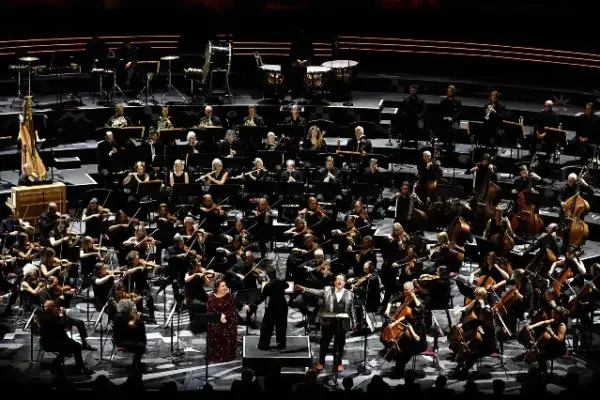
From the initial stroke of the overture, conductor Joana Mallwitz made her intentions unmistakably clear. The Vienna Philharmonic’s opening chords were sharp, biting, and relentlessly vivid. Mallwitz’s pacing steered clear of indulgent romanticism; instead, she drove the score with an organic, incisive momentum that took no prisoners.
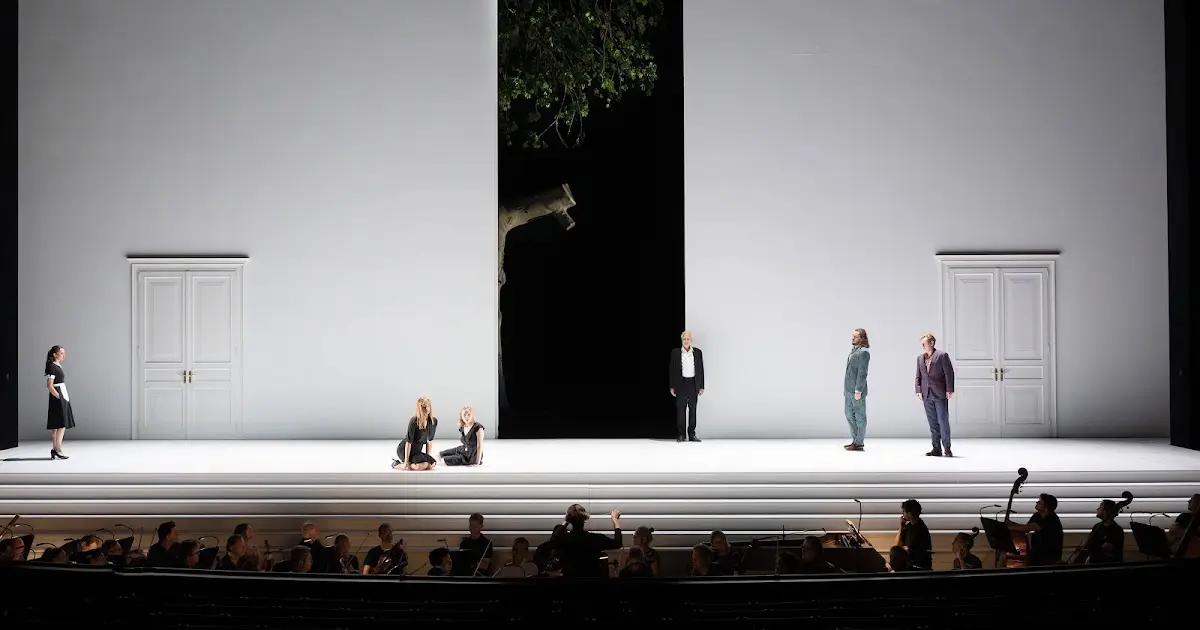
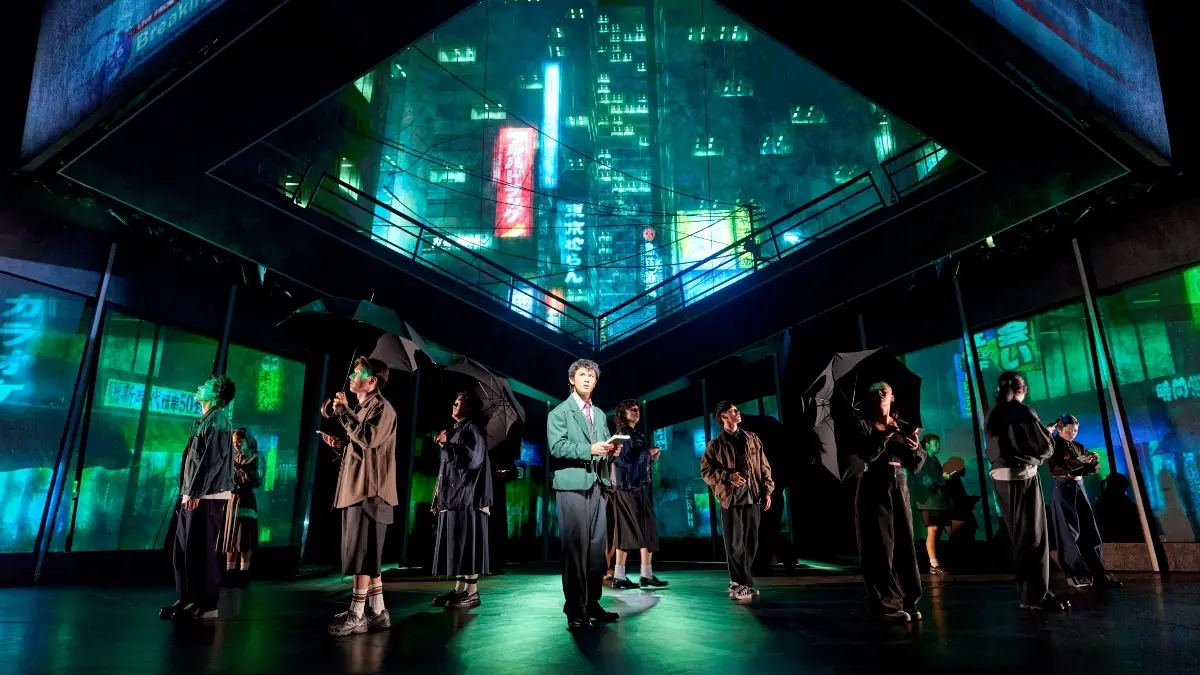
On stage, Johannes Leiacker’s set design was strikingly minimalist. The playing area was restricted to a relatively narrow platform with stark steps descending directly into the orchestra pit. The sisters, Fiordiligi (Elsa Dreisig) and Dorabella (Victoria Karkacheva), inhabited a world rendered in clean, modern black attire—Fiordiligi and Dorabella wearing unpretentious black court shoes, establishing a visual tone of elegant sobriety. When Ferrando (Bogdan Volkov) and Guglielmo (Andrè Schuen) made their entrance, they wore contemporary civilian clothes splashed with colour, deliberately bypassing any traditional reliance on absurd disguises, false mustaches, or comic-opera wigs.
Act I unfurled with an initial lightness, driven by Don Alfonso’s (Johannes Martin Kränzle) seemingly benign wager with the young officers. Kränzle portrayed Alfonso not as a dark, cynical puppet-master, but as an engaging know-all who viewed the experiment as an amusing parlor game. The soldiers happily bought into the premise, their laddish camaraderie played with infectious, casual arrogance.
Vocally, the performance established its high-water marks early. Bogdan Volkov’s rendering of "Un aura amorosa" floated through the hall with a lyric tenor that possessed surprising, hidden structural depth, standing as a momentary suspension of time. Elsa Dreisig’s delivery of "Come scoglio" was a tour de force of classical rigor and vocal intensity, anchored by a lithe, beautifully lined soprano voice that commanded immediate authority.
Act II: Crossing the Boundary into Darkness
If Act I belonged to the sunlit illusions of youth and testing theories, Act II shattered them completely. The dramatic pivot of the evening arrived early in the second act during the dialogue between the sisters, where they consciously crossed an invisible psychological boundary, daring to entertain dalliances with their disguised suitors.
Loy utilized a signature staging technique: keeping characters on stage during solos to force silent, agonizing confrontations. As Dreisig’s Fiordiligi wrestled with her destabilized emotions in her intense second-act aria, Volkov’s Ferrando remained present, silently watching her. Simultaneously, Karkacheva’s Dorabella—who earlier transitioned from a lighthearted opening aria to a fierce, cognizant exploration of Cupid’s power—stared intently at Ferrando before turning her gaze to Schuen’s Guglielmo.
The psychological climate shifted rapidly from playful experimentation to genuine distress. Schuen’s Guglielmo brought a dangerous suavity and richness of tone to his second-act numbers, but as the act progressed, a visceral viciousness emerged. Volkov’s second-act aria laid bare Ferrando’s inner torment: the agonizing realization that while he burned with jealousy over his fiancée’s betrayal, he was simultaneously falling under the spell of another. By the end of this number, both the character and the audience were left emotionally shell-shocked.
The Ambiguous Resolution
As the narrative rushed toward its obligatory tidy conclusion, Loy ensured that comfort remained entirely out of reach. The opera’s final scenes were performed with such razor-sharp intensity that the audience sat on the edge of its seats, entirely uncertain of how the psychological pieces would fall.
While the libretto’s "correct" couples were ultimately re-established on paper, Loy stripped the ending of any restorative harmony. The final tableau left a lingering, uncomfortable question hanging in the air: Had any of these individuals actually learned anything? The unseen Concert Choir of the Vienna State Opera Chorus—remaining invisible throughout the evening—added an ethereal, detached commentary to the human folly unfolding below, sealing an unforgettable evening of operatic theatre.
Supporting Context & Metrics
Production Data & Creative Team
Opera:Così fan tutte (Wolfgang Amadeus Mozart, libretto by Lorenzo Da Ponte)
Performance Date: August 6, 2026
Venue: Grosses Festspielhaus, Salzburg Festival
Director: Christof Loy
Conductor: Joana Mallwitz
Orchestra: Wiener Philharmoniker and members of the Angelika Prokopp Sommerakademie der Wiener Philharmoniker
Chorus: Concert Choir of the Vienna State Opera Chorus (unseen)
Set Designer: Johannes Leiacker
Costume Designer: Barbara Drosihn
Lighting Designer: Olaf Winter
Forte-piano Continuo: Pedro Beriso
Principal Cast & Vocal Profiles
Fiordiligi: Elsa Dreisig (Soprano) – Praised for lithe vocal line, remarkable intensity, and authoritative control in "Come scoglio."
Dorabella: Victoria Karkacheva (Mezzo-Soprano) – Provided a grounded, perceptive foil with a finely calibrated transition from youthful lightness to fierce psychological awareness.
Ferrando: Bogdan Volkov (Tenor) – Exhibited a lyric tenor of surprising emotional depth, culminating in a devastatingly raw second-act exploration of jealousy and shifting affection.
Guglielmo: Andrè Schuen (Baritone) – Delivered vocal suavity paired with a late-act transformation into volatile, wounded aggression.
Despina: Lea Desandre (Soprano) – Created a pert, youthful, and wise comedic presence, excelling physically in her medico and notary vignettes.
Don Alfonso: Johannes Martin Kränzle (Bass-Baritone) – Portrayed the architect of the wager as an initially casual provocateur who ultimately lost control of his own experiment.
Official Statements
Reflecting on his conceptual framework for the staging, director Christof Loy articulated his vision in the official Salzburg Festival programme book:
"A performance on this gigantic stage that nevertheless manages to be very intimate… It dispenses with all external aids: there are only two doors, the characters, the music… The performers are far closer to the audience."
Expounding on his broader dramaturgical philosophy regarding Mozart and Da Ponte’s intentions, Loy added:
"I want to release the characters from any concrete context so that one can perceive them as human beings, not historical figures from 18th-century Naples."
Future Outlook
The critical acclaim garnered by Christof Loy and Joana Mallwitz’s 2026 iteration of Così fan tutte at the Salzburg Festival signals a potential paradigm shift in how major European houses approach Mozart’s problematic comedies. In recent years, festival and opera house stages across the continent—ranging from Opera Holland Park’s 20th-century package-tour concepts to the Grange Festival’s gender-equity re-readings and the English National Opera’s circus-themed spectacles—have frequently relied on high-concept, external narrative layers to make the opera digestible for modern audiences.
Loy’s success proves that stripping away external gimmicks in favor of uncompromising psychological realism yields far more resonant theatrical fruit, even within a monumental venue like the Grosses Festspielhaus. By trusting the interplay of Mozart’s pristine score, Da Ponte’s intricate human blueprints, and a world-class ensemble of singing actors, this production has set a high-water mark for contemporary Mozart interpretation. As the Salzburg Festival evaluates its touring and revival strategies for future seasons, this production of Così fan tutte will undoubtedly serve as a benchmark for how minimalist staging, when married to fierce musical integrity, can elevate standard repertoire into urgent, contemporary psychological drama.