Executive Overview
In the vibrant cultural landscape of Northern England, classical music recently witnessed a transcendent moment of mentorship and community engagement. Renowned international cellist Sheku Kanneh-Mason—whose virtuosic talent and charismatic stage presence have redefined classical music for a modern audience—concluded a critically acclaimed regional tour by trading the grand concert hall stage for an open, sunlit concourse. Fresh from a series of powerful performances alongside the Royal Northern Sinfonia and conductor Dinis Sousa, Kanneh-Mason chose to cap his musical residency by rehearsing and performing shoulder-to-shoulder with 24 aspiring young cellists at The Glasshouse International Centre for Music in Gateshead.
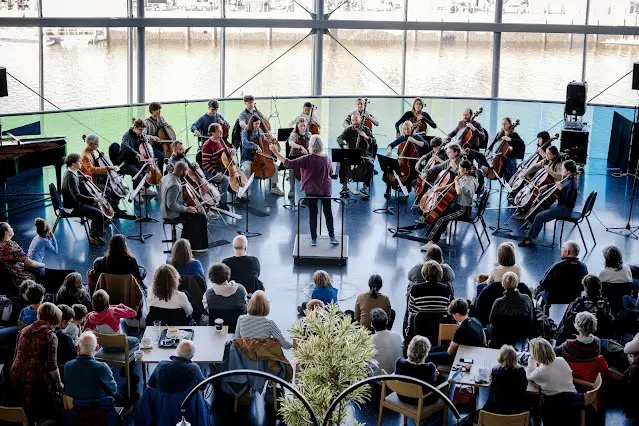
This extraordinary gathering brought together talents from The Glasshouse’s Young Sinfonia, its prestigious Centre for Advanced Training (CAT), dedicated music tutors, professional players from the Royal Northern Sinfonia, and accomplished alumni of the institution’s pioneering education programmes. The resulting 24-piece cello ensemble created an acoustic tapestry that resonated far beyond the walls of the Northern Rock Foundation Hall, culminating in a vibrant, free public lunchtime concert.
Designed as a core component of The Glasshouse’s broader Make Music Young People initiative and its popular Sunday Lunchtime Concerts series, the event underscored the institution’s unwavering commitment to grassroots music education. By pairing an internationally celebrated soloist with students taking their first serious steps into the classical world, the collaboration offered a powerful testament to the value of mentorship. It illustrated how world-class artistry can directly feed into local talent development, providing young musicians with memories and inspirations that will last a lifetime.
Detailed Chronology: From Regional Tour to Concourse Collaboration
The events leading up to this landmark massed performance spanned several days of rigorous artistic output across Northern England, blending high-profile professional orchestration with grassroots educational outreach.
The Northern Tour: Saint-Saëns with the Royal Northern Sinfonia
The journey began earlier in the week as Kanneh-Mason embarked on a collaborative tour across the North of England alongside the esteemed Royal Northern Sinfonia (RNS), under the visionary baton of conductor Dinis Sousa. The program was anchored by Camille Saint-Saëns’ emotionally expressive and technically demanding Cello Concerto No. 1 in A minor, Op. 33.
Performances kicked off in Middlesbrough, captivating audiences with the concerto’s seamless three-movement structure and the soloist’s liquid tone production. The ensemble then traveled to Kendal, where the intimate acoustics of the venue allowed Kanneh-Mason’s profound musicality to forge an immediate, visceral connection with the audience. The tour culminated at The Glasshouse in Gateshead, where the orchestral powerhouse of the RNS provided a rich, symphonic canvas for Kanneh-Mason’s soaring lyrical lines. Critics and concertgoers alike lauded the tour as a masterclass in expressive interpretation, cementing Kanneh-Mason’s status not only as a technical virtuoso but as a deeply communicative artist.
Transition to Mentorship: The Rehearsal Room
Rather than taking a well-deserved rest following the conclusion of his orchestral commitments, Kanneh-Mason redirected his creative energy toward the educational mission of his residency. On a brisk Sunday morning, he entered the Northern Rock Foundation Hall at The Glasshouse to meet the young participants of the Make Music Young People initiative.
The atmosphere in the rehearsal room was electric. The ensemble comprised an eclectic mix of eager minds and seasoned talents: current students from the Young Sinfonia and the Centre for Advanced Training (CAT), professional mentors from the Royal Northern Sinfonia, dedicated local music tutors, and alumni who had successfully transitioned from these very educational pipelines into professional music careers.
Kanneh-Mason approached the rehearsal not as a distant guest star, but as a collaborative partner. He offered nuanced technical advice on bow distribution, intonation blending within a large cello choir, and the emotional phrasing required to bring historical works to life. The young musicians, ranging widely in age, absorbed every instruction, their focus absolute as they blended their instruments’ warm, resonant timbers with that of a soloist they regularly listened to on recordings.

The Concourse Performance: Bringing Music to the Public
Following the intensive morning workshop, the 24-cellist ensemble migrated from the rehearsal hall to the sweeping, architectural expanse of The Glasshouse’s public concourse. Designed to break down the traditional barriers between high art and the everyday public, the concourse serves as a dynamic community hub.
As lunchtime approached, a curious and enthusiastic crowd gathered around the performance space, drawn by the rich, mahogany warmth of two dozen cellos tuning in unison. The free informal concert was presented as part of The Glasshouse’s celebrated Lunchtime Concerts series—a seasonal program of Sunday mini-performances dedicated to showcasing the fruits of the CAT students’ rigorous training.
The repertoire chosen for the afternoon was as diverse as the ensemble itself, moving effortlessly across musical genres and centuries. The performance opened with a striking movement from Heitor Villa-Lobos’s Bachianas Brasileiras No. 1, a masterwork specifically scored for an orchestra of cellos that bridges Brazilian folk traditions with the counterpoint of Johann Sebastian Bach. The ensemble then shifted gears with infectious syncopation and rhythmic flair, delivering vibrant arrangements of classics by George Gershwin and Scott Joplin. The sight of Sheku Kanneh-Mason playing side-by-side with young cellists—some small enough that their instruments dwarfed them—elicited visible delight from the assembled audience, transforming an ordinary Sunday afternoon into an unforgettable celebration of community music-making.
Supporting Context & Metrics: The Architecture of Opportunity
To truly appreciate the significance of this massed performance, one must examine the institutional framework that made it possible. The Glasshouse International Centre for Music—formerly known as Sage Gateshead—has long stood as a beacon of cultural democratization in the UK, anchoring its operational philosophy in the belief that music is for everyone, regardless of background or socioeconomic status.
The Glasshouse and Make Music Young People
The Make Music Young People programme is designed to cultivate musical talent from its earliest stages through to advanced pre-professional training. It operates on a tiered developmental model:
- Inclusive Weekend Schools: Non-auditioned, accessible ensembles, bands, and choirs designed for children and teenagers of all ages and abilities. These groups focus on fostering a lifelong love of music through collaborative play, requiring no prior formal training.
- Centre for Advanced Training (CAT): A specialist, intensive training ground funded by the Department for Education’s Music and Dance Scheme. The CAT program identifies exceptional young talent from across the region, providing them with world-class instrumental tuition, performance opportunities, and mentorship.
- Pathways to the Profession: Through partnerships with resident orchestras like the Royal Northern Sinfonia, students benefit from regular interactions with professional musicians, masterclasses, and transitional support for those wishing to pursue music at conservatoires and universities.
Applications for these educational pathways remain open year-round, ensuring that financial or administrative hurdles never stand in the way of a gifted or enthusiastic young person seeking to develop their craft.
The Acoustic and Symbolic Power of the Cello Choir
From a musicological standpoint, a massed cello ensemble is a uniquely powerful configuration. The cello’s vocal range closely mirrors that of the human voice, spanning from the rich, rumbling depths of the bass clef to the soaring, melancholic beauty of the tenor and treble registers. When 24 cellos play in unison or polyphonic harmony, the sonic result is a velvety, enveloping warmth that fills large architectural spaces without the need for heavy amplification.
Symbolically, the ensemble acts as an equalizer. In a cello choir, the boundaries between student and master, amateur and professional, blur into insignificance. Every player—whether a fourteen-year-old CAT student playing their first public gig or Sheku Kanneh-Mason holding a cello worth millions—contributes an essential frequency to the collective sound. This radical inclusivity lies at the heart of both Kanneh-Mason’s personal artistic ethos and The Glasshouse’s institutional mission.
Official Statements and Reflections
The impact of the residency and the subsequent massed performance was articulated eloquently by those who experienced it from the inside.

Reflecting on the whirlwind week of touring and the unique Sunday morning collaboration, Sheku Kanneh-Mason shared his thoughts with heartfelt sincerity:
"After my concerts in Middlesbrough, Kendal, and then here at The Glasshouse this week, it was a really special conclusion to hear the young cellists play in the rehearsal and then to join them out on the Concourse, on Sunday morning. The next generation of musicians matters so much, and I loved seeing all the enthusiasm and hearing the talent."
Educational leaders at The Glasshouse echoed these sentiments, emphasizing that moments like these are critical for validating the hard work that young musicians put into their weekend practice sessions. CAT coordinators noted that seeing an artist of international renown treat young students with such genuine respect and collegiality changes the psychological landscape for a developing musician. It transforms classical music from an intimidating, distant historical canon into a living, breathing, and profoundly welcoming community to which they rightfully belong.
Future Outlook: Sustaining the Momentum of Grassroots Musical Growth
As the dust settles on a triumphant week of music-making in Northern England, the legacy of Sheku Kanneh-Mason’s residency at The Glasshouse will continue to ripple outward. For the 24 young cellists who shared the stage on that Sunday afternoon, the experience has fundamentally shifted their perspectives on what is possible through dedication, education, and community support.
Expanding Access and Regional Impact
The success of the Make Music Young People programme and its public-facing initiatives points the way forward for classical music institutions across the globe. In an era where arts funding faces perpetual scrutiny and traditional classical audiences are often critiqued for aging demographics, events like the massed cello performance offer a clear blueprint for renewal. By embedding outreach directly into major artistic tours, venues can maximize the return on cultural investment—simultaneously delivering world-class performances to ticket-holders and planting deep artistic roots within the local youth population.
The Glasshouse continues to expand its offerings, with ongoing applications for its weekend schools and CAT programmes ensuring that a fresh wave of talent will walk through its doors in the coming months. Plans are already underway for future artist residencies that will replicate this model of integrated mentorship, pairing international luminaries with the North East’s brightest young creative minds.
Ultimately, the image of Sheku Kanneh-Mason standing among 24 young cellists on a bustling public concourse serves as a powerful metaphor for the health and future of classical music. It demonstrates that the art form is not locked away in ivory towers or confined to elite subscription series; rather, it is a living, communal tradition passed from hand to hand, bow to bow, and heart to heart.