Executive Overview
The Salzburg Festival has long served as an international crucible for avant-garde operatic interpretation, where traditional masterpieces are routinely dismantled and reassembled through contemporary lenses. On August 7, 2026, the Haus für Mozart played host to one of the most polarizing stagings of the festival calendar: a futuristic, Mars-colonized reinterpretation of Richard Strauss and Hugo von Hofmannsthal’s satirical masterwork, Ariadne auf Naxos.
Helmed by interdisciplinary visionary Ersan Mondtag—whose portfolio spans the German pavilion at the Venice Biennale and prominent opera houses across Europe—this new production transposed the 18th-century meta-theatrical comedy into an over-elaborate science-fiction enclave. While Mondtag’s high-concept staging ultimately collapsed under the weight of its own visual clutter and visual-musical dissonance, the evening was resoundingly salvaged by world-class musical execution. Under the baton of maestro Manfred Honeck, the Vienna Philharmonic delivered a glittering, emotionally resonant reading of Strauss’s intricate score. They were matched by an exceptional cast featuring Kate Lindsey, Christina Nilsson, Eric Cutler, and Ziyi Dai.
Ultimately, the production exposed a recurring fault line in contemporary regietheater: when a director’s conceptual machinery overwhelms the structural and emotional nuances of the music, the work’s foundational irony is lost. Yet, as a showcase of vocal and orchestral brilliance, the performance secured a complicated, unforgettable place in the annals of recent Salzburg history.

Detailed Chronology: A Martian Backstage Chaos
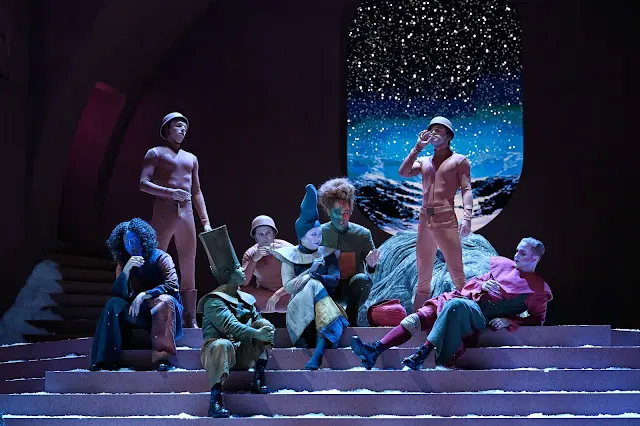
The conceptual journey of this Ariadne auf Naxos began well before the downbeat, signaled by an overture accompanied by video projections zooming into a red-dust Martian colony. With a retro-futuristic aesthetic reminiscent of mid-century space-age serials, the visual tone was immediately established. The multi-tiered, 1930s-inflected set served as a dual-purpose architectural framework for both the prologue’s frantic backstage preparation and the opera proper. At the rear, a continuous portal screen displayed the barren Martian surface and clunky spacecraft, creating occasional striking vistas while proving wildly distracting during intimate dramatic exchanges.
The Prologue: Bureaucracy and Backstage Tensions
The opera’s introductory framing device—depicting the chaotic collision of high art and low comedy mandated by a wealthy Viennese patron—was populated by an exhaustive ensemble of seventeen named roles, background guards in skin-tight uniforms, and modern dancers.
Identifying characters became an exercise in decoding obscure signifiers. Christoph Pohl cut an impressive figure as the Music Master, dressed somberly in black, while Blaż Štajnko appeared as a long-wigged wig-maker. Jonas Hacker injected sparkling energy into the Dancing Master, brandishing a remarkably flamboyant, bright-orange brush wig. Meanwhile, Johannes Silberschneider delivered the spoken role of the Majordomo with sharp elan.

At the emotional and dramatic center of the prologue stood Kate Lindsey as the Composer. Returning to a role she famously mastered at Glyndebourne in 2013, Lindsey offered a white-hot, intensely physical portrayal. Possessing a soprano-like brightness and an unwavering commitment, she navigated the character’s androgynous styling and nervous energy with total immersion. Her interactions with Ziyi Dai’s initially reticent Zerbinetta provided some of the prologue’s most genuinely touching, grounded moments.
The Opera Proper: Choreographic Clutter and Interrupted Statis
As the action transitioned into the opera proper, the thematic focus deteriorated. While Christina Nilsson (Ariadne) and Eric Cutler (Bacchus) attempted to execute Strauss’s demands for classical grandeur, the staging devolved into a chaotic spectacle.
Choreographer Ashley Alexandra Wright provided movement that was consistently angular, contorted, and hyper-energetic. Unfortunately, these routines frequently clashed with the underlying musical phrases. During the ethereal opening trio of the Naiad (Anja Mittermüller), Dryad (Jasmin Delfs), and Echo (Marlene Metzger)—the latter awkwardly suspended from the flies in a woolly, Smurf-like costume—dancers cluttered the stage, pulling focus away from the vocalists.

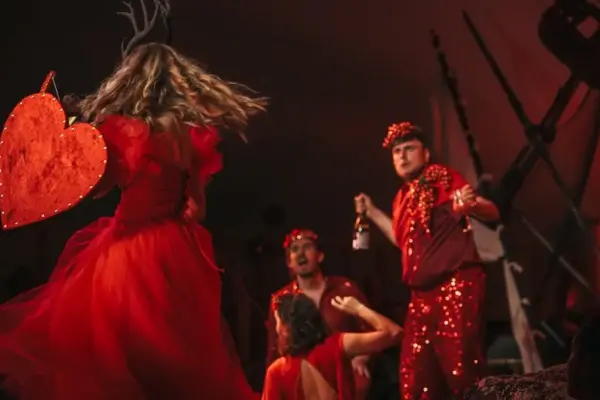
The dilution of musical intent reached its apex during Zerbinetta’s virtuosic aria, “Großmächtige Prinzessin”. Rather than addressing her reflections on human constancy to Ariadne, Dai directed her performance toward Lindsey’s lingering Composer, blurring the boundaries between art and life. As the aria progressed into its pyrotechnic climax, the stage erupted into an uninhibited, chaotic orgy involving Harlekin, the troupe, and the ensemble of dancers. Amidst heavy simulated smoking and guards joining the fray, Dai demonstrated remarkable technical stability, executing dizzying roulades while navigating the sensory overload around her.
When Eric Cutler finally descended as Bacchus, he was encumbered by an ill-fitting spacespace complete with winged helmet, transforming the mythological demigod into an ungainly, posturing figure. Cutler sang with heroic endurance and forceful tone, yet his physical presentation contrasted jarringly with Nilsson’s inward, deeply concentrated Ariadne. Nilsson’s rendition of “Es gibt ein Reich” achieved a rare moment of stillness, drawing the audience into her psychological torment through sheer vocal purity—before yet another wave of stage distractions intervened.
Supporting Context & Metrics: Production At a Glance
To fully contextualize the scope, scale, and artistic pedigree of this Salzburg production, several structural metrics and contextual factors must be considered:

- Premiere Date & Venue: August 7, 2026 (Second Performance); Haus für Mozart, Salzburg Festival.
- Creative Team:
- Composer: Richard Strauss
- Librettist: Hugo von Hofmannsthal
- Director & Designer: Ersan Mondtag
- Conductor: Manfred Honeck
- Orchestra: Vienna Philharmonic Orchestra
- Choreography: Ashley Alexandra Wright
- Video Design: Alexander Pannier
- Dramaturg: Till Briegleb
- Principal Cast Roster:
- Ariadne / Primadonna: Christina Nilsson
- Bacchus / Tenor: Eric Cutler
- Composer: Kate Lindsey
- Zerbinetta: Ziyi Dai
- Music Master: Christoph Pohl
- Dancing Master: Jonas Hacker
- Majordomo: Johannes Silberschneider
- Naiad / Dryad / Echo: Jasmin Delfs, Anja Mittermüller, Marlene Metzger
The Director’s Interdisciplinary Track Record
Ersan Mondtag’s approach to Ariadne auf Naxos aligns with his broader career trajectory as a boundary-pushing installation and theater artist. Known for transforming canonical spaces—such as his contribution to the German Pavilion at the Venice Biennale and recent high-fashion-infused stagings of Bizet’s Les Pêcheurs de Perles at the Vienna State Opera—Mondtag consistently applies radical environmental concepts to traditional repertoire. However, critics noted that while his visual vocabulary works effectively in more malleable 19th-century French scores, Strauss and Hofmannsthal’s tightly integrated text-music relationship requires a lighter, more responsive theatrical touch.
Official Statements & Critical Reception
The reaction from international critics and festival attendees highlighted a sharp divide between visual conceptualization and musical execution.
Festival organizers framed the production as an essential exploration of artistic isolation and futurism, emphasizing the timeless struggle of creators attempting to realize their vision under the financial constraints of patrons—whether in 17th-century Vienna or a speculative Martian colony. Dramaturg Till Briegleb defended the structural adaptations, noting that transposing the narrative framework to an isolated outpost heightened the claustrophobia of artistic creation.

Musically, however, the response was uniformly rapturous. Maestro Manfred Honeck, leading the Vienna Philharmonic, drew praise for drawing out the translucent textures of Strauss’s orchestration. Reviewers noted that Honeck’s pacing allowed the soloists room to breathe, even when the stage picture threatened to suffocate the musical architecture.
Colleagues and vocal coaches reviewing the production singled out Christina Nilsson and Kate Lindsey for particular acclaim. Nilsson’s ability to anchor Ariadne with dignity amidst the surrounding chaos was lauded as a masterclass in vocal control. Similarly, Lindsey’s physical and vocal tenacity cemented her status as one of her generation’s definitive interpreters of trouser roles.
Future Outlook
As the 2026 Salzburg Festival season progresses, Ersan Mondtag’s Ariadne auf Naxos will undoubtedly remain a central talking point in debates surrounding contemporary opera direction. The production serves as a cautionary tale of conceptual overreach, illustrating that high-concept sci-fi framing cannot substitute for an organic understanding of a score’s internal dramatic logic.

Yet, the legacy of this staging may ultimately rest on its musical merits. The triumph of the Vienna Philharmonic under Honeck, combined with career-defining vocal performances from Nilsson, Lindsey, and Dai, ensures that the production will be remembered not for its Martian mise-en-scène, but for the resilience of Strauss’s music in the face of theatrical adversity. Whether future iterations of this production tour to other international houses—or whether it remains a uniquely Salzburg experiment—it has firmly reignited the conversation on how directors can better serve, rather than subvert, the delicate marriage of word and tone.