In the contemporary landscape where avant-garde composition frequently untethers itself from historical anchors, Norwegian Hardanger fiddler and composer Benedicte Maurseth has forged a radically different path. Her latest release, Always and Never the Same, issued on LP, represents a landmark convergence between traditional Norwegian folk forms and the rigorous, experimental sensibilities of contemporary chamber music. At the heart of this eight-movement suite is the Hardanger fiddle—Norway’s national instrument, distinguished by its understrings that ring in sympathetic resonance with the melody above.
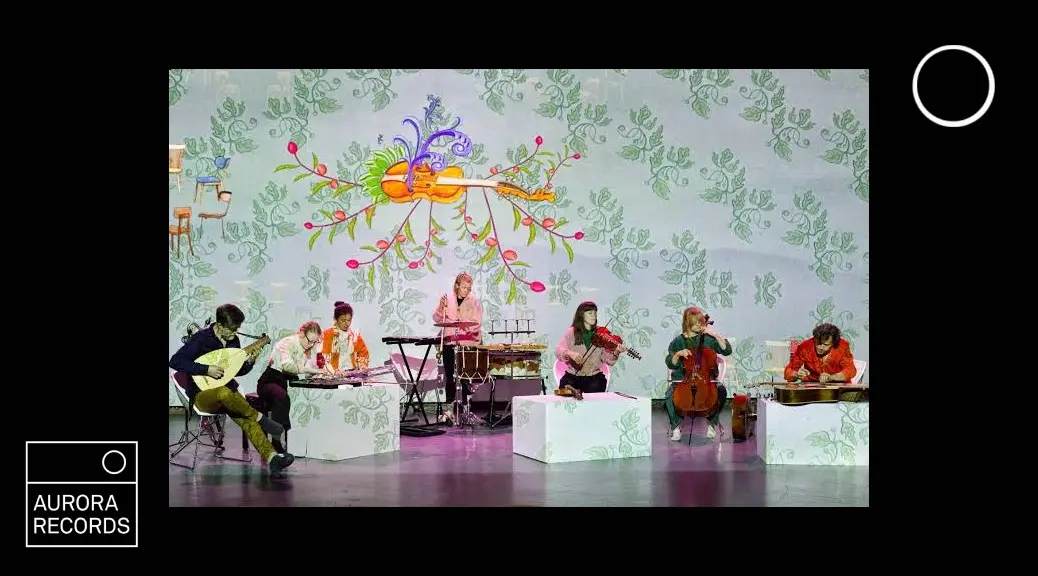
Far from treating this instrument as a museum artifact, Maurseth has reimagined its systemic DNA for a contemporary ensemble. Originally commissioned as a joint project by Ensemble neoN and Oslo’s Ultima Festival, the work premiered in 2023 at the Henie Onstad Kunstsenter as an immersive audiovisual production featuring live animations by Simone Hooymans. Following a rigorous compositional re-working—which stripped away the visual elements and adjusted the overarching structure—the project was captured at Paradiso Studio in Oslo in June 2025.
Teaming up with five core members of Ensemble neoN and an elite production crew helmed by Jørgen Træen, Håkon Stene, and Maurseth herself, the resulting album challenges listeners to unlearn conventional genre boundaries. Through carefully curated instrumentation that mimics and mirrors the acoustic halo of the Hardanger fiddle, Always and Never the Same offers both a masterclass in variation through repetition and an intensely personal, deeply philosophical exploration of musical return.
Detailed Chronology: From Visual Premiere to Studio Re-Imagining
The trajectory of Always and Never the Same is a study in artistic metamorphosis. Its genesis dates back to a joint commission by Ensemble neoN and the Ultima Festival in Oslo. When the piece first met the public in 2023 at the Henie Onstad Kunstsenter, it existed as a sprawling, multi-media production titled Always, and never the same—notably punctuated by a comma that has since been discarded.
During this initial iteration, the auditory experience was inextricably linked to the visual artistry of Simone Hooymans. Hooymans constructed live-drawn animations that projected behind the musicians, drawing heavily from Norwegian natural landscapes and the traditional decorative painting style known as rosemaling. The performance was designed as an instantaneous dialogue between moving image, acoustic improvisation, and avant-garde arrangement.
However, the realization of the project for phonographic release required a radical stripping away of non-musical elements. Between the 2023 premiere and the June 2025 recording sessions at Paradiso Studio in Oslo, Maurseth and her collaborators subjected the score to a rigorous editing and recomposition process. The comma vanished from the title, the animations were permanently retired, and the structural architecture of the suite was tightened into an eight-movement LP.
This journey—wherein a piece fundamentally about the return of material in an altered form has itself returned to the public in a completely altered state—lends the physical release a profound self-referential weight. Side one establishes the sprawling thematic baseline through three expansive movements, beginning with "Contented Pelicans I." Side two contracts time itself, opening with a truncated "Contented Pelicans II" and culminating in "Contented Pelicans III," the shortest movement on the record. Through this architectural design, the album physically embodies its thematic core: a statement is made, expanded, and eventually compressed into essential fragments.
Supporting Context & Metrics: Instrumentation, Lineup, and Philosophy
To fully grasp the acoustic architecture of Always and Never the Same, one must first understand the mechanics of the Hardanger fiddle and the intentionality behind the ensemble assembled to surround it. The Hardanger fiddle operates on principles foreign to the standard classical violin. Beneath its fingerboard lie sympathetic understrings that vibrate unbowed, creating a shimmering, perpetual halo of sound.
Maurseth’s brilliant conceptual breakthrough was designing an entire contemporary music ensemble to replicate, converse with, and extend this acoustic phenomenon. The line-up avoids any traditional violin or viola presence. Instead, the upper registers are anchored exclusively by Maurseth’s fiddle, while the lower registers are supported solely by the cello of Inga Grytøy Byrkjeland.

The remaining instruments are selected for their ability to produce natural drones, halos, and sympathetic overtones:
- Jan Martin Smårdal: Operates both prepared and unprepared twelve-string guitars.
- Solmund Nystabakk: Brings the delicate, resonant plucking of the lute.
- Ane Marthe Sørlien Holen: Handles vibraphone and percussion.
- Kristine Tjørgersen: Deploys a dizzying array of sound sources including clarinets, bass clarinet, a traditional zither (a flat box of strings plucked in place), harmonica, percussion, and even a 1982 Casio Casiotone MT-70 mini-keyboard with light-up keys and a barcode-reader pen.
- Specialized Acoustics: Four players share strike-activated aluminium wah-wah tubes, whose long, bending rings shift as the player’s thumb covers and uncovers the instrument’s aperture.
This meticulous orchestration ensures that the soloist remains unequivocally at the head of the musical hierarchy, mirroring the traditional staging of Norwegian folk performance. Furthermore, the sonic landscape is heavily shaped by the production team. Jørgen Træen—widely celebrated for his work with Mäs&ter!—co-produced, mixed, and mastered the album at Luftgrotten in Bergen, contributing a subtle modular synthesizer guest appearance that bridges acoustic tradition with understated electronic textures.
Philosophical Foundations: The Dhammapada and the Art of Slått
Beyond its instrumental brilliance, Always and Never the Same draws profound structural and spiritual inspiration from non-Western philosophical texts. The album’s movement titles—specifically "As a bee among blooms just walking through," "Delightful are forests unintended for delight," and "Unmoved by praise or blame"—directly echo verses from the Dhammapada, a collection of sayings attributed to the Buddha.
These literary anchors parallel the structural nature of traditional Norwegian slått music, which runs on endless repetition. In a slått, a player repeats the exact same handful of bars multiple times. The artistry does not lie in inventing new melodies, but in micro-variations executed each time around: a subtle ornament added or omitted, a shifted bow placement, or a drone left to swell beneath the tune.
Similarly, the Dhammapada verses invoke the archetype of the sage: the bee that takes nectar from a flower without harming its color or fragrance; the deep forest where worldly, unspiritual people find no pleasure; and the wise individual who stands as immovable as a rock against the shifting tides of praise and blame. The concluding track title, "Nor mine, nor me, nor I," serves as a direct textual reworking of the Buddhist formula for non-self (anatta).
These philosophical inquiries into impermanence, non-attachment, and returning to a familiar theme with altered awareness provide an intellectual framework that elevates the music far beyond standard folk-fusion experiments.
Future Outlook: Live Performance and Upcoming Projects
As Always and Never the Same reaches global audiences on LP, Benedicte Maurseth shows no signs of slowing her relentless creative output. Her transition from the stark, plateau-inspired acoustic soundscapes of her award-winning Hubro releases (Hårr and Mirra) into large-scale contemporary ensemble writing marks a major evolution in her career.
Listeners seeking to experience her virtuosic artistry in a live setting have a robust schedule of performances ahead:
- 19 October: Maurseth performs Mirra at the Arendal Jazzklubb alongside Morten Qvenild, Mats Eilertsen, and Håkon Stene.
- 20 October: The global music community awaits the winner announcement of the prestigious Nordic Council Music Prize, for which Maurseth and the Kronos Quartet are nominated for Elja—a landmark quintet commissioned for Hardanger instruments built specifically for the occasion by master luthier Ottar Kåsa and premiered at Carnegie Hall in March 2025.
- 27 October: The world premiere of an entirely new collaborative work at Troldsalen, KODE, in Bergen, featuring the same core quartet.
- 16 December: A performance of Telehiv at Bergen Kjøtt, featuring an expanded lineup of collaborators including Øyvind Skarbø, Martin Myhre Olsen, Joel Ring, Ola Høyer, and Håvard Aufles.
Ultimately, Always and Never the Same stands as a generous, unyielding gateway for listeners meeting the Hardanger fiddle for the first time. By forcing a contemporary classical ensemble to think, breathe, and execute like a traditional folk fiddler, Maurseth has not only preserved a national heritage—she has reinvented its future.