Executive Overview
London’s cultural landscape has long been defined by its ability to bridge vast historical epochs, but a new exhibition at the world-renowned Saatchi Gallery suggests that our collective fascination with the pre-modern era has reached a fever pitch. Titled The Raw and the Cooked and running through September 11, this ambitious showcase explores the undeniable resurgence of medievalism in contemporary art and visual culture. Curated by artist and historian Harry Jones London, the exhibition challenges rigid historical timelines, positioning the "medieval" not merely as a chronological epoch spanning from 500 to 1500 AD, but as a fluid, malleable repository of tropes, anxieties, desires, and human impulses.
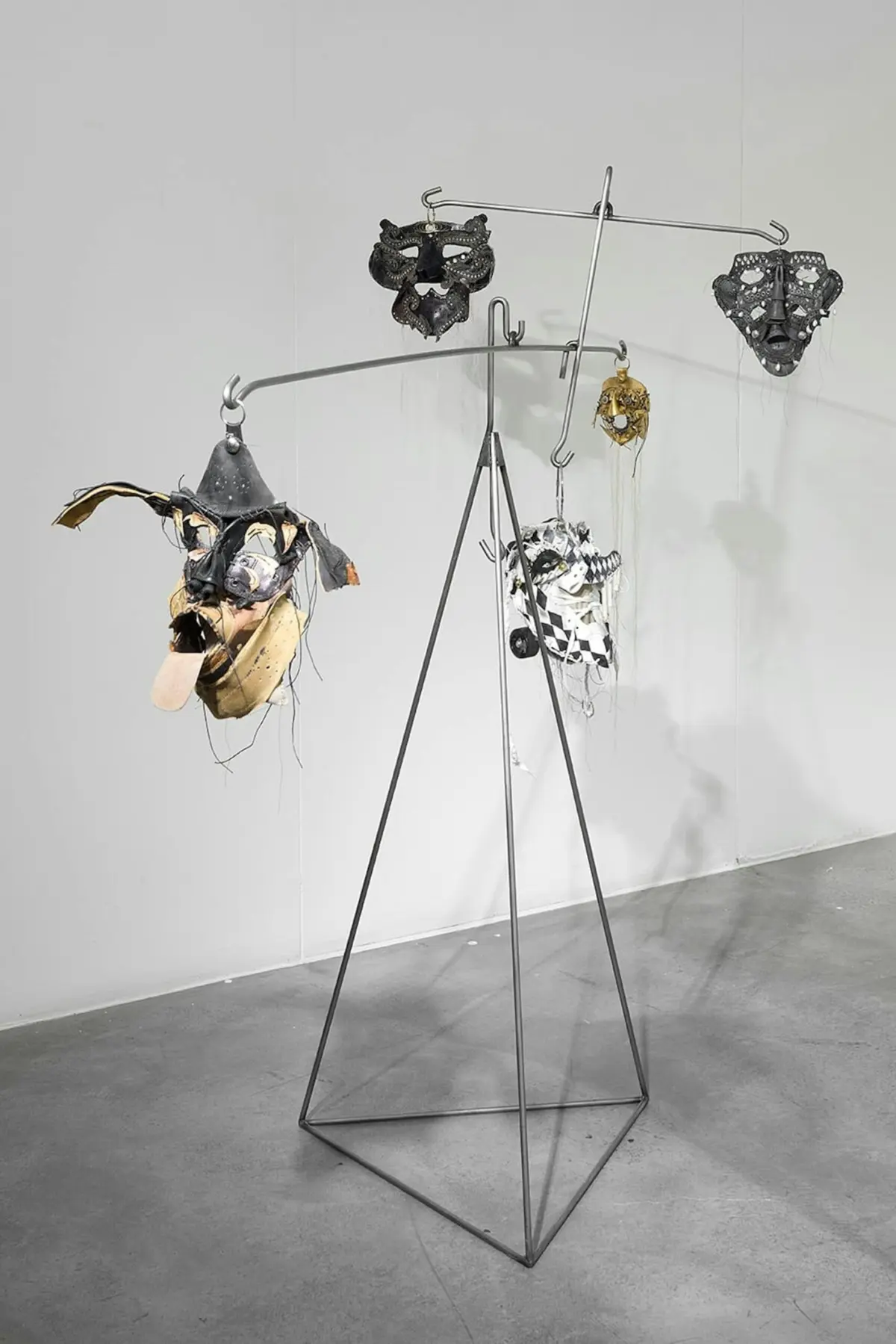
From life-sized historical reenactments of Tudor atrocities to Prada shoes transformed into grotesque memento mori death masks, The Raw and the Cooked brings together an eclectic roster of contemporary practitioners. These artists use ancient techniques, tactile materials, and existential themes to interrogate the modern human condition. Rather than policing historical accuracy, the exhibition embraces anachronism as an artistic tool, demonstrating how the physical, handmade, and spiritually charged motifs of a bygone era continue to resonate powerfully in the twenty-first century.
This comprehensive review explores the thematic core of the exhibition, its interaction with historical realities and modern anxieties, the specific works capturing critical acclaim, and the broader cultural movement positioning the medieval as a vital lens for understanding our contemporary moment.
Detailed Chronology & Curatorial Framework
To understand the intellectual weight of The Raw and the Cooked, one must first confront its opening statement—a massive, arresting visual thesis that occupies the entire back wall upon entering the Saatchi Gallery.
The Anchor Piece: The Punishment of Richard Roose (2026)
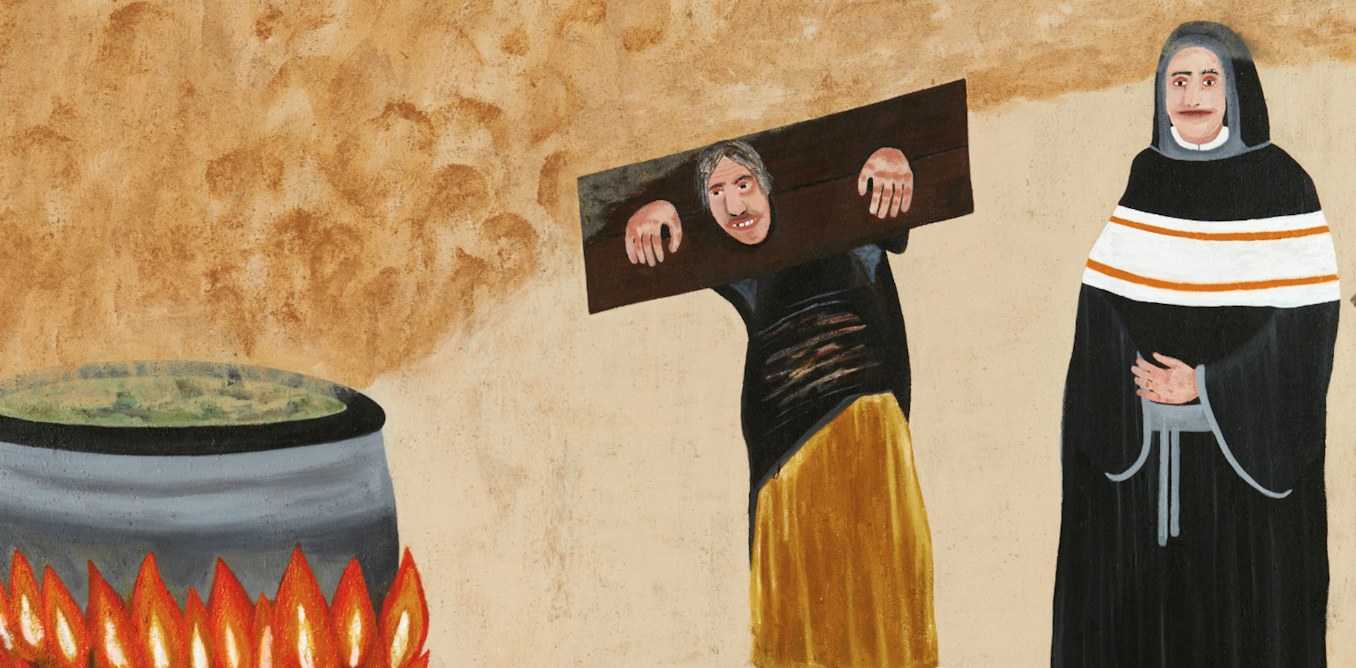
Painted by exhibition curator Harry Jones London, The Punishment of Richard Roose is a magnificently anachronistic project. The museum-scale oil painting depicts a stiff, stylized, life-sized tableau against a stark, plain background. At its center stands a boiling cauldron, venting a toxic, menacing cloud of steam—the imminent fate of a hapless figure whose head and hands are securely locked in heavy wooden stocks. Monks, armed guards bearing heraldic banners, and sinister, crouching hounds complete the tableau, evoking a visceral, theatrical vision of medieval retributive justice.
Yet, this striking imagery carries a profound historical paradox. The event depicted did not occur in the Middle Ages at all. In 1532, during the reign of Henry VIII, a cook named Richard Roose was convicted of poisoning the household of the Bishop of Rochester. Parliament hastily passed a retroactive, novel poisoning act specifically for his case, condemning him to be boiled alive. Roose thus became the first person in England to suffer this horrific execution.
By framing a Tudor-era atrocity with medieval visual tropes, the painting embodies what medievalist Umberto Eco famously termed the "barbaric" medieval. It captures the horrifying reduction of an irreplaceable human consciousness into mere meat—a spectacle that English medieval common law would have strictly forbidden. Through this intentional anachronism, Jones London establishes the exhibition’s core thesis: the "medieval" in contemporary culture is less a precise historical date and more a psychological and aesthetic landscape.
Blending Epochs: Chivalry Meets the Cyborg
This thematic blurring of timelines extends to other works in the exhibition, notably Jessica Luostarinen’s paintings Fitting (2024) and Fitting – 2nd (2025). Luostarinen bridges the chivalric world of knightly adventure with futuristic, post-human aesthetics. Her canvases portray an androgynous figure being encased in meticulously crafted plate armor that evokes the sleek, metallic geometry of a cyborg. By fusing medieval armory with science-fiction tropes, Luostarinen suggests that our aspirations for protection, bodily enhancement, and armored invulnerability have changed very little over the centuries.
Supporting Context & Metrics: The Resurgence of Medievalism
The Raw and the Cooked does not exist in a vacuum. It is part of a broader, measurable cultural pivot toward pre-modern aesthetics across major British and European cultural institutions. Over the past three years, galleries and museums have noted a significant spike in visitor engagement with exhibitions exploring pre-modern art, religious mysticism, and material culture.
Key institutional precursors and contemporaries include:
- The National Gallery (2023): Saint Francis of Assisi, an exhibition exploring the enduring legacy of the 13th-century friar, which drew massive crowds seeking spiritual and ecological contemplation in a secular age.
- Green and Stone Gallery (2025): Medieval Relics, showcasing contemporary responses to sacred fragments and devotional objects.
- The Sainsbury Centre, Norwich (Ongoing): Living by the Rule: Contemporary Meets Medieval, an immersive exploration of monastic rules, communal living, and artistic discipline applied to modern lifestyles.
The Material Turn: Artisanal Craft and the Handmade
At the heart of this contemporary medieval revival is a rejection of hyper-digital alienation. The exhibition’s curatorial statement highlights the concept of an "artisanal medieval age"—defined as the physical, tangible world of the handmade. This encompasses leatherwork, metalwork, woodwork, traditional painting, ceramics, and even baking.
In an era dominated by screens, algorithms, and artificial intelligence, artists and audiences alike are experiencing a profound tactile hunger. The medieval period serves as a powerful proxy for a simpler, more human-scaled relationship with materials. It summons an era defined by the human impulse to find meaning, shared community, and spiritual grounding through physical labor.
Artistic Highlights & Material Explorations
The exhibition features a stunning array of works that manipulate materials to provoke deep philosophical reflection on mortality, fragility, and historical memory.
The Apogee of Foolishness by Jakob Rowlinson (2024)
One of the most striking sculptures on display is Jakob Rowlinson’s The Apogee of Foolishness. Rowlinson takes a luxury Prada shoe and ingeniously transforms it into a grotesque, haunting death mask. This witty, unsettling sculpture gives a thoroughly modern, consumerist form to the medieval concept of memento mori—artistic reminders of the inevitability of death and the transience of earthly possessions. By merging high-fashion branding with medieval mortality tropes, Rowlinson critiques contemporary vanity while honoring an ancient philosophical tradition.
Pilgrim Badge Replicas by Caitlin Hazell (2024)
Metal artist Caitlin Hazell explores the erosion of memory through her series Pilgrim Badge Replicas. In the Middle Ages, pilgrims traveled vast distances to holy shrines, purchasing mass-produced lead-alloy badges as souvenirs and proof of their devotion. Hazell’s initial castings are sharp and intricately detailed, but they intentionally deteriorate into indistinct, fragmentary forms. These tiny, weathered objects serve as a poignant meditation on fragility, weathering, and the inevitable fading of human endeavor over time.
Unknown Individual by Caitlin Hazell (2024, rebaked 2026)
Perhaps defying expectations most effectively, Hazell’s Unknown Individual does not rely on overt medieval pastiche. Instead, it presents a life-sized skeleton laid out inside a glass vitrine, surrounded by an assortment of natural debris: pebbles, shells, and driftwood. Upon closer inspection, the "bones" are revealed to be entirely sculpted from bread. This fragile, organic relic of an imaginary past plays with notions of preservation, decay, and the sacredness of the human form.
Sankofa by Emmanuel Awuni (2022)
Emmanuel Awuni taps into ancestral memory and emotional vulnerability with Sankofa. Derived from the Akan language of Ghana, the word translates to "go back and get it," evoking the vital importance of reflecting on the past to move forward. Awuni’s sculpture features a sculpted head that has been cracked open, revealing a delicate layer of gold leaf and a gleaming cowrie shell nestled within. Despite the implicit violence of the fracture, the head maintains a serene expression. The resulting object is deeply emotive, tender, and intensely precious.
Official Statements and Academic Perspectives
The shift toward embracing anachronism and creative reimagining has forced a quiet revolution within academic medieval studies. Historically, medievalists were quick to correct popular inaccuracies, historical distortions, and cinematic clichés regarding the period. However, The Raw and the Cooked highlights a growing consensus among scholars that policing popular culture is ultimately less productive than understanding it.
"Imagination can know things that scholarship misses," notes the exhibition’s critical commentary. "Mapping the contours of what people do with the medieval is more productive than policing it. This exhibition proves that the medieval, however it is constructed or misconstrued, retains a dynamic, active agency in the present day."
Academic institutions are increasingly recognizing that contemporary artists are not trying to write history textbooks; rather, they are utilizing the Middle Ages as a mirror to reflect modern crises—ranging from political authoritarianism and climate anxiety to digital burnout and the search for authentic community.
Future Outlook: The Enduring Relevance of the Pre-Modern
As The Raw and the Cooked prepares to close its doors at the Saatchi Gallery on September 11, its broader implications for the art world are already clear. The exhibition marks a maturing of "neo-medievalism" in contemporary visual arts. No longer confined to the realms of fantasy literature, role-playing games, or historical reenactment societies, medieval motifs have firmly secured their place in the avant-garde.
The success of this exhibition, alongside concurrent shows across the United Kingdom, signals a lasting cultural appetite for art that connects us to deep histories. By re-engaging with the handmade, confronting mortality through material culture, and embracing the poetic license of anachronism, contemporary artists are ensuring that the echoes of the pre-modern era will continue to shape our artistic and philosophical horizons for decades to come.