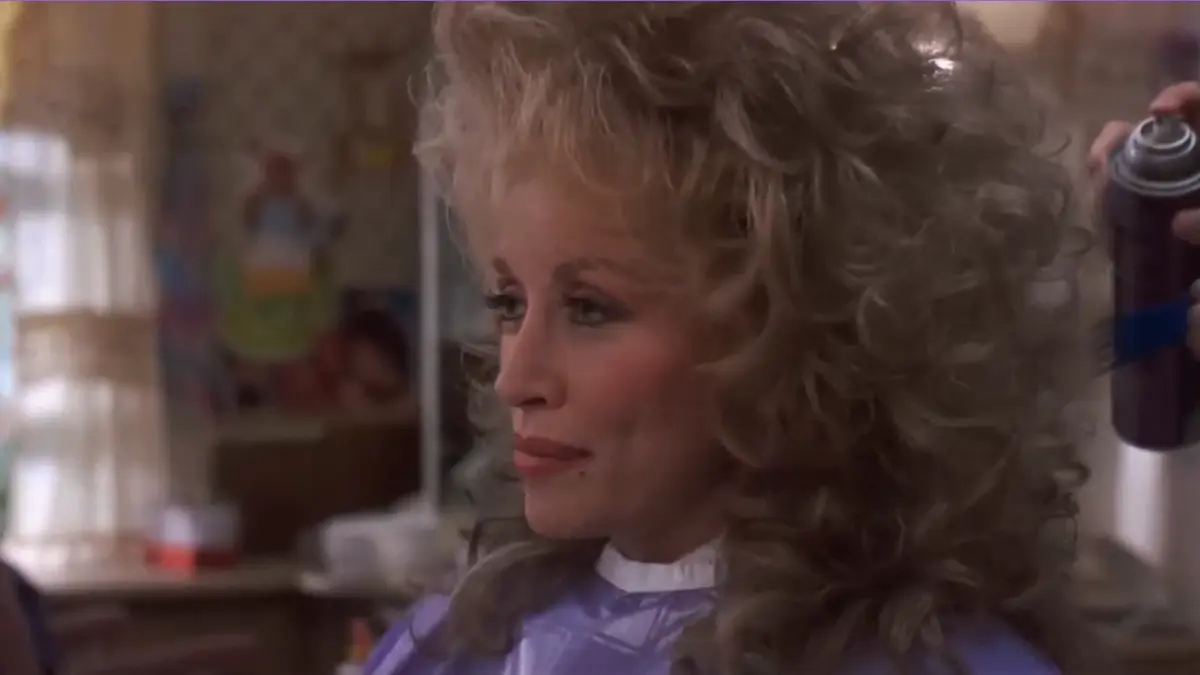
Dolly Parton was more than a global music icon; she was a cultural touchstone whose infectious optimism, razor-sharp self-deprecation, and boundless empathy made her a natural fit for the silver screen. While her contribution to American music remains unmatched, her cinematic legacy is anchored indelibly by her performance as Truvy Jones in the 1989 cinematic adaptation of Robert Harling’s stage play Steel Magnolias. Directed by Herbert Ross, the film captured the intricacies of female resilience, grief, and enduring friendship in a small-town Louisiana parish.
Surrounded by a legendary ensemble cast that included Shirley MacLaine, Julia Roberts, Daryl Hannah, Sally Field, and Olympia Dukakis, Parton held her own, delivering a performance defined by heart and humor. Truvy Jones—the big-haired, big-hearted beauty salon owner whose shop served as the epicenter of community life—showcased Parton’s natural acting abilities.
Though Parton and Daryl Hannah were famously the only members of the core female cast not to receive Academy Award nominations for their efforts, Parton’s contribution to the cultural lexicon of the film is second to none. Her character delivered a steady stream of iconic, Southern-fried one-liners that continue to be quoted decades later. Beyond her performance on screen, behind-the-scenes accounts from her co-stars illustrate a woman whose staggering professionalism, unwavering gratitude, and deep-seated kindness matched the radiant persona she projected to the world.
Following news of Parton’s passing, the global entertainment community united in mourning. Tributes poured in from former colleagues, chief among them Julia Roberts, who reflected on Parton’s magical presence, noting that "the sun has dimmed today." This retrospective explores Parton’s role in Steel Magnolias, examines the unforgettable humor that defined Truvy Jones, shares legendary behind-the-scenes anecdotes, and evaluates the enduring impact of a truly singular American icon.
Detailed Chronology: From Country Star to Silver Screen Icon
The Road to Truvy Jones
By the late 1980s, Dolly Parton had already conquered the world of country music, establishing herself as a prolific singer-songwriter, a savvy businesswoman, and a cross-over pop success. However, her cinematic footprint was still developing. Having made her feature film debut a decade earlier alongside Jane Fonda and Lily Tomlin in the workplace comedy 9 to 5 (1980)—for which she earned Golden Globe nominations and an Academy Award nod for her title song—and subsequently starring in The Best Little Whorehouse in Texas (1982) and Rhinestone (1984), Parton was searching for a project that would allow her to flex her dramatic and comedic muscles in an ensemble setting.
Enter Steel Magnolias. Based on Robert Harling’s semi-autobiographical play about the loss of his sister, the story centered on a tight-knit circle of women in Chinquapin, Louisiana. The project attracted a powerhouse cast of Hollywood royalty. When Parton was cast as Truvy Jones—the local beauty salon proprietor who dispenses life advice alongside perms and frostings—it was a match made in casting heaven. Truvy’s business was where the town’s women gathered to laugh, cry, gossip, and heal. Parton brought an authentic, lived-in warmth to the role, channeling the resilient Southern women who had populated her own upbringing in Sevier County, Tennessee.
Production Realities in Louisiana
Filming Steel Magnolias in Natchitoches, Louisiana, during the sweltering Southern summer presented severe physical challenges for the cast. As Julia Roberts later revealed during promotional tours and retrospective interviews, the climate was punishingly hot and humid.
While many actors might have complained about wearing heavy period-appropriate costumes, woolens, and elaborate wigs under blistering studio and location lighting, Parton maintained an attitude of profound gratitude. Roberts recalled sitting on a porch with Parton during a grueling shoot, listening to her legendary co-star muse about her journey from rural poverty to international superstardom. Parton famously told Roberts:
"When I was a little girl, I wanted to be famous, and I wanted to be rich, and now I’m both of these things, I’m not going to complain about it."
This work ethic was mirrored on set, where Parton took every critique in stride. According to IMDb production lore, director Herbert Ross once reprimanded Parton after a particularly poor take, bluntly asking her whether she could act at all. Without missing a beat, Parton delivered a quintessential piece of self-deprecating wit:
"No, but it’s your job to make me look like I can."
That collaborative spirit, combined with her innate star power, cemented her place within the ensemble, earning the deep respect of her veteran peers who went on to dominate the awards circuit that season.
Supporting Context & Metrics: The Wit and Wisdom of Truvy Jones
While Shirley MacLaine, Sally Field, Olympia Dukakis, and Julia Roberts earned Oscar nominations for their breathtaking dramatic turns, Parton’s Truvy Jones provided the comedic anchor of Steel Magnolias. Her character balanced the heavy, tear-jerking narrative beats with unmatched verbal agility. Truvy’s beauty shop was a sanctuary, and her philosophical observations became legendary.
According to IMDb and film archives, several of Truvy Jones’s lines stand out as enduring masterclasses in Southern comedic writing, delivered with Parton’s trademark vocal cadence:
On the duality of emotion:"Laughter through tears is my favorite emotion."
On static and attraction:"There’s so much static electricity in this room, I pick up everything but boys and money."
On the passage of time:"Honey, time marches on and eventually you realise it is marchin’ across your face."
On personal presentation:"Smile! It increases your face value."
On modern aesthetics:"Louie brought his new girlfriend over, and the nicest thing I can say about her is all her tattoos are spelled correctly."
On natural beauty:"I don’t like her. I don’t trust anyone who does their own hair. I don’t think it’s natural." (A sentiment echoed in the film’s iconic promotional imagery).
On marital dynamics:"I’m just screamin’ at my husband; I can do that any time!"
On spiritual inclusivity:"Oh, honey, God don’t care which church you go, long as you show up!"
On high-maintenance personalities:"When it comes to pain and suffering, she’s right up there with Elizabeth Taylor."
On compulsive spirituality:"Got me, maybe she was praying for Marshall and Drew and Bell. My she was praying for us cause we was gossipin’. Maybe she was praying because the elastic is shot in her pantyhose. Who knows — she prays at the drop of a hat these days."
On solidarity in sorrow:"Oh sweetheart don’t. Please don’t cry or I will too. I have a strict policy that nobody cries alone in my presence."
These quotes highlight why Steel Magnolias remains a foundational text in popular culture. Truvy’s parlor was a place where women processed life’s heaviest blows—marital strife, health crises, and unimaginable loss—while maintaining their dignity, humor, and hair spray.
Official Statements and Tributes
The announcement of Dolly Parton’s passing sent shockwaves across the globe, prompting an outpouring of grief, gratitude, and remembrance from fans, political figures, and Hollywood royalty alike. The bonds forged on the set of Steel Magnolias in 1989 proved to be lifelong, with Parton’s co-stars leading the chorus of tributes.
Julia Roberts released a deeply personal and emotional statement commemorating her late friend and colleague:
"Dolly was a magical and joyous human. I hold knowing her as a treasure in my life. The sun has dimmed today."
Roberts’ sentiment captured the collective feeling of an entertainment industry that viewed Parton not merely as a celebrity, but as a beacon of unadulterated goodness. Throughout her career, Parton utilized her immense platform to fund literacy programs through her Imagination Library, support disaster relief efforts, and champion humanitarian causes, all while maintaining the down-to-earth persona that endeared her to millions. Her portrayal of Truvy Jones was, in many ways, an extension of her authentic self: a woman dedicated to lifting up those around her, ensuring that nobody in her presence ever had to cry alone.
Future Outlook: Preserving a Cultural Legacy
As the world processes the loss of Dolly Parton, her cultural footprint remains omnipresent. While her catalog of diamond-certified country anthems—from "Jolene" to "I Will Always Love You"—will continue to dominate airwaves for generations, her cinematic contributions, led by Steel Magnolias, secure her position as a multi-hyphenate talent of the highest order.
Film historians and cinematic institutions are already discussing retrospectives dedicated to Parton’s filmography, ensuring that her work on the big screen receives the same critical reverence as her musical achievements. Furthermore, the values embodied by Truvy Jones—radical empathy, female solidarity, and the healing power of humor in the face of adversity—serve as a timeless blueprint for community building.
Dolly Parton’s journey from a one-room cabin in Sevier County to the pinnacle of global stardom is a testament to perseverance, grace, and unmatched talent. Though "the sun has dimmed today" for those who knew and loved her, the warmth, wisdom, and laughter she embedded into the cultural consciousness will continue to illuminate the world for generations to come. As Truvy would remind us all in a moment of sorrow: laughter through tears remains our finest, most enduring emotion.