Executive Overview
It is a crisp, brilliant Thursday morning in London, the kind of autumnal day that feels both sharp and full of possibility. Seated across a rustic wooden table at Soho’s iconic Café Bohème, Dutch singer-songwriter Caro is in the middle of a breathless, four-day promotional blitz. More importantly, she is standing on the precipice of a monumental career milestone: the eve of her new album release.
Titled Returning To Innocence, this record marks a historic turning point. It is the very first body of work she has released entirely under her own given name. For more than a decade, the music industry and millions of international fans knew her simply as the face, voice, and vibrant energy behind Caro Emerald—the multi-million-selling jazz-pop collective that shattered global charts. Her debut album famously surpassed Michael Jackson’s Thriller to claim the longest-running No. 1 LP record in her native Netherlands.
Yet, beneath the glossy veneer of vintage-infused global stardom, chart-topping singles like “A Night Like This” and “That Man,” and sold-out arena tours, lay a quiet, suffocating reality. Trading safety for authenticity, Caro spent years hiding behind a meticulously curated theatrical character. Now, stepping entirely into her own light, she has crafted her most raw, unflinching, and deeply personal work to date. Returning To Innocence is not merely a record; it is an act of reclamation—an artistic, emotional, and feminist awakening.
Detailed Chronology: From Vintage Persona to Independent Truth
To understand the weight of Returning To Innocence, one must retrace the winding, often pressurised trajectory of Caro’s career. Her ascent into the global consciousness began in 2009. Emerging as the colourful frontwoman of Caro Emerald, she captivated audiences with an early 20th-century aesthetic that flawlessly mirrored the collective’s genre-bending, vintage jazz sound. To the outside world, Caro was Caro Emerald. But to the woman holding the microphone, the act had transformed into a gilded cage.
“I never really wanted to be a character, but I felt I had to because people wanted me to be,” she confesses, reflecting on the psychological toll of her early success. “And I never questioned it because I didn’t want to look like a fool. Who would ever come to a show for just me, you know? So I went along with it, hoping somebody would come up to me and say, ‘You don’t need all of this.’ And nobody ever did.”
The realization hit her with the force of an epiphany: nobody was going to rescue her from the persona she had built unless she took the decisive leap herself.
Following the release of the final Caro Emerald single in 2020, she quietly slipped away from the machine to recalibrate. In the spring of 2022, she tested the waters under the pseudonym The Jordan—a subtle nod to Amsterdam’s historic De Jordaan neighbourhood where she spent her formative years. Releasing the parent album Nowhere Near The Sky, she eventually unmasked, paving the way for her most authentic artistic chapter yet.
Now, working under the mononym Caro, she has placed her true self at the center of the sonic universe. Across 14 cinematic and deeply confessional tracks, Returning To Innocence explores the multi-faceted reality of modern womanhood: examining her identity not just as an artist, but as a mother, a daughter, and a human being navigating the complexities of existence.
Supporting Context & Influences: Sonic Landscapes and Modern Feminism
Sonically and lyrically rich, Returning To Innocence draws from an eclectic palette of inspirations. Caro cites the queen of reinvention Madonna, Swedish pop architects ABBA, the purple-hued genius of Prince, classic ’90s power ballads, and her parents’ lifelong love of classical music as foundational pillars of her musical education.
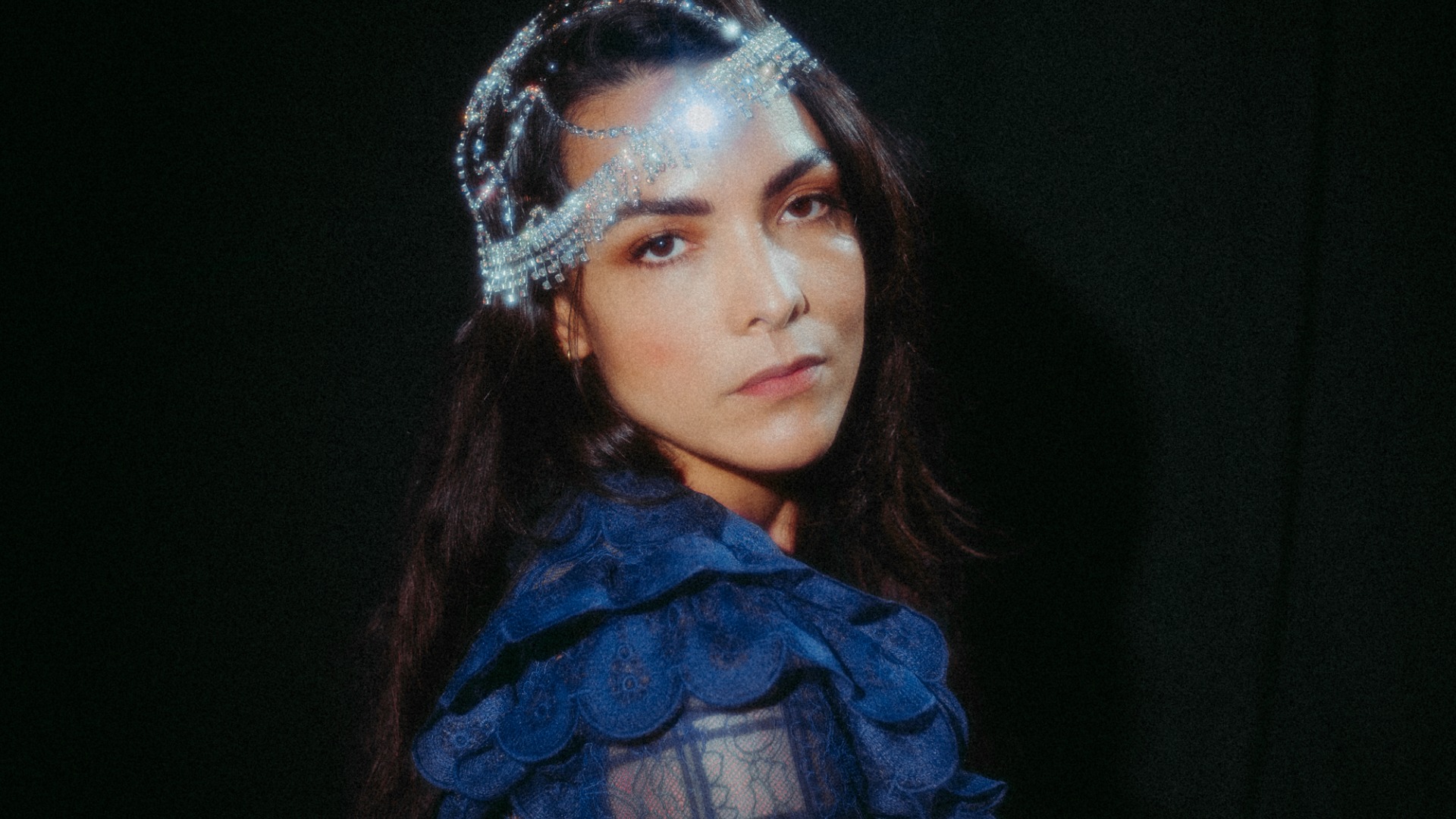
Yet, the album’s thematic anchor is deeply rooted in contemporary socio-cultural critiques—specifically, the narrow definitions historically assigned to women.
Discussing the artwork and historical symbols of feminism, Caro points toward J. Howard Miller’s iconic World War II “We Can Do It!” poster, featuring a woman in a polka-dot bandana flexing her bicep. While acknowledging its historical importance, she argues that modern feminism often forces women into an impossible binary.
“It’s a great picture and I think it represents a lot that needs to be represented, but it also fails to show things that are very feminine and deserve to be seen,” she asserts. “Somewhere underneath that image lies the idea that a successful woman is like a man: strong, decisive, and maybe even harsh. That’s not all we are… I wanted the doubt and the fear to be part of that victory, ’cause that’s what brought me here.”
This vulnerability pulses through the heart of the album. On tracks like “Already Lost,” she confronts her inner demons head-on, singing lines like, “Tied with one foot out the door / Tell me what I’m waiting for.” Elsewhere, she vies for autonomy on “Call The Shots,” craves genuine connection on “Worship Me,” honors her lifelong ambitions on “Mama,” and dismantles her internal insecurities on “Mirror.”
Perhaps the most striking moment on the record arrives with the track “Goddess,” a piece that took a year and a half to construct. Inspired by the ambient, spiritual soundscapes of Romanian-German producer Michael Cretu’s project Enigma—whose 1993 global smash bore the strikingly similar title “Return To Innocence”—Caro sought to capture a meditative state.
Opening the track with the stark confession “This is my confession,” the song features a chilling spoken-word introduction delivered by Caro’s eldest daughter. The text was sourced directly from an internet query: "What does the Bible say about women?"
“I basically asked Google, ‘What does the Bible say about women?’, and these are words that I found on the Internet,” Caro explains, visibly shaken by the discovery. “She’s supposed to be quiet, and only open her mouth with wisdom, and she has to serve her husband and support her husband. I’m like, ‘Fuck.’ We’re still living with this idea. It’s still inside of us.”
Official Statements & Personal Reflections
For Caro, the decision to merge her personal life as a mother with her public identity as a recording artist was a long-overdue breakthrough. In the past, she maintained a rigid boundary between her domestic world and her professional stardom, fearing that domesticity might somehow dilute her artistic gravity.
Today, that hesitation has vanished.

“If you’re talking about all sides of humanity and womanhood, then motherhood is part of it,” she reflects, her eyes welling with tears as she speaks of her daughters, aged 12 and 9. “There’s so many things that are unfair and I don’t want them to grow up in this world. They deserve a different world. As a parent, you’re kind of powerless; you can do so much, then the rest is up to the village. The only thing I can do is give the right example and show them how I deal with all of these things that are so tough, especially on girls. That gave me the extra drive to do this.”
Though her daughters are supportive fans of her new music—even if they playfully hold her to impossible streaming standards, comparing her metrics to pop juggernaut Taylor Swift—Caro recognizes that she has already won the most important battle. Twenty years after she was first approached to voice “Back It Up,” the track that launched her international career, she stands entirely on her own terms.
“At some point I realised: ‘Nobody’s ever gonna pull me out of this—until I do…’ I feel like a mid-career artist now,” she smiles. “I want to do justice to what [Caro Emerald] did together, and I think choosing my own name now, just Caro, does that. It honours what we’ve done and how proud I am of that, and it allows me to bring that into my career, right now, as the artist I am today.”
Future Outlook & Tour Itinerary
With the ghosts of her past persona firmly laid to rest, Caro is looking toward an expansive, unburdened future. Rather than resting on the commercial triumphs of her past or the raw critical acclaim of her latest release, she is already eyeing the horizon with unbridled optimism.
“I still feel like my best album is yet to come,” Caro grins warmly. “It might not even be the next. It might be the one after that. I have so many things to explore still; it’s a great place to be in.”
The next chapter of her journey begins immediately. Returning To Innocence is officially out now via Big Mouse. Following its release, Caro will launch her sweeping European tour on October 21 in Amsterdam, traversing the continent before concluding with a prestigious, two-night residency at London’s legendary Ronnie Scott’s Jazz Club on November 28.
For an artist who spent years hiding behind a character, the message to the world is now crystal clear: the performance is over. This is Caro, stripped of the emerald veil, standing tall in her own truth.