Executive Overview
Pop culture history is defined by towering figures, seismic shifts, and monumental shifts in modern consciousness. Yet, few creative tensions match the labyrinthine personal and professional dynamics that bound Paul McCartney and John Lennon during and after their tenure in The Beatles. While decades of historical analysis, musical archeology, and tabloid journalism have dissected their song-writing partnerships, creative rivalries, and eventual reconciliation before Lennon’s tragic 1980 assassination, a surprisingly persistent sore spot continues to ignite McCartney’s passions over half a century later: verticality.
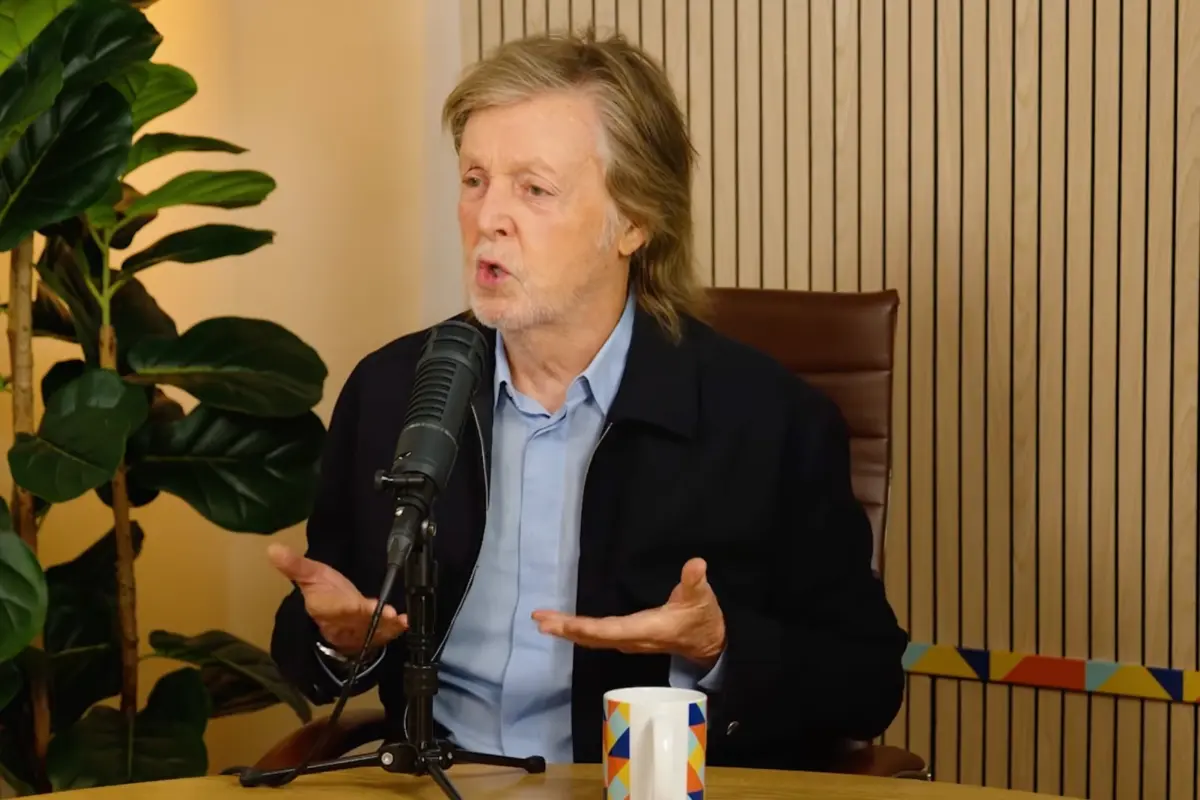
During a recent, wide-ranging appearance on Amy Poehler’s popular podcast, Good Hang with Amy Poehler, an animated McCartney—now 84 years old—re-litigated a grievance that has quietly bugged him for decades. What began as a lighthearted biographical inquiry from Poehler regarding age gaps within the legendary Liverpool quartet quickly devolved into a passionate, humorous defense of the band’s physical dimensions.
McCartney’s frustration is not directed at his former bandmates, but rather at the modern cinematic apparatus. From Sam Taylor-Johnson’s 2009 biographical drama Nowhere Boy to Sam Mendes’s upcoming, highly anticipated four-part cinematic exploration of the band, filmmakers repeatedly commit what McCartney considers an unforgivable historical inaccuracy: portraying him as physically smaller than John Lennon.
This deep dive examines McCartney’s ongoing crusade for historical vertical accuracy, the complex psychology of Beatles myth-making, how Hollywood has repeatedly stretched the truth, and what this obsession reveals about the enduring legacy of the world’s most famous band.
Detailed Chronology: From the Cavern Club to the Silver Screen
To understand why a throwaway comment about height elicits such a vehement response from one of the greatest living songwriters, one must trace the physical and psychological reality of the early Beatles era.
The Original Equalizers: The 1960s Reality
In the formative days of Hamburg’s Reeperbahn and the sticky floors of the Cavern Club, the Fab Four operated as an impenetrable, unified aesthetic unit. Matched suits, synchronized mop-top bows, and carefully curated public personas erased individual differences. Crucially, this homogenization extended to their physical stature.
As McCartney emphatically clarified to Poehler, the core dynamic of the band was one of absolute parity:
"We were all the same height… and Ringo was a bit smaller. And if you look at photos, we’re all the same height."
Statistically, McCartney is not far off. Standing roughly 5 feet 11 inches, McCartney shared a very similar physical footprint with Lennon and George Harrison. Ringo Starr, famously the youngest and slightly shorter member, completed a lineup where no single musician loomed over the others. This physical balance reinforced the democratic branding of the group—four working-class lads from Liverpool standing shoulder-to-shoulder against the world.
The Revisionist History of Nowhere Boy (2009)
The friction between cinematic license and historical reality first boiled over for McCartney during the production of director Sam Taylor-Johnson’s 2009 biographical drama, Nowhere Boy. The film focused on Lennon’s turbulent teenage years prior to the formation of the Beatles, featuring Aaron Taylor-Johnson as a young Lennon and Thomas Brodie-Sangster as a young McCartney.
In the film, McCartney’s character is depicted as noticeably smaller, wimpy, and physically subservient—culminating in a scene where Lennon knocks him directly to the floor. For McCartney, who maintains a sharp memory of their youth, this was an egregious misrepresentation.
"Sam, this is not true!" McCartney recalled telling the director.
According to McCartney, Taylor-Johnson brushed off the complaint with the classic defense of narrative art: "This is a movie, it’s not a documentary." McCartney’s deadpan retort to Poehler—"Well, I don’t like that explanation"—highlighted his lingering annoyance at seeing "little Paul" cast in the shadow of his "great big hero" John.
The Sam Mendes Quadripartite Biopic Crisis
The battle lines were redrawn recently when Oscar-winning director Sam Mendes announced an ambitious, unprecedented cinematic feat: a four-part biographical film series focusing on each individual member of The Beatles, with intersecting narratives that converge on the group’s meteoric rise and breakup.
The casting choices immediately reignited McCartney’s height anxieties. Paul Mescal—himself hovering around 5 feet 11 inches—was cast to portray McCartney. Meanwhile, English actor Harris Dickinson (The Iron Claw, Urchin), standing at an imposing 6 feet 2 inches, was tapped to play Lennon.
Recognizing an impending cinematic disaster of proportions matching his previous grievances, McCartney immediately reached out to Mendes.
"Sam, I’ve got just one thing that I need to say to you," McCartney recounted, addressing the glaring three-inch height discrepancy between the two principal leads.
The situation escalated when Mendes sent McCartney promotional production stills recreating the iconic Abbey Road album cover shoot. True to the casting, the digital composite or blocking revealed a distinctly smaller "Paul" trailing behind a towering "John."
With classic wit, Amy Poehler chimed in during the podcast recording with a historically airtight observation: "And you can’t put lifts on those bare feet," referencing McCartney’s famous barefoot stride across St. John’s Wood in 1969.
Recognizing the intensity of McCartney’s campaign, Mendes attempted damage control by adjusting the camera angles, choreography, and stride patterns, eventually sending a revised image where the two actors appeared balanced. Yet, the saga illustrates how fiercely protective McCartney remains of his historical image, refusing to let Hollywood diminish his physical or cultural stature.
Supporting Context & Metrics: The Physics of the Fab Four
To properly evaluate McCartney’s claims, we can examine the physical metrics of the original group alongside their cinematic counterparts.
Historical Metrics (Actual Lineup)
- John Lennon: ~5’ 10.5” to 5’ 11”
- Paul McCartney: ~5’ 10.5” to 5’ 11”
- George Harrison: ~5’ 10”
- Ringo Starr (Richard Starkey): ~5’ 8”
Historical consensus: While minor footwear variations, posture, and stage positioning could alter perceptions on any given night, the original Beatles were remarkably close in height, functioning visually as a solid, unbroken horizontal block.
Cinematic Metrics (Sam Mendes Project)
- Harris Dickinson (John Lennon): 6’ 2”
- Paul Mescal (Paul McCartney): 5’ 11”
- The Discrepancy: A net cinematic gain of roughly 3 inches for Lennon over McCartney, fundamentally altering the visual dynamic of the Lennon-McCartney partnership.
Psychological Implications of Height in Rock Historiography
In the psychology of rock-and-roll mythology, height is often subconsciously equated with dominance, intellectual authority, and creative leadership. Because Lennon’s post-Beatles martyrdom and sharp, confrontational wit often positioned him as the "dangerous intellect" of the group, cultural narratives frequently lean toward portraying him as physically larger than life.
McCartney’s resistance to this trope is deeply logical. Throughout the group’s lifespan, McCartney was an equal driving force—musically, commercially, and physically. Allowing cinema to shrink him next to Lennon risks validating a revisionist hierarchy that undermines his foundational role in the band’s architecture.
Official Statements & Transcripts
The exchange on Good Hang with Amy Poehler captured a rare, unguarded moment of rock royalty playfully wrestling with the absurdities of their own legend. Below is an expanded transcript excerpt reflecting the core of McCartney’s grievance:
Amy Poehler: "Who was the tallest?"
Paul McCartney: "We were all the same height." (Holds up a finger in emphasis)
Amy Poehler: "You really were." (Laughs knowingly)
Paul McCartney: "You know I’ve got a thing about that, do you?"
Amy Poehler: "Oh my God. Well, we were all the same height and Ringo was a bit smaller. And if you look at photos, we’re all the same height… But in Nowhere Boy, Aaron [Taylor-Johnson] is bigger than me. My character is kind of… wimpy… smaller than John… John knocks me to the floor. And it’s like, ‘Sam, this is not true!’"
Amy Poehler: (Laughing) "What did she say?"
Paul McCartney: "She said, ‘This is a movie, it’s not a documentary.’ And I said, ‘Well, I don’t like that explanation.’"
Future Outlook: Will Hollywood Get the Height Right?
As Sam Mendes prepares his monumental four-part Beatles cinematic universe—projected to be one of the most exhaustive and scrutinized music biopic events in film history—the pressure on the production team to honor the legacy of the band is absolute.
While filmmakers naturally prioritize dramatic tension, emotional truth, and actorly chemistry over tape-measure accuracy, Paul McCartney’s lighthearted yet unyielding crusade serves as a warning shot. Whether through clever blocking, cinematography, post-production digital adjustments, or simply ensuring Paul Mescal and Harris Dickinson find equal footing on the pavement of Abbey Road, Hollywood directors ignore Sir Paul’s vertical demands at their own peril.
In the end, as McCartney’s timeless lyricism reminds us: "You say high, you say low / You say why, and I say I don’t know." But when it comes to the silver screen adaptation of rock’s greatest partnership, Paul McCartney wants the record—and the measuring tape—to show that they stood shoulder to shoulder, giants of the twentieth century, every single inch of the way.