Executive Overview
In the sprawling, intricate landscape of modern music production, broadcast engineering, and post-production, few audio processing tools have exercised as much foundational influence as sidechain compression. At its most fundamental level, sidechain compression is a dynamic processing technique wherein a compressor lowers the amplitude of one audio signal in direct response to the level, dynamics, or frequency content of an entirely separate audio signal. While contemporary popular music listeners instantly recognize this mechanism as the rhythmic, breathing pulse driving electronic dance music—often characterized by the rhythmic ducking of synths and pads beneath a four-on-the-floor kick drum—its historical roots run deep into the foundational eras of cinema and radio broadcasting.
Originally engineered not to create rhythmic effects, but rather to solve persistent technical limitations in early sound recording, sidechain compression has evolved into a Swiss Army knife for audio engineers. It acts as an invisible hand that manages spatial real estate in crowded mixes, prevents vocal masking, cleans up complex multi-microphone live recordings, and crafts signature aesthetic identities for entire musical genres. This comprehensive report examines the mechanical anatomy of sidechain compression, traces its fascinating historical trajectory from 1930s Hollywood soundstages to modern digital audio workstations (DAWs), analyzes its primary professional applications, and explores its enduring role in shaping contemporary sonic culture.
Detailed Chronology: From Cinematic Fixes to Electronic Staple
To fully understand how sidechain compression operates today, one must trace its development across nearly a century of technological innovation, acoustic engineering, and creative experimentation.
[1930s] Hollywood Innovation: Douglas Shearer invents the "side" input for de-essing.
   │
[1950s-70s] Broadcast & Studio Adoption: Automatic ducking used for voiceovers and music beds.
   │
[1980s-90s] The Electronic Underground: Producers experiment with aggressive kick-to-bass ducking.
   │
[Late 1990s] The French Touch Era: Daft Punk and Stardust popularize the pumping aesthetic.
   │
[2000s-Present] Digital Era: In-the-box routing and dedicated plugins democratize the technique.
   │
The 1930s: Douglas Shearer and the Birth of the "Side" Chain
The genesis of sidechain compression dates back to the golden age of cinema sound design in the 1930s. As talking pictures gained prominence, recording engineers faced immense acoustic challenges. One of the most grating issues was sibilance—the harsh, high-frequency "S," "Sh," and "T" sounds that overloaded optical film soundtracks, causing distortion and listener fatigue.
Enter Douglas Shearer, a pioneering cinema sound designer and recording director at Metro-Goldwyn-Mayer (MGM). In an effort to tame these troublesome frequencies without compromising the overall integrity of the dialogue, Shearer conceptualized a radical modification to standard dynamic range compressors.
Most compressors of the era split an incoming audio signal internally, routing one copy to the amplification reduction circuit while using the other to measure the signal’s dynamics. Shearer’s breakthrough was providing an external input to a compressor’s sensor signal path—a modification he referred to simply as a "side" input. By boosting high frequencies in the audio fed specifically to this side input, Shearer made the compressor drastically more sensitive to the sibilant frequencies he needed to control, while leaving the rest of the frequency spectrum relatively untouched.
This ingenious workaround effectively invented the process of de-essing. More importantly, it introduced the audio engineering world to the concept of a secondary signal processing pathway: the "sidechain."
The Mid-20th Century: Broadcast Automation and Voiceover Ducking
As audio technology transitioned from film sets to radio broadcast facilities and television studios in the post-war decades, engineers adapted Shearer’s sidechain concept for a different problem: intelligibility.
Radio announcers and television presenters needed background music and sound effects to accompany their broadcasts, but these elements frequently competed with spoken dialogue, rendering broadcasts muddy and difficult to understand. Engineers realized that by routing the presenter’s microphone signal into the sidechain input of a compressor processing the background music track, they could automate the mixing process.
Whenever the presenter spoke, the compressor automatically "ducked"—or lowered—the volume of the background music, restoring it to full volume the moment the presenter stopped talking. This technique became an indispensable standard in broadcasting, establishing the operational template for automated dynamic balancing that persists in automated podcast editing and broadcast mixing today.
The Late 20th Century: The Electronic Underground and the French Touch
While sidechain compression remained largely a corrective, utilitarian tool for decades, adventurous music producers in the late 1980s and 1990s began to view it through a creative lens. In genres like synth-pop, house, and techno, producers sought ways to make dense electronic arrangements breathe, groove, and sit together cohesively.
By intentionally routing a heavy, percussive kick drum into the sidechain input of a compressor spanning across an entire synthesizer submix or pad track, producers discovered they could create a rhythmic, pumping motion. This technique became the definitive signature of the late-1990s electronic music movement known as the "French Touch"—championed globally by pioneering acts such as Daft Punk, Stardust, and Cassius. What was once designed to quietly suppress background noise during a speech suddenly became the rhythmic heartbeat of modern dance music.
Supporting Context & Metrics: How Sidechain Compression Works
To harness the full potential of sidechain compression, an audio engineer must understand the internal signal flow and mechanical principles governing dynamic processors.
The Anatomy of a Compressor
To grasp sidechain compression, one must first dissect how a standard compressor operates. At its core, a compressor is an automated volume control device. It monitors the amplitude of an audio signal and, once that signal crosses a user-defined threshold, it attenuates the gain according to a designated ratio.
Internally, most hardware and software compressors divide incoming audio into two distinct pathways:
- The Main Audio Path: The primary signal that passes through the compressor’s VCA (Voltage Controlled Amplifier) or gain reduction element, where it is actively processed and altered.
- The Detector Path (Sidechain): The internal or external sensor circuit that measures the signal’s changing dynamics and drives the processor’s response.
In a traditional, standard compression setup, the main audio path and the detector path share the exact same source. The signal evaluates itself; when it gets loud, it turns itself down.
The External Sidechain Paradigm
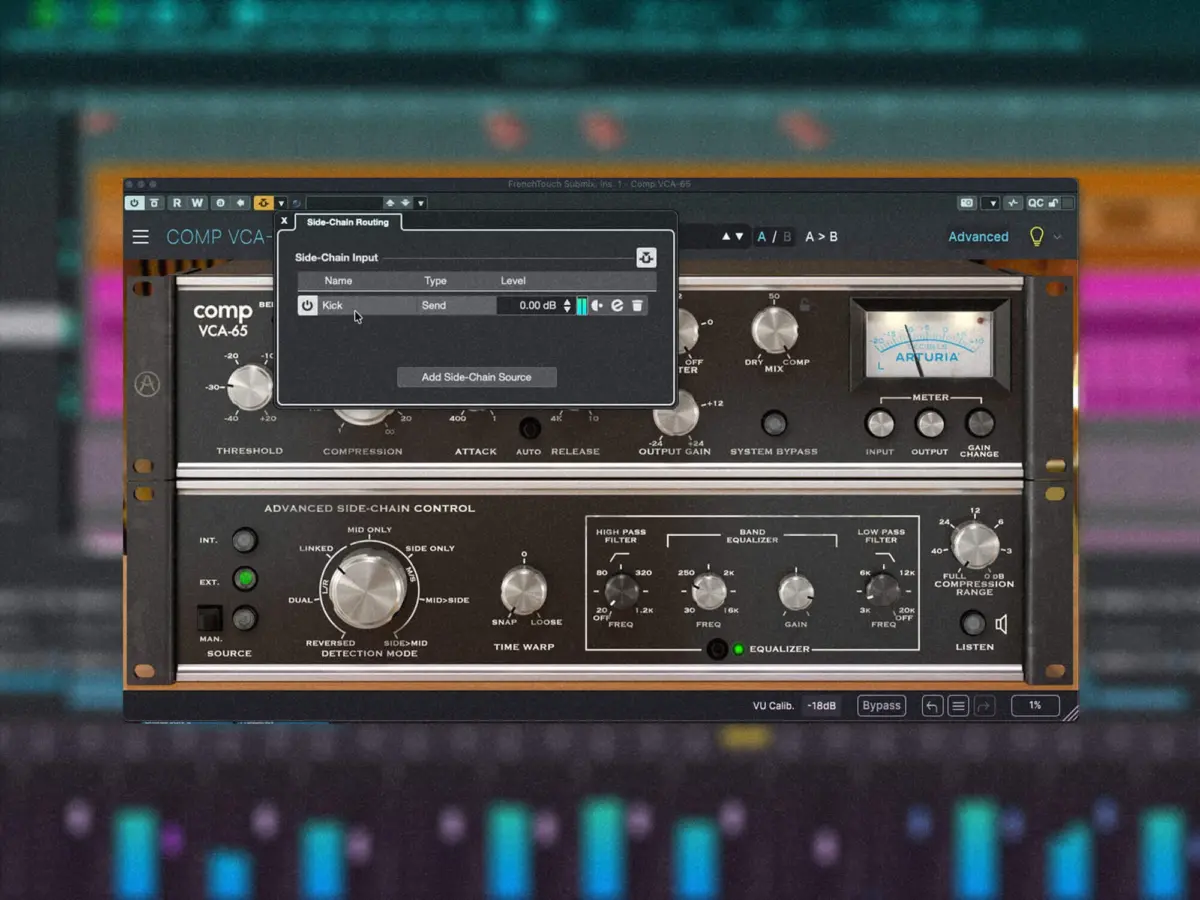
In an external sidechain configuration, the unity between these two pathways is severed. The detector path is opened up to accept a completely independent audio signal from elsewhere in the mixing console or DAW.
When this happens, the compressor’s gain reduction circuit no longer reacts to the audio playing through its main channel. Instead, it listens exclusively to the guest signal entering the sidechain input. When the sidechain signal crosses the threshold, the compressor attenuates the main audio signal, regardless of whether the main signal is loud, quiet, silent, or playing entirely different notes.
Advanced Applications in Modern Audio Production
While the aesthetic pumping effect popularized by electronic dance music producers remains immensely popular, professional audio engineers deploy sidechain compression across a vast array of technical and creative scenarios.
┌────────────────────────────────────────────────────────┐
│               SIDECHAIN COMPRESSION USES               │
├────────────────────────┬───────────────────────────────┤
│ Technical Utility      │ Creative Expression           │
├────────────────────────┼───────────────────────────────┤
│ • De-essing            │ • Electronic "Pumping"        │
│ • De-plosive control   │ • Rhythmic Pulsing            │
│ • Mic bleed reduction  │ • Genre-defining Grooves      │
│ • Reverb management    │ • Dynamic Space Carving       │
└────────────────────────┴───────────────────────────────┘
1. Tuning Compressor Response: Frequency-Conscious Dynamics
Douglas Shearer’s original de-essing concept remains the foundational blueprint for frequency-conscious compression. Modern audio engineers routinely use sidechain filtering to make compressors react selectively to specific frequency ranges within a single signal:
- De-Essing: By routing a vocal track through an internal high-pass sidechain filter, an engineer can ensure that low-end vocal warmth does not trigger the compressor, leaving the processor free to clamp down exclusively on harsh high-frequency sibilance.
- De-Plosive Control: Conversely, boosting low-frequency content in an internal sidechain path allows engineers to target and suppress violent low-frequency "pops" and microphone bumps caused by breath blasts on vocal or speech tracks.
2. Strategic Ducking for Mix Clarity
In dense, multi-track mixes, frequency masking is an omnipresent enemy. Instruments competing for the same sonic real estate often result in a muddy, undefined mix. Sidechain ducking offers an elegant surgical solution to carve out spatial clarity:
- Vocals and Instrumentation: In modern pop and rock mixing, engineers frequently insert a compressor on lead instrumental buses (such as guitars, keyboards, or synths) and sidechain the lead vocal into them. Whenever the vocalist sings, the instruments subtly duck out of the way, ensuring the vocal sits prominently in the foreground without requiring excessive fader automation or destructive EQ notches.
- Kick Drum and Bass Guitar: The low-end clash between a kick drum and a bass guitar is legendary. By sidechaining the kick drum to a compressor on the bass track, the lowest fundamental frequencies of the bass instantly dip the moment the kick drum strikes. This grants the kick maximum transient impact and punch, while allowing the bass to swell back up immediately afterward, maintaining a rich, full low-end foundation.
3. Mitigating Microphone Bleed in Live and Multi-Mic Recordings
Recording multi-instrument setups—such as an acoustic drum kit, a live horn section, or a panel discussion—inevitably introduces microphone bleed, where sound from one source leaks into neighboring microphones, causing phase issues, comb filtering, and muddy acoustics.
Sidechain expansion and compression offer a remedy. By routing individual close-mic signals into sidechain paths, engineers can dynamically suppress ambient room mics or neighboring instrument mics whenever the primary instrument is inactive, tightening up the transient response and cleaning up the overall noise floor of the recording.
4. Reverb and Delay Management
Ambient effects like lush reverbs and sprawling delays add wonderful depth, width, and emotion to musical elements, but excessive wet effects can easily wash out a mix, obscuring the clarity and intelligibility of the dry source material.
To solve this, engineers routinely employ sidechain ducking on reverb and delay return tracks. By sidechaining the dry vocal or lead instrument into a compressor applied to the reverb return, the lush tail of the reverb is forcefully pushed down in volume while the dry vocal is actively singing. The moment the vocal pauses, the reverb rushes back up to fill the acoustic space, delivering the best of both worlds: massive, atmospheric depth coupled with crystal-clear lyrical intelligibility.
5. Achieving the "French Touch" Pumping Effect
For producers aiming to recreate the legendary, pulsing aesthetic of French house music, setting up a pumping sidechain compressor requires precise configuration of internal parameters:
- The Routing: A percussive element—most commonly a steady four-on-the-floor kick drum—is routed to the sidechain input of a bus compressor spanning across a submix of pads, rhythmic synths, or the entire instrumental mix.
- Threshold and Ratio: The compressor’s threshold must be set low enough, and the ratio high enough, to ensure noticeable gain reduction occurs with every single kick transient.
- Attack and Release: A fast attack time ensures the compressor reacts instantaneously to the initial punch of the kick drum. The release time is then carefully tuned to match the tempo of the track; adjusting the release dictates the duration of the ducking curve, allowing the compressed elements to pump smoothly in time with the groove of the music.
Official Industry Perspectives and Engineering Insights
To gauge the contemporary standing of sidechain compression within professional audio culture, industry-leading mix engineers, plugin developers, and broadcast professionals consistently emphasize its evolution from a corrective fix to an essential creative instrument.
"Sidechain compression transformed from a mechanical bandage in Hollywood cinema into one of the most expressive rhythmic tools in electronic music production," notes veteran mixing engineer Sarah Jenkins. "When you watch top-tier mix engineers work today, you realize that sidechain compression isn’t just about turning things down—it’s about choreography. You are choreographing how sound waves interact, ensuring every single element in a mix has its own designated moment to shine without fighting for space."
Broadcast engineers similarly praise its ongoing utility in automated dialogue systems. With the explosive rise of podcasting, automated dialogue replacement (ADR), and streaming media platforms, standardized sidechain ducking ensures compliance with strict broadcast loudness standards while maintaining professional sonic polish.
Furthermore, modern software developers have revolutionized the accessibility of the technique. Where early analog engineers required complex patchbay routing, outboard gear chains, and hardware splitters to achieve external sidechaining, contemporary digital audio workstations (DAWs) like Pro Tools, Logic Pro, Ableton Live, and FL Studio allow producers to assign sidechain paths with a single mouse click. Advanced modern plugins even incorporate frequency-specific sidechain processing, allowing engineers to duck only specific frequency zones—such as carving out a narrow 300Hz notch in a guitar bus whenever a vocal’s fundamental frequencies hit, leaving the rest of the guitar’s tonal spectrum entirely untouched.
Future Outlook: The Next Generation of Dynamic Processing
As audio production technology continues to advance at a breakneck pace, the future of sidechain compression points toward unprecedented levels of intelligence, automation, and spectral precision.
The integration of machine learning and artificial intelligence into modern audio plugins is already reshaping how engineers approach dynamic interaction. Next-generation spectral sidechain processors go far beyond traditional broadband amplitude ducking. Utilizing advanced Fast Fourier Transform (FFT) analysis, these intelligent tools can analyze two independent audio signals in real time, identifying precise frequency clashes across the entire audio spectrum and dynamically attenuating only the exact overlapping frequencies. This means a lead vocal can automatically carve out a microscopic, transparent spectral home within a dense instrumental arrangement without altering the overall tonal balance of the backing tracks.
Additionally, immersive audio formats—such as Dolby Atmos and spatial audio mixing—are redefining how engineers think about physical space in three dimensions. In spatial environments, sidechain compression is evolving to manage not just volume and frequency, but positional masking. As objects move dynamically across a 3D soundstage, intelligent sidechain routing ensures that critical elements like dialogue or lead vocals dynamically push competing spatial sound effects and background beds out of their immediate acoustic vicinity, maintaining absolute clarity regardless of where an object is positioned in the virtual room.
Conclusion
From Douglas Shearer’s pioneering 1930s cinematic experiments designed to tame unruly sibilance, to the pulsing dance floors of late-90s house music, and onward to the sophisticated spectral algorithms of modern spatial audio, sidechain compression has proven to be one of the most enduring and versatile concepts in audio engineering. By granting engineers the power to govern one acoustic element through the dynamic behavior of another, it remains an indispensable pillar of professional sound craftsmanship—an invisible yet profoundly powerful force shaping the way the world listens.