Executive Overview
Stoner metal occupies a uniquely revered space within the wider heavy music continuum. While other subgenres evolved through increased velocity, mechanical precision, or sonic extremity, stoner metal looked backward to move forward. It resurrected the warm, analog distortion, blues-infused improvisation, and cavernous low-end frequencies pioneered during the birth of heavy rock in the early 1970s.
Defined by down-tuned guitars, vintage tube amplification, hypnotic repetition, and an unhurried sense of groove, stoner metal transformed from a localized underground phenomenon into a thriving global industry. What began as informal "generator parties" in the arid scrublands of Southern California and isolated rehearsal spaces in the post-industrial English Midlands has blossomed into a international touring circuit. Today, major multi-day festival brands—such as Desertfest (London, Berlin, Antwerp, New York) and the Heavy Psych Sounds Tour—draw tens of thousands of dedicated attendees annually.
To understand how stoner metal maintained its unyielding identity while continuously expanding its aesthetic boundaries, one must examine the critical discographical turning points that defined its trajectory. These five landmark records served as evolutionary catalysts, shifting the direction of heavy music and cementing the sonic blueprint for generations of musicians.
Detailed Chronology: The Landmark Records That Shaped the Haze
   1971                    1992                         1994                           1998                      2000
    │                       │                            │                              │                         │
    ▼                       ▼                            ▼                              ▼                         ▼
BLACK SABBATH             SLEEP                        KYUSS                        CATHEDRAL             SPIRITUAL BEGGARS
Master of Reality       Sleep's Holy Mountain        Welcome to Sky Valley         Caravan Beyond Redemption       Ad Astra
(The Blueprint)         (Sludge/Doom Revival)        (The Desert Standard)         (UK Doom-Stoner Pivot)    (Scandinavian Heavy Rock)
1. The Archetypal Genesis: Black Sabbath – Master of Reality (1971)
[Artist]        Black Sabbath
[Album]         Master of Reality
[Release Date]  July 21, 1971
[Origin]        Birmingham, England
[Key Tracks]    "Sweet Leaf", "Into the Void", "Children of the Grave"
Historical Context
While Black Sabbath’s self-titled 1970 debut and its follow-up Paranoid established the foundational architecture of heavy metal, it was their third studio LP, Master of Reality, that birthed stoner metal. Recorded at Island Studios in London, the record caught the Birmingham quartet in a state of rapid artistic and lifestyle evolution, heavily influenced by perpetual touring, exhaustion, and widespread cannabis consumption.
Sonic Architecture & Innovation
Guitarist Tony Iommi made a radical technical decision that fundamentally altered the physics of rock guitar tone. To alleviate tension on his prosthetic fingertips—the result of a teenage industrial accident—Iommi detuned his Gibson SG three half-steps down to C# (C-sharp). Bassist Geezer Butler followed suit, matching Iommi’s lower register.
The resulting frequency spectrum was unprecedentedly dense and subterranean. The album’s legendary opener, "Sweet Leaf"—introduced by an iconic, tape-looped recording of Iommi coughing after hitting a joint—served as both a lyrical ode to cannabis and a masterclass in riff-centric songwriting. Tracks like "Into the Void" and "Lord of this World" paired sluggish, tectonic tempos with swinging, jazz-influenced percussion from drummer Bill Ward, establishing the push-and-pull dynamic that defines stoner rock rhythm sections to this day.
2. The Sludge-Fueled Revival: Sleep – Sleep’s Holy Mountain (1992)
[Artist]        Sleep
[Album]         Sleep's Holy Mountain
[Release Date]  November 1992
[Origin]        San Jose, California
[Key Tracks]    "Dragonaut", "Holy Mountain", "Aquarian"
Historical Context
By the early 1990s, mainstream rock was dominated by the rise of Seattle grunge, while underground metal pursued extreme thrash, death, and black metal subgenres. In San Jose, California, a trio of young musicians—guitarist Matt Pike, bassist/vocalist Al Cisneros, and drummer Chris Hakius—rejected contemporary trends entirely. Drawing inspiration from the slow-burn doom of Saint Vitus and the viscous sludge of early Melvins, Sleep recorded their sophomore effort, Sleep’s Holy Mountain, for Earache Records.
Impact on the Subgenre
Sleep’s Holy Mountain was a watershed moment that codified the 1990s stoner metal movement in the United States. Pike’s performance was an unabashed homage to Tony Iommi, driven through cranked Green and Orange tube amplifiers to produce a wall of roaring fuzz. Tracks like "Dragonaut" demonstrated how a power trio could generate an overwhelming physical resonance while maintaining a loose, organic swagger.
The album served as an absolute high-water mark for the American heavy underground, opening the floodgates for contemporary acts such as Monster Magnet, Corrosion of Conformity, and Clutch to assert a distinctly North American voice within heavy rock.
3. The Desert Standard: Kyuss – Welcome to Sky Valley (1994)
[Artist]        Kyuss
[Album]         Welcome to Sky Valley
[Release Date]  June 28, 1994
[Origin]        Palm Desert, California
[Key Tracks]    "Gardenia", "Demon Cleaner", "Superscoupa and Mighty Scoop"
The Palm Desert Scene
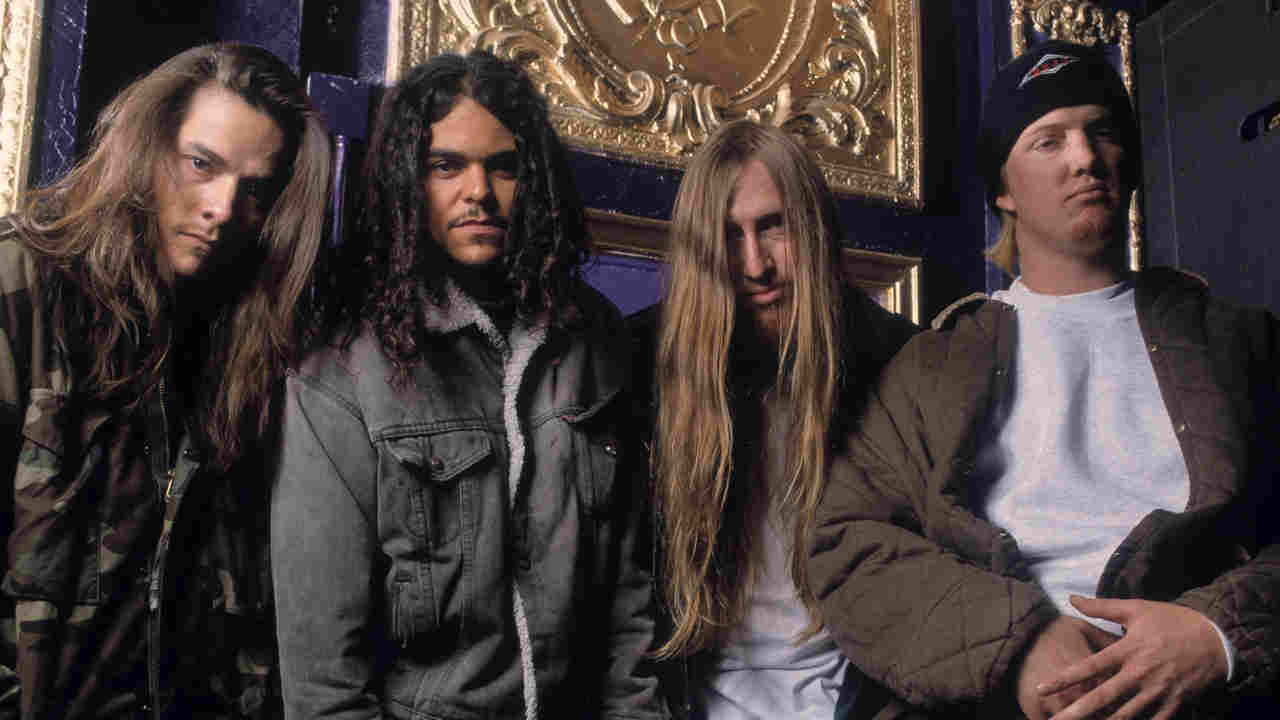
Isolation bred innovation in the arid climate of Palm Desert, California. Local teenage musicians, unable to secure gig bookings in the distant club circuits of Los Angeles or San Francisco, organized suburban outdoor gatherings known as "generator parties." Hauling gasoline-powered generators, PA systems, and amplification stacks deep into the high desert, bands performed long, improvised sets under the stars. Chief among these outfits was Kyuss—comprising guitarist Josh Homme, vocalist John Garcia, bassist Scott Reeder (who replaced Nick Oliveri), and drummer Brant Bjork.
+-----------------------------------------------------------------------+
|                    THE PALM DESERT GENERATOR PARTY                    |
|                                                                       |
|   [Gasoline Generator] ───> [Ampeg SVT Bass Amps] ───> [Down-Tuned SG]  |
|                                                                       |
|   • Location: Remote Desert Canyons & Dry Lake Beds                   |
|   • Aesthetic: Long-form Improvisation, Sub-Bass Vibrations           |
|   • Legacy: Spawned Kyuss, Queens of the Stone Age, Fu Manchu          |
+-----------------------------------------------------------------------+
Masterpiece Breakdown
Following their critically acclaimed 1992 release Blues for the Red Sun, Kyuss signed with major label Elektra Records to release Welcome to Sky Valley. Produced by Chris Goss, the album featured a structural concept: the tracks were grouped into three long movement suites, forcing the listener to experience the record as an uninterrupted journey rather than a collection of skippable singles.
Homme revolutionized guitar tones by running a Gibson Les Paul detuned to C-standard through an Ampeg SVT bass amplifier setup, creating a dry, low-end punch that perfectly mirrored the vastness of the Southern California landscape. On tracks like "Demon Cleaner" and "Gardenia," John Garcia’s soulful, grit-laden vocals provided a compelling emotional counterweight to the instrumentals, taking stoner rock out of Sabbath’s shadow and launching it into a dynamic cosmic domain.
4. The UK Doom-Stoner Pivot: Cathedral – Caravan Beyond Redemption (1998)
[Artist]        Cathedral
[Album]         Caravan Beyond Redemption
[Release Date]  November 6, 1998
[Origin]        Coventry / London, England
[Key Tracks]    "Voodoo Fire", "Hopkins (Witchfinder General)", "Captain Casket"
Genre Transmutation
In the early 1990s, Britain’s heavy scene was defined by bleak, mournful doom metal. Fronted by former Napalm Death vocalist Lee Dorrian, Cathedral was initially heralded as the absolute vanguard of ultra-slow, depressing doom via their 1991 debut, Forest of Equilibrium. However, Dorrian and guitarist Garry Jennings possessed a vast appetite for 1970s hard rock, Captain Beyond, and vintage psychedelia.
The Bridge to Europe’s Heavy Underground
By 1998’s Caravan Beyond Redemption, Cathedral completed a transformation from funeral doom into a groove-heavy stoner rock engine. The album incorporated brass, analog synth flourishes, and boogie-rock riffs reminiscent of Mountain and Deep Purple, all fed through a high-octane metal framework.
Crucially, Dorrian’s influence extended beyond his own recordings. Through his independent record label, Rise Above Records, Dorrian scouted, signed, and released seminal works by burgeoning British stoner/doom icons such as Electric Wizard and Orange Goblin. Cathedral’s artistic shift validated the blend of doom, stoner rock, and vintage psychedelic hard rock across Europe.

5. The Scandinavian Heavy-Rock Refinement: Spiritual Beggars – Ad Astra (2000)
[Artist]        Spiritual Beggars
[Album]         Ad Astra
[Release Date]  January 11, 2000
[Origin]        Halmstad, Sweden
[Key Tracks]    "Angel of Betrayal", "Mantra", "Per Aspera Ad Astra"
The Swedish Connection
While Sweden became internationally famous in the 1990s for melodic death metal and Scandinavian garage rock, guitarist Michael Amott—already renowned for his work with death metal pioneers Carcass and Arch Enemy—harbored a deep passion for vintage hard rock. Formed in 1992, his side project, Spiritual Beggars, spent the late ’90s refining a blend of heavy metal precision and retro-rock swagger.
The Masterwork: Ad Astra
Released in early 2000 through Music For Nations, Ad Astra represented the apex of Scandinavian stoner metal. Unlike the raw, desert-dry production of their North American counterparts, Spiritual Beggars embraced a lush, arena-ready production value. Keyboardist Per Wiberg added heavy Hammond organ runs, invoking the classic spirits of Jon Lord (Deep Purple) and Ken Hensley (Uriah Heep), while Amott traded twin-lead guitar solos with melodic finesse over Christian "SJB" Sjöstrand’s thunderous basslines.
Ad Astra proved that stoner metal could be anthemic, immaculate, and musically sophisticated without losing its low-end power. The record earned Spiritual Beggars high-profile tour slots alongside mainstream giants like Iron Maiden and Queens of the Stone Age, introducing the European stoner sound to vast arena audiences.
Supporting Context & Metrics: Cultural Ecosystem, Tonality, and Economics
1. The Technical Architecture of the Stoner Sound
The sonic identity of stoner metal relies on specific vintage gear configurations designed to saturate signal chains with harmonic distortion and sub-bass resonance.
+-----------------------------------------------------------------------------------+
|                        THE STONER METAL SIGNAL CHAIN                              |
+-----------------------------------------------------------------------------------+
|  [GUITAR / BASS]        [FUZZ / BOOST]         [TUBE AMPLIFICATION]   [SPEAKER]   |
|  • Tuning: C-Standard   • Electro-Harmonix     • Sunn O))) Model T    • 4x12 /    |
|    or C#                • Big Muff / Fuzz Face • Orange OR120         |   2x15    |
|  • Heavy Gauge Strings  • Dallas Rangemaster   • Matamp GT120         | Enclosures|
+-----------------------------------------------------------------------------------+-
String Tension & Down-Tuning: Standard tuning (E-A-D-G-B-E) is systematically replaced by C#-Standard (C#-F#-B-E-G#-C#) or C-Standard (C-F-A#-D#-G-C). To

maintain string tension at these lower pitches, players utilize thick, heavy-gauge string sets (.012–.056 or higher).
- Amplification & Overdrive: High-gain digital modeling amplifiers are eschewed in favor of high-wattage, non-master-volume analog tube amplifiers (Sunn O))), Matamp, Orange, Marshall Super Lead). These units are pushed to natural power-amp clipping, creating a dense, compression-rich soundwave.
- The Fuzz Spectrum: Overdrive pedal chains rely heavily on silicon and germanium transistors—most notably variants of the Electro-Harmonix Big Muff, Dallas Arbiter Fuzz Face, or Univox Super-Fuzz—to round off high frequencies and fatten the mid-range spectrum.
2. Live Infrastructure: The Festival Micro-Economy
Stoner metal built a resilient self-sustaining global circuit. Rather than relying on commercial rock radio or mainstream television, the genre sustained itself through dedicated live festivals, independent record labels, and physical media sales.
       [LOCAL SCENES]                    [INDEPENDENT LABELS]                [GLOBAL FESTIVALS]
┌──────────────────────────┐      ┌───────────────────────────────┐      ┌──────────────────────┐
│ • Palm Desert (US)       │      │ • Rise Above Records (UK)     │      │ • Desertfest London  │
│ • Midlands / London (UK) │ ───> │ • Heavy Psych Sounds (IT)     │ ───> │ • Desertfest Berlin  │
│ • Bay Area (US)          │      │ • Tee Pee Records (US)        │      │ • Psycho Las Vegas   │
│ • Gothenburg (SE)        │      │ • Blues Funeral (US)          │      │ • Stoned From The Underground │
└──────────────────────────┘      └───────────────────────────────┘      └──────────────────────┘
The success of Desertfest serves as a primary metric of the genre’s endurance:
- Established: 2012 (London/Berlin).
- Global Footprint: Annual flagship editions in London, Berlin, Antwerp, and New York City.
- Capacity & Growth: Expanded from multi-venue club crawls catering to 1,000 underground fans to multi-day, multi-stage indoor/outdoor events drawing upwards of 10,000 attendees per city.
- Label Networks: Boutique record labels—such as Heavy Psych Sounds (Italy), Tee Pee Records (USA), Blues Funeral Recordings (USA), and Ripple Music (USA)—operate vertical integration models, hosting branded festival stages, pressing limited-edition colored vinyl, and directly managing tour logistics.
Comparative Analysis of Landmark Releases
| Album Title | Year | Primary Origin | Key Technical Characteristic | Major Historical Contribution |
|---|---|---|---|---|
| Master of Reality | 1971 | Birmingham, UK | C# down-tuning, acoustic/heavy contrast | Established the low-end, riff-centric blueprint for all subgenres of doom and stoner metal. |
| Sleep’s Holy Mountain | 1992 | San Jose, USA | Green/Orange amp tube saturation, heavy fuzz pedals | Reasserted 70s Sabbathian rock within the 90s US underground; launched the modern stoner revival. |
| Welcome to Sky Valley | 1994 | Palm Desert, USA | Electric guitars routed through Ampeg SVT bass setups | Defined the "Desert Rock" aesthetic; introduced suite-based track sequencing and open-air jam dynamics. |
| Caravan Beyond Redemption | 1998 | Coventry, UK | Dual-guitar hard rock harmonies, organ accents | Pivoted the gloomy UK doom scene toward retro-hard rock swagger; spurred the Rise Above label empire. |
| Ad Astra | 2000 | Halmstad, SE | Hammond organ integration, clean production, twin leads | Demonstrated the crossover potential of Scandinavian stoner rock for arena-level heavy metal audiences. |
Critical Analysis & Industry Commentary
Music historians and journalists consistently emphasize that stoner metal’s endurance lies in its unpretentious, organic relationship with heavy metal’s original ethos.
Reflecting on the genre’s evolution, industry commentators highlight how stoner rock resisted the commercialization that swallowed other contemporary movements of the 1990s:
"When grunge collapsed under its own tragedy and nu-metal pivoted toward rap-rock angst, stoner metal remained fundamentally pure. It was about the physical sensation of sound—the feeling of a cranked tube amplifier vibrating through a wooden floorboard. Acts like Kyuss and Sleep didn’t care about MTV rotation; they cared about finding the perfect riff."
— Music Journalist & Metal Historian Analysis
Furthermore, the cross-pollination between extreme metal musicians and stoner rock continues to be a subject of critical study. The transition of figures like Lee Dorrian (Napalm Death to Cathedral) and Michael Amott (Carcass to Spiritual Beggars) illustrates that stoner metal served as an artistic sanctuary for musicians seeking an escape from the formulaic tempo constraints of grindcore and death metal.
+-------------------------------------------------------------------------------+
|                       THE EXTREME METAL TO STONER PIVOT                       |
+-------------------------------------------------------------------------------+
|  ARTIST          EXTREME METAL ORIGIN           STONER ROCK DESTINATION       |
|  ---------------------------------------------------------------------------  |
|  Lee Dorrian     Napalm Death (Grindcore)   ──> Cathedral (Stoner/Doom)       |
|  Michael Amott   Carcass / Arch Enemy (Death)──> Spiritual Beggars (Stoner)   |
|  Matt Pike       Asbestosdeath (Sludge)     ──> Sleep / High on Fire (Stoner) |
|  Scott Kelly     Neurosis (Post-Metal)      ──> Shrinebuilder (Stoner/Doom)   |
+-------------------------------------------------------------------------------+
Future Outlook: The Perennial Persistence of the Heavy Groove
As stoner metal enters its fifth decade of existence, its influence shows no signs of waning. The subgenre has successfully avoided obsolescence by adhering to a foundational philosophy: tone and groove are timeless.
                                  [THE MODERN STONER METAL CONTINUUM]
                                                   │
         ┌─────────────────────────────────────────┼─────────────────────────────────────────┐
         ▼                                         ▼                                         ▼
[PSYCHEDELIC EXPLORATION]               [SLUDGE / HIGH-GAIN HYBRIDS]                [RETRO HARD ROCK REVIVAL]
• Elder                                 • High on Fire                              • Green Lung
• Earthless                             • Monolord                                  • Kadavar
• All Them Witches                      • Red Fang                                  • Graveyard
Key Trends Shaping the Future of the Genre:
- Genre Hybridization: Contemporary artists are breaking out of traditional 12-bar blues constraints. Bands like Elder incorporate elements of progressive rock and krautrock, while outfits like Green Lung infuse their stoner doom with folk horror theatrics and classic NWOBHM (New Wave of British Heavy Metal) hooks.
- Vinyl & Physical Media Dominance: Stoner metal remains one of the most lucrative subgenres for physical media sales. Limited vinyl pressings featuring liquid-filled wax, gatefold artwork, and custom fuzz pedal bundles routinely sell out within minutes, insulating the genre from the low payouts of digital streaming platforms.
- Global Expansion: Beyond its traditional hubs in North America and Western Europe, vibrant stoner scenes have emerged across South America (Argentina, Brazil), North Africa (Morocco), and East Asia (Japan, South Korea). Bands like Japan’s Church of Misery and Argentina’s Los Natas prove that the heavy, fuzz-laden groove is a universal musical language.
Ultimately, whether born from the damp, industrial streets of Birmingham or the sun-baked sand dunes of the Mojave, stoner metal’s lasting legacy is its absolute commitment to the riff. As long as musicians can plug down-tuned guitars into wall-sized stacks of vintage amplifiers, the warm, mesmerizing haze of heavy metal’s most enduring subgenre will continue to resonate across generations.