Executive Overview
In a monumental development for British musicology and cultural heritage, one of the most significant private collections of Sir Edward Elgar memorabilia in existence has crossed the Atlantic to find its permanent home in Manchester. Comprising approximately 1,500 meticulously curated items amassed over six decades by New Jersey-based businessman and Elgar devotee Arthur Reynolds, the archive has been successfully integrated into the historical collections of the Hallé Orchestra.
The transatlantic journey—spanning over 3,500 miles from New Jersey to London, and subsequently transported securely to Manchester—was made possible through a vital grant of nearly £105,000 from the UK’s National Heritage Memorial Fund (NHMF). This critical financial backing covered the complex legalities and logistical hurdles of international repatriation, ensuring the multi-faceted archive remained entirely intact. Reynolds, who serves as the Chairman of the North American Branch of the Elgar Society and is a familiar figure at the Three Choirs Festival, harbored a lifelong ambition: to prevent the dispersal of Elgar’s creative footprint and ensure that his exhaustive collection would ultimately be returned to the public domain in the United Kingdom.
Now housed within the Hallé’s state-of-the-art archival facilities at The Bridgewater Hall, the collection bridges a profound historical circle. The Hallé boasts a deeply rooted, symbiotic relationship with Elgar, having premiered his seminal Symphony No. 1 in 1908 at Manchester’s historic Free Trade Hall under the baton of Dr. Hans Richter, the orchestra’s second Principal Conductor and a close personal friend of the composer.
By rescuing these priceless manuscripts, first-edition scores, and personal correspondences from the threat of market fragmentation, the acquisition secures a treasure trove of primary source material. It offers scholars, musicians, and enthusiasts an unprecedented lens through which to examine the working methods, personal relationships, and cultural impact of Britain’s most celebrated musical nationalist.
Detailed Chronology: The Genesis and Repatriation of the Collection
The Roots of a Lifelong Passion (The 1960s)
The genesis of this extraordinary archive dates back to the mid-1960s, a period when Arthur Reynolds traveled to the United Kingdom for his studies. To his profound astonishment, Reynolds encountered a British cultural landscape where enthusiasm for Elgar had plummeted to a historic nadir. Among his academic contemporaries, Elgar’s music was frequently dismissed, overlooked, or subjected to post-war critical backlash that viewed the composer’s grand, imperial idioms as out of touch with modern sensibilities.
Rather than accepting this cultural amnesia, Reynolds resolved to take direct action. Recognizing that valuable manuscripts, letters, and association items were being undervalued, neglected, and exposed to the risk of irreversible loss, he initiated what would become a lifelong mission. Over the next sixty years, operating primarily out of New Jersey, Reynolds systematically tracked down, authenticated, and acquired significant artifacts related to Elgar’s creative life. What began as a personal passion evolved into an institutional-grade archive, rivaling many public holdings in its depth and specificity.
The Working Relationship: A Window Into Elgar’s Process
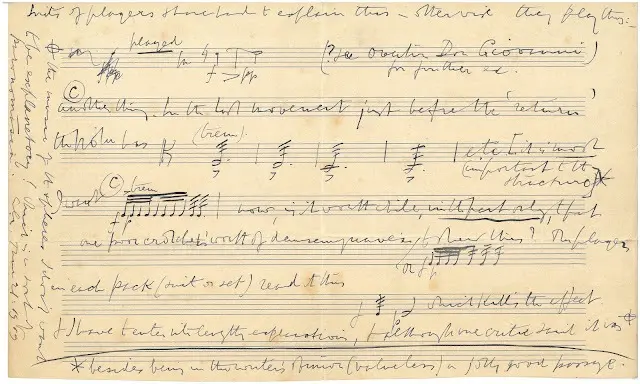
Among the crown jewels of the newly relocated archive is a rare, highly revealing manuscript dated January 21, 1919. Comprising a half-sheet of music paper filled densely on both sides, the document preserves passages and queries concerning Elgar’s introspective Piano Quintet in A minor, Op. 84.
The manuscript features direct questions addressed by Elgar to Harold Brooke—who succeeded the legendary Augustus J. Jaeger at the renowned publishing firm Novello—acting simultaneously as music printer and virtuoso pianist. As noted by archival experts, this single artifact illuminates the rigorous, highly collaborative working relationship between Elgar and his publishers during the frantic final years of the First World War, when the composer sought refuge in Sussex and poured his anxieties into chamber music.
The Transatlantic Odyssey (2023–2024)
As Reynolds approached his later years, securing the legacy of his life’s work became an urgent priority. Crucially, he insisted that the collection must never be broken up or sold piecemeal to private speculators.
To achieve this, negotiations were initiated with the Hallé, whose historic ties to Elgar made it the ideal institutional custodian. However, transferring a fragile, multi-part archive weighing thousands of items across international borders presented formidable financial and legal challenges.

The National Heritage Memorial Fund stepped in with a pivotal grant of nearly £105,000. These funds defrayed the specialized legal expenses required to clear international export-import protocols and financed the high-security freight transport. The collection was carefully packed, flown from New Jersey to London, and loaded onto specialized transport for the final leg up to Manchester, successfully concluding its 3,500-mile journey without incident.
Supporting Context & Metrics
To understand the true magnitude of the Arthur Reynolds Elgar Archive, one must examine its composition, structural scope, and the institutional framework now responsible for its preservation.
Collection Scope and Key Metrics
- Total Item Count: Approximately 1,500 distinct items.
- Geographical Span: Acquired in North America over 60 years; permanently relocated to Manchester, UK.
- Financial Investment: Backed by an NHMF grant of nearly £105,000 for transport, legal curation, and administrative transition.
- Core Content Categories: Autograph musical manuscripts, rare first-edition scores, extensive personal and professional correspondence, and historical memorabilia.
- Chronological Range: Spans Elgar’s early career development through his late masterpieces and his pioneering involvement in early electrical sound recording technology.
The Hallé’s Manchester Heritage
The selection of the Hallé as the permanent repository is far from coincidental; it is a homecoming rooted in the bedrock of British orchestral history. Founded in 1858 by Sir Charles Hallé, the orchestra enjoyed an intimate association with Elgar during the height of his creative powers.
Dr. Hans Richter, the Hallé’s second Principal Conductor, was an ardent champion of Elgar’s music. It was Richter and the Hallé who delivered the world premiere of Elgar’s Symphony No. 1 in A flat major on December 3, 1908, at Manchester’s Free Trade Hall—an event so triumphant that the audience erupted into spontaneous applause, demanding the conductor take multiple bows. By housing Reynolds’ collection at The Bridgewater Hall, the Hallé connects its ongoing performance traditions directly back to the primary source materials of the composer who helped define its artistic identity.
Official Statements and Archival Vision
Reflecting on the emotional culmination of his six-decade endeavor, Arthur Reynolds shared his perspective on the journey:
"Edward Elgar’s music offered me sensations of reverence to the United Kingdom. When I came to study there in the mid-1960s, I was surprised to find my admiration for Britain’s greatest composer unshared by my contemporaries whose interest in Elgar’s music had reached a nadir of negativity. One consequence was a neglect that threatened to consign Elgar memorabilia to an undeserved oblivion. I decided then and there to make it my life’s work to prevent the disappearance of material related to Elgar’s creative life. The result is the archive that has now reached its final resting place with Hallé."
The leadership of the Hallé has echoed this sentiment, emphasizing the profound responsibilities and opportunities that come with housing such a collection. A Hallé spokesperson noted that the acquisition transforms the organization from a mere performing body into a premier center for Elgar research:
"This archive is not merely a collection of dead paper; it is a living blueprint of genius. To have Arthur Reynolds’ life work entrusted to our care in Manchester is an immense privilege. It strengthens our historical lineage and ensures that future generations of scholars and music lovers can touch, read, and understand the intricate processes behind Elgar’s immortal scores."
Future Outlook: Accessibility, Research, and Exhibition
The arrival of the Reynolds archive in Manchester marks the beginning of a new chapter of public engagement and academic scholarship. The Hallé has laid out a comprehensive roadmap to ensure the collection transitions from private stewardship to public accessibility:
- Digital Integration: Mr. Reynolds’ meticulous cataloging system is currently being integrated into the orchestra’s digital infrastructure. It will soon be accessible via the Connecting Manchester’s Music Archives website, allowing global researchers and curious listeners to search the archive’s holdings remotely.
- Physical Access by Appointment: While the collection is presently housed within the Hallé’s secure archive facilities at The Bridgewater Hall, arrangements have been made for researchers, students, and biographers to view specific items by appointment.
- Exhibition Programming: The Hallé plans to curate selected highlights from the 1,500 items for inclusion in upcoming public exhibitions, bringing manuscripts such as the 1919 Piano Quintet draft out of the vault and into the public eye.
- Permanent Display Development: Looking further ahead, the organization aims to secure additional funding to establish a permanent, fully accessible exhibition space dedicated to the archive, ensuring that Elgar’s creative spirit remains perpetually embedded in the cultural fabric of Northern England.
Through the dedication of Arthur Reynolds, the financial intervention of the National Heritage Memorial Fund, and the institutional commitment of the Hallé, a vital piece of British musical heritage has been saved from the shadows of oblivion and restored to the heart of the community it so powerfully evokes.