Executive Overview
Mounting Olivier Messiaen’s mammoth 1983 opera Saint François d’Assise has always been an act of daring bordering on the quixotic. Spanning over four hours of dense musical architecture—stretching past six hours in the theater once intervals are accounted for—the opera demands unprecedented physical, spiritual, and technical stamina from everyone involved. It requires a massive orchestra with quadruple woodwinds, specialized instruments like the Ondes Martenot, an off-stage chorus, extensive dance and acting troupes, and a central protagonist who must embody a saint while undergoing profound psychological and physical trials.
On August 9, 2026, the Salzburg Festival confronted this twentieth-century masterpiece head-on at the Felsenreitschule. In a new production directed, designed, and lit by Romeo Castellucci—with dramaturgy by Christian Longchamp and choreography by Yasmine Hugonnet—the festival offered an evening quite unlike any other in recent memory. At the heart of this colossal undertaking stood baritone Philippe Sly, whose selfless, all-encompassing, and fearless portrayal of St. Francis anchored a production that was by turns mesmerizing, provocative, and deliberately frustrating.
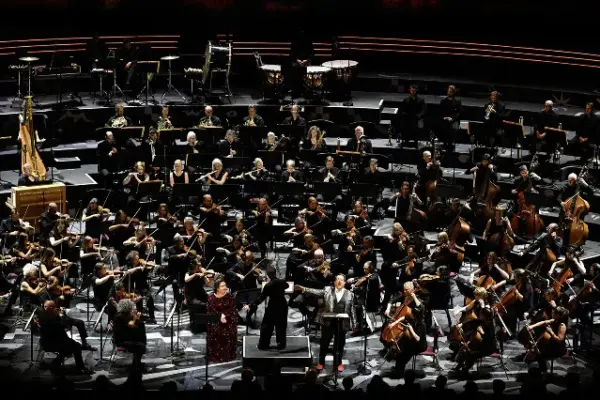
Conducted with astonishing clarity and precision by Maxime Pascal at the helm of the Vienna Philharmonic Orchestra, alongside a stellar supporting cast featuring Lauranne Oliva as a striking Angel and Russell Braun as a dignified Brother Leo, this Salzburg staging provided a fascinating tension. While the pit and off-stage chorus poured forth Messiaen’s ecstatic, transcendent vision of heavenly joy, Castellucci’s staging focused relentlessly on the raw, gritty, and often disturbing earthly travails of humanity. The result was a profound intellectual and sensory dialogue between sacred music and secular, provocative theater.
Detailed Chronology: Act by Act Through Castellucci’s Lens
Olivier Messiaen structured Saint François d’Assise into three acts comprising eight distinct scenes, charting the spiritual evolution of Francis from a man burdened by human weakness to a figure of mystical transfiguration. In Castellucci’s hands, however, the hagiographical certainty of Messiaen’s original vision was radically reinterpreted. Rather than portraying Francis as an unshakeably serene holy man, Castellucci presented a protagonist whose journey was fraught with psychological turmoil, physical degradation, and stark earthly realism.

Act I: The Cross, the Leper, and the Smell of Bread
The production established its iconoclastic tone even before a note of Messiaen’s official score sounded. The evening opened with an unscripted prologue in which Philippe Sly’s St. Francis stripped entirely naked, stripping away all symbols of societal and religious identity to stand exposed before the audience.
Once the opera commenced, The Cross subjected Francis and his newly gathered Franciscan brothers to an unforgiving barrage of environmental elements, including driving rain and clinging dirt. This gritty naturalism persisted into Lauds, during which the friars baked real bread inside real working ovens on stage. By the end of Act One, the rich, comforting scent of newly baked bread drifted through the Felsenreitschule, while Sly’s Francis playfully and frantically covered himself in flour and kneaded dough—a jarring, earthy counterpoint to Messiaen’s celestial harmonies.
The tension escalated in the scene featuring the Leper. Sung with intense vocal commitment by Sean Panikkar from off-stage or nearby, the physical incarnation of the Leper was handled by an uncredited actor. In a moment of striking vulnerability and raw theater, Sly’s Francis washed the naked actor’s entire body and kissed him, turning an act of spiritual charity into a deeply intimate, visceral encounter.
Act II: The Sinister Angel and the Gold-Painted Viola
Act Two introduced Lauranne Oliva as the Angel, a presence that was magnetic yet deeply unsettling. Eschewing any traditional, comforting celestial imagery, Oliva’s Angel possessed an air of ambiguous, borderline sinister intent that kept the audience guessing throughout her appearances.

In The Journeying Angel, the friars busied themselves making pottery, only for the Angel to methodically destroy their creations. A moment of striking visual mystery followed when the Angel painted her own leg and hand in shimmering gold. In The Angel Musician, the surrealism intensified: the Angel’s viola was literally buried in sand while she and her companions shed their wings, shedding copious amounts of intensely red "angelic" blood onto the stage. Yet, miraculously, as the stage ran red with theatrical blood, the Vienna Philharmonic conjured some of the score’s most sublime, heavenly melodies.
This juxtaposition continued into The Sermon to the Birds. Francis and his brothers treated the pooled angelic blood like holy relics, with Sly strapping the excavated, sand-covered viola to his bare back. True to Castellucci’s idiosyncratic lexicon, the brothers also painted their own legs a stark blue, blending surrealist modern art performance with medieval mysticism.
Act III: The Stigmata, the Grave, and the Final Silence
As the narrative moved toward its climax in Act Three, Castellucci’s staging plunged into profound physical and emotional darkness. The Stigmata opened with Sly’s Francis seemingly digging his own grave. Suddenly, the earth itself appeared to rise up, embodied by a troupe of eight actors, leaving Sly semi-naked and covered in a dark, earthy matter. Notably, Castellucci chose to present this pivotal mystical moment entirely in physical shadow; all the blinding, ecstatic light of the stigmata was left solely to the explosive, glorious transfiguration of Messiaen’s orchestration.
The final scene, Death and New Life, maintained this austere, somber atmosphere. In a moving touch, the Angel and the Leper returned to gently wash Francis’s body, preparing him for death. There was no traditional cross on display; instead, there was only darkness, the raw earth, and Messiaen’s soaring, joyous dance of eternal life.

Following Francis’s death, his lifeless body was pulled away and left naked—a direct visual echo of the opera’s opening moments. As a live flock of sheep quietly populated the stage, the off-stage Vienna State Opera Chorus continued to sing music of unmitigated heavenly joy, creating a heart-wrenching friction between the quiet reality of mortal death and the roaring infinity of the divine.
Supporting Context & Metrics
Production Logistics and Scale
Saint François d’Assise remains one of the largest logistical challenges in the operatic canon. The sheer scale of the Salzburg production required massive coordination across multiple disciplines:
- Total Performance Length: Over four hours of continuous music, expanded to over six hours in the theater when factoring in two extended intervals.
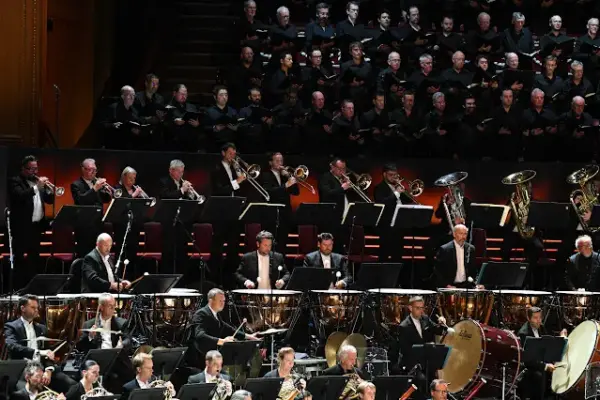
- Orchestral Forces: The Vienna Philharmonic featured quadruple woodwinds, an expansive percussion section split into two banks flanking the auditorium, and a trio of Ondes Martenots masterfully played by Nathalie Forget, Augustin Viard, and Cécile Lartigau.
- Cast and Ensemble: Headlined by Philippe Sly (St. Francis) and Lauranne Oliva (The Angel), the cast included Sean Panikkar (Voice of the Leper), Russell Braun (Brother Leo), Leo Vermont-Desroches (Brother Masseo), Aaron-Casey Gould (Brother Elie), Willard White (Brother Bernard), Marius Aron (Brother Sylvestre), and Ivan Lyvch (Brother Rufin).
- Stage Personnel: Beyond the principal singers, the staging utilized 12 dancers (six angels, six Franciscan brothers), 20 actors, and live animals including sheep, a dog, and a pea-hen.
Historical Context at the Salzburg Festival
Olivier Messiaen’s masterwork has a storied, albeit sparse, history at the Salzburg Festival. Following its 1983 world premiere at the Paris Opera—where the legendary José van Dam originated the title role—Salzburg first mounted the opera in 1992 (with Van Dam reprising his iconic portrayal) and revived it subsequently in 1998. The 2026 staging at the cavernous Felsenreitschule marks a major milestone, proving that contemporary houses are still willing to invest massive resources into staging twentieth-century avant-garde monuments that resist commercial shortcuts.
Official Statements & Artistic Perspectives
The collision between Messiaen’s deeply devout, mystical Catholicism and Romeo Castellucci’s secular, highly conceptual theatrical language generated considerable discourse among critics and festival attendees alike.

In interviews surrounding the production, Castellucci emphasized his desire to find a physical, earthly counterpart to Messiaen’s transcendent musical language. Rather than illustrating the score literally, Castellucci’s dramaturgy—developed in close collaboration with Christian Longchamp—sought to examine the human cost of sainthood. The director argued that spiritual elevation cannot be understood without first confronting the brutal, grounding realities of physical suffering, labor, and psychological disintegration.
Conductor Maxime Pascal offered a complementary view from the musical side, praising the flexibility and technical brilliance of the Vienna Philharmonic. Pascal noted that despite the sheer density of Messiaen’s rhythmic and harmonic structures—which utilize bird song transcriptions, additive rhythms, and complex modal scales—the orchestra managed to maintain remarkable transparency. "The challenge," Pascal indicated in rehearsal notes, "is never to let the mathematics of Messiaen’s score overshadow its luminous, emotional core."
Philippe Sly, reflecting on the grueling demands of embodying St. Francis across six hours of theater and physical exposure, described the role as a transformative journey. "You cannot hold anything back," Sly noted. "To enter into Castellucci’s world while sustaining Messiaen’s vocal line requires you to surrender your ego entirely to the architecture of the piece."
Future Outlook
The Salzburg Festival’s 2026 staging of Saint François d’Assise is destined to be analyzed by musicologists, opera directors, and theater critics for years to come. By refusing to offer a safe, hagiographical postcard of the saint’s life, Castellucci and his collaborators forced audiences to grapple with the difficult intersections of faith, bodily trauma, and artistic abstraction.

While some purists found the stark, occasionally grim visual iconography at odds with Messiaen’s radiant musical theology, the consensus points to an artistic triumph of monumental proportions. The sheer vocal and physical heroism of Philippe Sly, the crystalline precision of Maxime Pascal and the Vienna Philharmonic, and the fearless conceptual daring of Romeo Castellucci have set a new benchmark for how twentieth-century masterworks can be reinterpreted for modern audiences.
As opera houses increasingly lean toward safe, crowd-pleasing repertoire, Salzburg’s bold gamble on Saint François d’Assise serves as a powerful reminder that opera remains a vital medium for addressing the ultimate questions of human existence, suffering, and transcendence. Whether this specific production will travel to other international houses remains to be seen, but its imprint on the history of festival performances is already firmly secured.