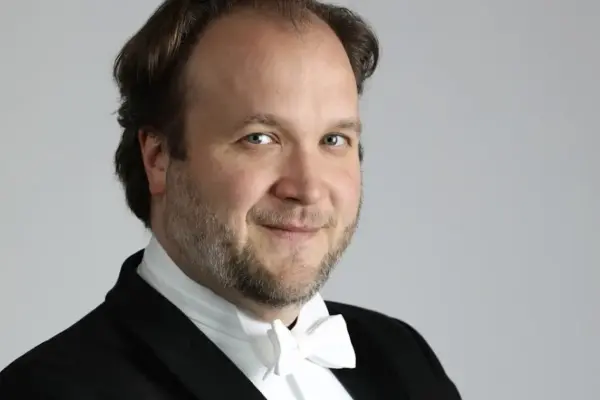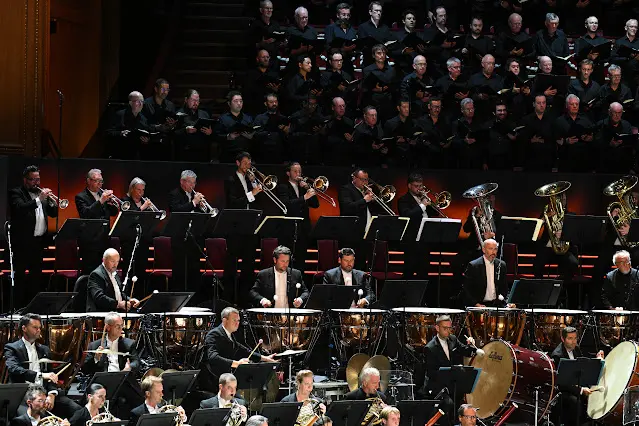
On Saturday, August 15, 2026, the Royal Albert Hall played host to one of the most monumental undertakings of the classical music calendar: a searing, meticulously engineered performance of Hector Berlioz’s Grande messe des morts (Requiem), Op. 5, at the BBC Proms. At the podium stood Sir Antonio Pappano, guiding the forces of the London Symphony Orchestra (LSO), the London Symphony Chorus (chorus-master Mariana Rosas), and the BBC Symphony Chorus (chorus-master Neil Ferris). The performance also marked the Proms debut—and likely the UK debut—of French tenor Julien Henric.
Berlioz’s Requiem is a work of staggering architectural proportions, historically requiring massive instrumental forces, spatial brass fanfares, and an immense vocal ensemble. Yet, rather than surrendering entirely to unbridled sonic chaos, Pappano’s interpretation was defined by a striking balance: combining monumental grandeur with razor-sharp control, structural clarity, and moments of startling, austere intimacy.
While purists accustomed to cathedral acoustics—such as Sir Colin Davis’s legendary 2012 account at St Paul’s Cathedral—might have yearned for a more atmospheric, cavernous bloom, Pappano’s focus on precision paid massive dividends. The performance laid bare Berlioz’s genius, contrasting thunderous orchestral outbursts with breathtakingly hushed, transcendent vocal writing. This review explores the structural choices, musical execution, and historical context of an unforgettable evening at the Proms.
Detailed Chronology & Musical Analysis
From Quiet Intensity to Earth-Shattering Power: The Opening Movements
Berlioz’s conception of the mass for the dead is fundamentally misunderstood if viewed merely as an exercise in "blood and thunder." While its cataclysmic climaxes are legendary, a vast majority of the score thrives on profound contemplation and stark minimalism.
.JPG)
Pappano understood this implicitly from the outset. The opening movement unfolded with an orchestra that was remarkably restrained yet saturated with presence. The initial entry of the massed choirs featured a sublime synthesis of floated tone and sharply defined, pointed accents. Rather than rushing into bombast, Pappano maintained an aura of quiet, burning intensity, building slowly toward the first truly thrilling proclamation of the "Requiem aeternam." The subsequent "Kyrie" was approached with an unexpected degree of spareness—a descriptor that would echo throughout critical notebooks as the evening progressed.
The Cataclysm of the "Dies Irae"
The structural centerpiece of the work, the sequence surrounding the "Dies Irae," showcased Pappano’s mastery of large-scale dramatic timing. Beginning with a measured, foreboding weight, the music surged forward into complex, interwoven choral counterpoint.
A defining visual and sonic element of the performance was the spatial arrangement of the brass. While traditional interpretations often place brass ensembles in remote balconies or church domes to maximize acoustic delay, Pappano brought them into closer alignment. Two extra brass ensembles were positioned directly behind the massive arc of timpani—which featured ten players managing no fewer than 19 drums—while the remaining two groups were placed at the rear of the choir.
This configuration meant that the performance sacrificed some of the disorienting, distant echo Berlioz originally envisioned. However, the trade-off was absolute, terrifying control. When the "Tuba mirum" struck, the simultaneous visual impact and sonic assault of the massed timpani and visible brass choirs were nothing short of electrifying. The "Mors stupebit" possessed a deep, unsettling mysterioso quality, while the "Liber scriptus" highlighted the astonishingly hushed, delicate tone produced by the male choristers.
.JPG)
As the sequence progressed through "Rex Tremendae"—featuring the rich, burnished resonance of eight French horns—Pappano masterfully manipulated dynamic contrasts. The "Quaerens me" emerged as a major vocal triumph: an almost entirely unaccompanied, deeply intimate passage defined by austere counterpoint. The sequence culminated in an operatic, blistering "Lacrimosa," where the integration of the extra brass created a dense, brilliantly complex sonic fabric.
String Mastery and Choral Precision in the Second Half
As the mass transitioned into the "Offertorium," the spotlight shifted to the string section. Pappano coaxed a rich, highly expressive phrasing from the LSO strings, steadily building atmospheric tension. In the "Hostias," the warmth of the choral sections collided with the distinctive, almost archaic gravity of the extra trombones, whose rich harmonic voicing added a remarkably grounded, earthy layer to the texture.
The "Sanctus" offered a sublime vehicle for tenor Julien Henric. Making his Proms debut, Henric delivered a performance characterized by fine-grained vocal tone, elegant phrasing, and effortless projection that cut cleanly through the Albert Hall acoustic. His solo work contrasted sharply with the vigorous, interlocking counterpoint of the "Hosanna."
In the repeated sections of the "Sanctus," Berlioz’s notorious orchestration calls for eight pairs of cymbals to strike simultaneously—a bizarre, brilliant stroke that creates a shivering, atmospheric whoosh across the auditorium. Pappano handled this theatrical moment with panache.
.JPG)
The subsequent "Agnus Dei" was handled with profound restraint, relying on hushed, warm choral tones before the orchestra gradually re-entered under strict, calculated dynamic management. The final movement, beginning with "Te decet hymnus," moved at a deliberate, measured pace, weaving moments of intense drama with fragile intimacy before dissolving into a state of genuine transcendence at the final chord.
Supporting Context & Metrics
The Performance Architecture
- Venue: Royal Albert Hall, London
- Date of Performance: Saturday, August 15, 2026
- Featured Ensemble: London Symphony Orchestra (LSO)
- Choral Forces: London Symphony Chorus (Chorus-Master: Mariana Rosas) & BBC Symphony Chorus (Chorus-Master: Neil Ferris)
- Featured Soloist: Julien Henric (Tenor)
- Conductor: Sir Antonio Pappano
- Broadcast Status: Available for streaming via BBC Sounds for 57 days post-broadcast. (Note: No official television cameras were deployed inside the hall, limiting documentation to audio recordings and photography).
Berlioz’s Monumental Forces: Ideal vs. Reality
Hector Berlioz famously prescribed monumental performing forces for the Grande messe des morts, calling for an orchestra of roughly 140 players and a chorus of at least 200 singers, augmented by four distinct brass bands placed at the cardinal points of the performance space.
| Element | Berlioz’s Ideal Specification | LSO / Proms 2026 Execution |
|---|---|---|
| Orchestra Size | ~140 instrumentalists | Modern LSO augmented forces |
| Choral Bodies | ~200 voices | Combined London Symphony & BBC Symphony Choruses (~300+ voices) |
| Timpani | Multiple players / distributed drums | 10 players managing 19 drums in a unified arc |
| Brass Bands | Four geographically separated groups | Integrated into the rear of the orchestra and choir for maximum control |
While modern symphony orchestras inherently possess greater sonic volume and carrying power than their 19th-century counterparts, the massive combined forces of the LSO and the two symphonic choruses successfully avoided a muddy texture. Pappano’s acute ear for balance ensured that even the most thunderous tuttis retained inner transparency.
Historical Comparison: St. Paul’s Cathedral vs. Royal Albert Hall
A performance of the Requiem invariably invites comparisons regarding spatial acoustics. In June 2012, Sir Colin Davis led the London Symphony Orchestra in a legendary, site-specific realization of the work within the cavernous stone expanse of St Paul’s Cathedral.
.JPG)
- The St. Paul’s Approach (2012): Emphasized maximum spatial separation. Placing brass bands high up in the dome allowed the immense natural reverb of the cathedral to smear and magnify the sound, creating an overwhelming, terrifying atmosphere of shock and awe. However, this came at the expense of polyphonic clarity.
- The Royal Albert Hall Approach (2026): Sir Antonio Pappano prioritized precision, clarity, and control. By keeping the extra brass within closer physical proximity to the main orchestra and centering the massed timpani, Pappano traded atmospheric "bloom" for structural transparency. Every countermelody, rhythmic shift, and dynamic shading could be heard with crystal clarity, reframing the Requiem as an intricately crafted masterpiece of classical architecture rather than a mere acoustic storm.
Future Outlook & Critical Legacy
Sir Antonio Pappano’s tenure with the London Symphony Orchestra continues to yield landmark interpretations of large-scale symphonic and choral repertoire. This rendition of the Berlioz Requiem at the 2026 BBC Proms serves as a masterclass in how to manage historically unwieldy scores without sacrificing their intrinsic emotional power.
Questions of historical authenticity naturally linger among musicologists. Modern instrument performances of Berlioz inevitably spark debate regarding historical performance practice—such as whether a 19th-century French pronunciation of Latin would yield a more idiomatic vocal texture, or whether modern valves and the absence of period saxhorns fundamentally alter the intended brass timbre (similar to John Eliot Gardiner’s 2013 Paris experiments with Les Troyens).
Nevertheless, for the thousands packed into the Royal Albert Hall—and the countless others listening via the BBC broadcast—these musicological queries remained secondary to the sheer visceral and spiritual impact of the evening. Pappano proved that Berlioz’s Requiem remains one of the supreme achievements of Western classical music: a bridge connecting terrifying mortal dread with sublime, heavenly peace.