Executive Overview
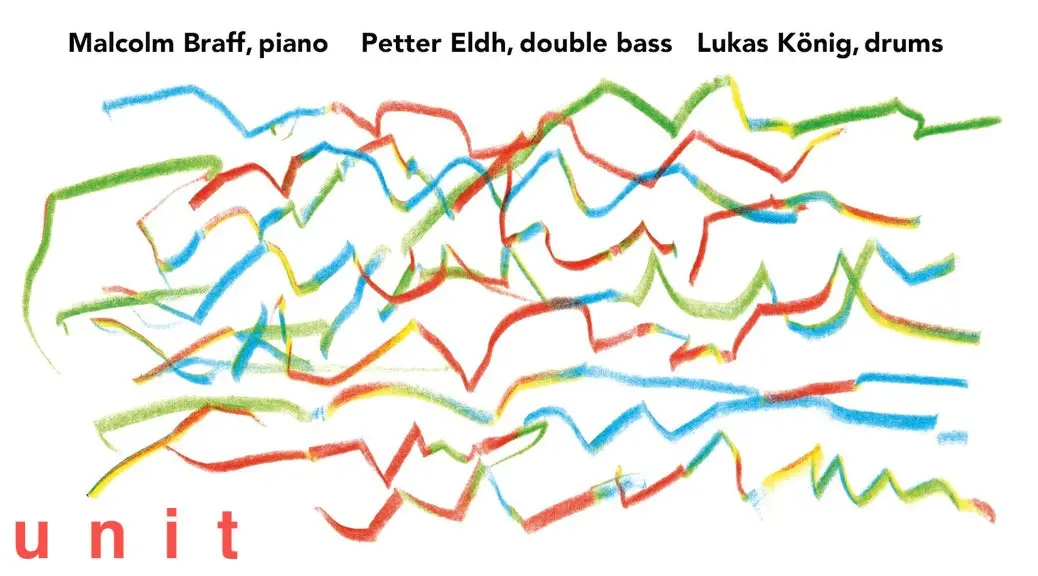
In the contemporary landscape of improvised music, few pianists approach their craft with the philosophical detachment and rigorous academic inquiry of Malcolm Braff. For Braff, the piano is not an extension of the ego nor a vehicle for personal mythology; rather, it is a familiar physical apparatus through which he can momentarily disappear. His latest project, the concise yet potent exploratory release Outside, captures this ethos in real time. Featuring the formidable rhythm section of Swedish bassist Petter Eldh and Austrian drummer Lukas König, the album is a masterclass in temporal subversion, genre-agnostic adventurousness, and emotional immediacy.
Far from a standard piano-trio outing, Outside challenges listeners to recalibrate their internal clocks. It serves as both a musical artifact and a practical application of Braff’s decades-long academic research into the "mechanics of swing." Having spent over twenty years mapping out what he terms a "Generalized Theory of Swing" at Jazzcampus Basel, Braff treats rhythm not as a static metronomic grid, but as a fluid, malleable wave.
This review-feature examines the multifaceted career of Braff—from his nomadic upbringing across three continents to his foundational artistic partnerships—and unpacks the kinetic brilliance of Outside. By analyzing the album’s structural anatomy, its thematic obsession with time, and the synergistic interplay between Braff, Eldh, and König, we gain a clearer picture of how this avant-garde trio is quietly reshaping the boundaries of modern jazz.
Detailed Chronology & Background: A Nomadic Musical Evolution
From Rio to the World: Formative Years
To understand Malcolm Braff’s idiosyncratic approach to the piano, one must look far beyond the traditional conservatories of Europe. Though currently anchored in the European jazz ecosystem, Braff’s worldview was forged through a nomadic childhood. Born in Rio de Janeiro, Brazil, to a missionary father, his early years were defined by constant cultural transposition. Growing up across Cape Verde and Senegal before eventually settling in Switzerland, Braff absorbed a vast mosaic of polyrhythmic traditions, linguistic cadence, and spiritual viewpoints long before he ever formalized his musical education.
While many artists raised in such diverse environments consciously curate a "global fusion" pastiche, Braff took the opposite route. He resists the notion of being a "citizen of the world," preferring to view himself simply as a traveler who happened to catch the rhythm of wherever he happened to land. This geographical displacement fostered a unique relationship with time and space—one where musical pulse is not bound to European classical bar lines, but is instead felt as a living, breathing pulse of the earth.
The Yaya Ouattara Connection and the Djembe Years
A critical turning point in Braff’s artistic evolution was his decade-long collaboration with Burkinabé percussionist Yaya Ouattara. Described by Braff as "more than a brother," Ouattara became a central musical inspiration and a foundational anchor for Braff’s rhythmic vocabulary.
In a bold departure from conventional jazz setups, Ouattara’s West African djembe frequently took the place of a traditional drum kit in Braff’s formations. This partnership culminated in the critically acclaimed 2006 live album Yele, released via Unit Records. Working alongside Ouattara forced Braff to rethink how a keyboard instrument interacts with polyrhythmic percussion. The experience dissolved the traditional hierarchies of melody and rhythm, teaching Braff how to weave piano voicings directly into the grain of hand-drummed grooves. It was an apprenticeship in groove physics that would permanently inform his academic theories and his subsequent trio configurations.
The Academic Pursuit: The Mechanics of Swing
Parallel to his career as an active performer, Braff spent more than two decades immersed in an exhaustive, almost scientific research project: decoding the mechanics of swing. This wasn’t merely an exercise in historical transcription; it was an attempt to understand how micro-timing variations affect human perception.
Bringing this extensive research to his role as an educator at Jazzcampus Basel, Braff formulated his witty yet profoundly ambitious "Generalized Theory of Swing." At its core, the theory investigates the intentional distortion of time as perceived by the listener. Braff explores how minute, calculated shifts in micro-rhythm can create a sense of weightlessness, disorientation, or profound emotional pull. When applied to Outside, this decades-long academic endeavor ceases to be abstract theory and transforms into a thrilling, high-wire act of musical execution.
Supporting Context & Musical Anatomy: Inside Outside
The Philosophy of the Instrument
Malcolm Braff’s relationship with the piano is refreshingly unpretentious. "This is not what I am, just something I enjoy doing," he has noted, rejecting the grandiose self-importance often associated with virtuoso soloists. When performing, Braff avoids listening to himself in the traditional sense; instead, he listens exclusively to the impact his playing exerts on his fellow musicians, constantly posing the internal question: What power am I having on the music?

By treating the trio not as three distinct soloists vying for dominance, but as a single, multi-limbed organism, Braff steps out of the way of his own instrument. The piano ceases to be a machine for hammers and strings and becomes a vehicle for pure physical action—a kinetic release of energy felt intensely in the present moment.
Time as Waves, Not Lines
The thematic core of Outside is a direct meditation on the nature of time. Eschewing the conventional linear model—where time marches inexorably forward from one measure to the next—Braff treats time as a series of overlapping, undulating waves.
This duality defines his artistic output: he approaches music with the analytical rigor of a scientist when theorizing, but transforms into a deeply soulful, intuitive improviser the moment his fingers touch the keys. The resulting music on Outside is fiercely experimental and formally adventurous, yet remarkably accessible. It bypasses the listener’s intellectual defenses, making a direct emotional connection before the conscious mind has time to dissect what is happening to traditional musical conventions.
The Rhythmic Engine: Petter Eldh and Lukas König
No avant-garde trio can succeed without sympathetic, fearless collaborators, and Braff has found kindred spirits in Swedish bassist Petter Eldh and Austrian drummer Lukas König.
- Petter Eldh: Known for his relentless curiosity, jagged phrasing, and warm, woody tone, Eldh is one of the most in-demand bassists in contemporary European jazz. His ability to anchor a disorientating harmonic space while simultaneously pulling against the gravitational center of the beat makes him an ideal foil for Braff’s conceptual excursions.
- Lukas König: Boasting a "whiplash styling" that balances explosive energy with acute textural sensitivity, König treats the drum kit as a sonic laboratory. His percussive accents and rapid-fire rim clicks provide a volatile, unpredictable spark to the ensemble.
Though Outside is compact enough in duration to lean closer to an extended play (EP) than a full-length long player (LP), its relative brevity is entirely appropriate. As Braff’s music proves, time is relative; duration matters far less than the density of the musical experience contained within those minutes.
Track-by-Track Breakdown
1. "Viennese Gröt à la Berlinaise"
The album opens with a culinary-titled masterclass in tension and release. "Viennese Gröt à la Berlinaise" is immediately arresting from its first seconds. König’s percussive attack hits the ear like a sudden gunshot, cutting sharply through the warm, viscous gloopiness of Eldh’s low-end bass tones. Meanwhile, Braff’s inimitable rhythmic bounce acts as the binding agent—a musical glue holding these disparate textures together. It is a stunning introductory statement that sets the tone for the rest of the record: thought-provoking, sonically adventurous, and intensely enjoyable.
2. "3TOES"
Appearing second on the tracklist, "3TOES" serves as a showcase for Braff’s "Generalized Theory of Swing" put into violent, beautiful motion. Here, the traditional jazz swing feel is completely dismantled, turned inside out, and reassembled in front of the listener’s ears. The track grants equal weight to all three instruments. König’s frenetic rim clicks and Eldh’s deep, thrumming vibrations are given expansive room to breathe, engaging in sharp, telepathic dialogue across the eccentric, wide-open intervals of Braff’s exuberant piano phrasing.
Official Statements & Critical Perspectives
While Outside operates largely in the instrumental realm, the theoretical framework surrounding its creation has been articulated by Braff himself through his lectures and interviews. Below is a synthesis of the key conceptual pillars governing the release:
- On the Act of Playing: "This is not what I am, just something I enjoy doing… With a familiar instrument, it’s easier to get out of the way, forget yourself and get on with the action of simply playing. The trio is a single instrument rather than three separate individuals." — Malcolm Braff
- On the Perception of Time: "Time is not linear; it moves in waves. Music must connect emotionally before the mind begins to ask questions about what is happening to musical conventions." — Malcolm Braff
- On the Mechanics of Swing: Braff’s ongoing academic research at Jazzcampus Basel posits that swing is fundamentally an acoustic illusion—a calculated distortion of temporal expectations that alters how the listener perceives the passage of time.
Future Outlook
As the contemporary jazz scene continues to grapple with the tension between tradition and futurism, Malcolm Braff, Petter Eldh, and Lukas König have charted a refreshingly idiosyncratic path forward. Outside is not a record designed to pander to nostalgia or comfort zone aesthetics. Instead, it invites audiences into a world where rhythm is elastic, identity is fluidly transnational, and intellectual rigor coexists effortlessly with visceral, gut-level joy.
Looking ahead, Braff’s ongoing work at Jazzcampus Basel promises to further codify his theories on swing, potentially influencing a new generation of European improvisers to rethink the grid-locked limitations of standard meter. For listeners, Outside stands as a vital waypoint in Braff’s ongoing journey—an invitation to step outside conventional listening habits and surrender to the wave-like motion of a master craftsman at work. Whether this trio expands upon these micro-temporal explorations in future full-length releases or lets Outside stand as a concentrated burst of creative energy, one thing remains certain: Malcolm Braff’s unique power over the music is only just beginning to be fully understood.