In the contemporary landscape of recorded music, the intersection of institutional scholarship and large-ensemble jazz remains largely uncharted territory. Enter ACP Records—the scholarly publishing arm of Amherst College Press—which has applied the rigorous machinery of academic peer review, Creative Commons licensing, and free digital distribution to a breathtaking new release. This is not a commercial record label in the traditional sense; rather, it is an academic publisher asserting that a seventeen-piece jazz orchestra constitutes fully realized, publishable scholarship.
While physical copies exist as a limited vinyl pressing and a compact disc, the core ethos of the release relies on open-access dissemination. Listeners are placed in the unfamiliar position of choosing to purchase a physical object that is simultaneously available for free download under terms set directly by the artists.
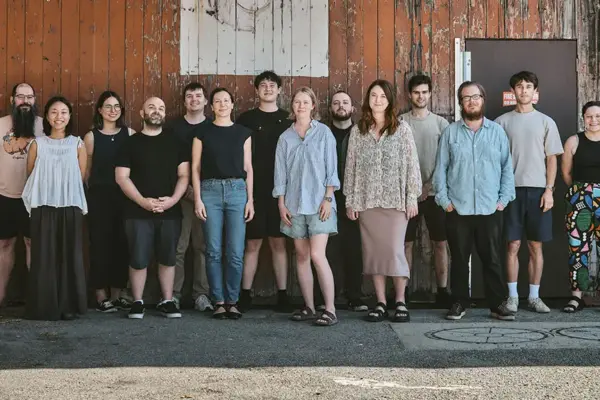
At the center of this paradigm shift is the New England Jazz Collaborative (NEJC). Formed in Cambridge, Massachusetts, in 2021 in the wake of shuttered venues, the ensemble was built to solve a crushing, mundane problem for large-ensemble composers: scores accumulate while the financial and logistical resources required to hear them realized by seventeen skilled players do not. Over five years, the NEJC has commissioned, performed, and documented more than 30 new works, securing an ensemble-in-residence post at the Longy School of Music. Their debut record features six intricate compositions crafted by four hands, showcasing a collective model that prioritizes democratic composition, cross-cultural rhythm, and institutional innovation.
Conducted by Ken Schaphorst, the orchestra seamlessly merges seasoned Boston-area luminaries with fresh voices, challenging traditional models of jazz leadership and distribution.
Detailed Chronology: A Track-by-Track Breakdown of the Debut LP
The physical release is structured across two vinyl sides, varying flexibly in ensemble size from seventeen to twenty players depending on the demands of the score.
Side A
-
“Another Brighter Day” (Composition by Jeremy Cohen | ~10:14)
Serving as the outsized event of the record, this ten-minute opening statement consumes a quarter of the album’s runtime. It immerses the listener in dawn imagery, layered harmony, and complex instrumental doubling. Felipe Salles navigates soprano, flute, and piccolo; Brian Landrus shifts from baritone saxophone to flute; Ian Buss moves to clarinet; and Temidayo Balogun takes a turn on soprano, resulting in a six-man reed section covering ten distinct instruments. Angel Subero anchors a second bass trombone, Bob Nieske lays down electric bass, and Mitch Selib commands a solitary guitar.The piece immediately establishes its authority. Selib’s guitar introduces the motif, answered swiftly by Balogun’s soprano saxophone, before a deep, effortless groove washes over the room. It is a masterclass in modern orchestral jazz writing that leaves the listener wishing for another ten minutes.
-
“Ol’ Liminal” (Composition by Matan Rubinstein | ~3:54)
As the shortest piece on the record and its chosen lead single, “Ol’ Liminal” acts as a sharp calling card following the sprawling opener. Avoiding the complex doubling of the previous track, it features five standard-chair reeds, four trumpets, four trombones, Nieske on upright bass, and Eric Hofbauer joining Selib on guitar.Jerusalem-born composer Matan Rubinstein juxtaposes the collective improvisation of early New Orleans jazz with contemporary sonic textures drawn from rock, hip-hop, and electronic music. The staccato figure driving the rhythm is propelled by drummer Lumanyano Mzi and bassist Bob Nieske.
-
“Kiss Me Again” (Composition by Darryl Harper | ~6:00 range)
Closing out Side A, this piece marks the first appearance of the strict seventeen-piece configuration as advertised. Harper utilizes two instrumental doublings—Landrus on bass clarinet and Mark Tipton on flugelhorn—to soften the overall sonic palette.Drawn directly from George Russell’s Lydian Chromatic Concept, the piece features three distinct solo voices: Tipton’s expressive flugelhorn, Ellie Pruneau’s piano, and a tenor turn from Balogun. Pruneau delivers the most exposed, vulnerable moment on the album, concluding the side with a poignant ballad. While the execution is pristine, the composition pulls away from traditional jazz idioms, demanding patience from the listener.
Side B
-
“The Secret” (Composition by Darryl Harper | ~7:29)
Flipping the vinyl brings Harper back immediately with an odd-meter funk piece. It utilizes the sparsest scoring on the album: seventeen players with zero instrumental doublings.
Solo responsibilities are distributed in a round-robin format to Bijon Watson and Chris Gagne, the first chairs of the trumpet and trombone sections respectively, with Mzi answering dynamically from the drum kit. Harper himself—a celebrated, in-demand clarinetist—plays no instruments on the track, functioning purely as a composer. Supported by Nieske’s unyielding bass swagger and robust trombone writing, this track serves as an immediate, refreshing high point for the record.
-
“Gee, Em…” (Composition by Sam Spear | Variable duration)
Standing as the ultimate outlier of the six tracks, this composition features a single, focused featured soloist. Spear, a Cleveland-born disciple of Gunther Schuller, builds the work upon a strict twelve-tone row. He assigns the primary statement to Allan Chase on alto saxophone 1, while sitting within the section himself on alto 2. The title offers a direct, respectful nod to Gunther and Marjorie Schuller. -
“Green Turtle Strut” (Composition by Jeremy Cohen | Variable duration)
Jeremy Cohen closes the record with a profound nod to his extensive ethnomusicological background. Having studied Ewe drumming with Ghanaian master C.K. Ladzekpo, continued his education under Emmanuel and Ruben Agbeli, performed with Boston’s Agbekor Drum & Dance Society, and spent a decade running study-abroad programs in West Africa and Cuba, Cohen infuses this piece with authentic Ghanaian highlife and Congolese sebene rhythmic feels.The orchestration relies on pairs: two sopranos, two flutes, two guitars, two bass trombones, alongside Balogun on talking drum and Mzi supplying auxiliary percussion. Because highlife is fundamentally interlocking music, singular instrumentation is insufficient. Hofbauer takes the featured guitar role. Rather than a composer borrowing exotic colors from a textbook, the album concludes precisely where its founder’s musical journey began.
Supporting Context & Metrics
The Rhythmic Engine: Lumanyano Mzi
While much of the promotional copy focuses on the compositional framework, the rhythmic engine driving all six pieces deserves standalone recognition. Lumanyano Mzi hails from Cape Town, South Africa, rising through the University of Cape Town’s South African College of Music. He expanded his own Unity Band from a trio into an eight-piece ensemble, capturing a Mzantsi Jazz Award before Berklee College of Music brought him to Boston. Today, he holds the esteemed drum chair in the Bokani Dyer Trio. Mzi’s deep groove and sophisticated polyrhythms elevate the New England Jazz Collaborative, serving as a vital anchor for the diverse compositional voices on the record.
Ensemble Dynamics and Personnel
Conducted expertly by Ken Schaphorst, the orchestra represents a generational and stylistic bridge. It unites celebrated Boston-area stalwarts—such as Watson, Jason Palmer, Landrus, and Hofbauer—with emerging, less familiar voices.
| Metric / Dimension | Detail |
|---|---|
| Ensemble Founding Year | 2021 (Cambridge, Massachusetts) |
| Core Founders | Jeremy Cohen and 7 fellow composers |
| Ensemble Output (5 Years) | 30+ new pieces commissioned, performed, and documented |
| Institutional Residency | Longy School of Music |
| Album Repertoire | 6 works by 4 primary writing hands |
| Ensemble Size Variation | 17 to 20 players across tracks |
| Publishing Model | ACP Records (Amherst College Press) – Open Access, Creative Commons |
Official Statements & Institutional Philosophy
The release of this debut record via Amherst College Press marks a watershed moment in how academic institutions view modern musical composition. By applying peer-review standards and free digital distribution to a seventeen-piece jazz orchestra, ACP Records challenges the commodification of art.
In a joint statement implied through their operational framework, the university press and the NEJC assert that large-ensemble jazz composition equals the intellectual rigor of traditional academic publishing. Artists retain agency over distribution terms, while the public gains unrestricted digital access. The inclusion of physical formats (limited vinyl and CD) creates an intentional philosophical tension: Why purchase a physical object when the scholarship is freely accessible to all? This inquiry redefines the value proposition of physical media in the digital age, transforming the record from a mere consumer product into an artifact of peer-reviewed cultural documentation.
Future Outlook
As the New England Jazz Collaborative looks beyond its ambitious debut, critical questions remain regarding long-term sustainability. Can a collective comprising composers with such divergent stylistic languages maintain a distinct, unified ensemble identity over successive releases? One album is certainly too early to provide a definitive answer.
Nevertheless, the debut record definitively proves that the collaborative model works. While certain tracks resonate more immediately than others, the sheer scale of the achievement cannot be overstated: six major orchestral works written, rehearsed, recorded, and released by a five-year-old nonprofit, championed openly by a college press for global dissemination.
Judged by its audacious ambition, institutional bravery, and the collaborative hurdles cleared to bring it to life, the New England Jazz Collaborative stands as a triumphant blueprint for the future of modern orchestral jazz.